Software
Houzz Logo Print
quakerwildcat

Best Placement of Remote Blower for Kitchen Hood?

2 months ago
I have invested in a Wolf Pro Island Hood for my kitchen, with a 900 cfm remote blower. I am now debating with the contractor where to mount the blower on the outside of the house.


The good news: There is an attic right above the kitchen hood and we have 3 viable options that are all fairly close for the 10" ducts to reach the hood mounted below.


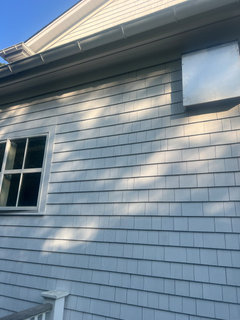
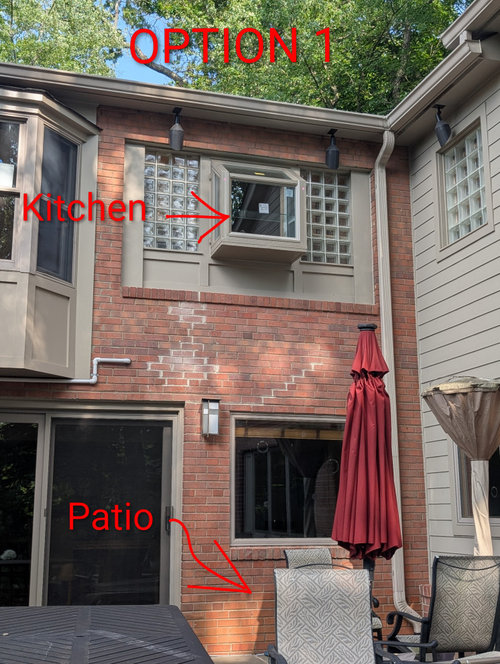
OPTION 1: On the shallow slanted roof on the rear of the house (see photo below)

  • Pros: Won't see the remote blower from the street.
  • Concerns: The Remote blower will exhaust right above the kitchen garden window that extends above a patio below. So would this still be noisy in the kitchen? On the patio? Would it blow grease onto the garden window?
  • Also Contractor says blower should be on a wall and would present a weather risk if it's on the slanted roof (though the Wolf manual shows both options).


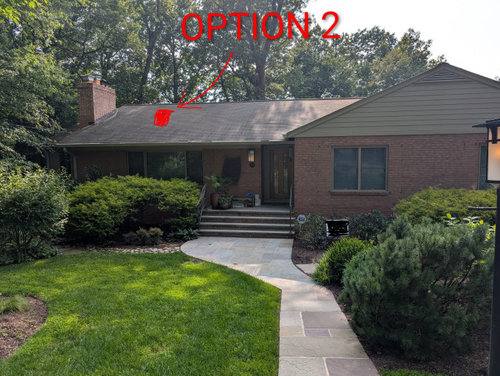
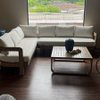
OPTION 2: On the shallow slanted roof on the front side of the house

  • Pros: Possibly the best location in terms of outside noise (the living room below is barely used).
  • Concerns: Visible on the roof from the street (it's a metal box approx 25" x 30").
  • Also as before Contractor says blower should be on a wall and would present a weather risk if it's on the roof.


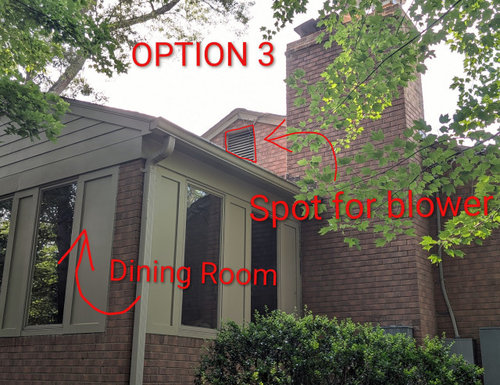
OPTION 3: On an exterior side wall above the dining room

  • Pros: Won't see the remote blower from the street.
  • Pros: Contractor says this is the safest location for the appliance to be mounted.
  • Concerns: Not much clearance below: The exhaust would point down maybe just a foot or two directly at another, lower roof -- the gabled roof of our dining room (a renovated/enclosed former screened porch). Should I be concerned that it would be loud in the dining room when the fan is on? What about 900 cfm blowing straight down at the shingles? The installation manual says nothing about required clear space around the blower!


The contractor obviously likes OPTION 3, and I like it too!, except for the concern about being mounted right above the dining room.


WHAT TO DO?

FYI 2 other notes:

1. Since I have this outside noise concern, I realize that perhaps an inline blower in the attic might've been better. However that ship has sailed.

2. In case you're wondering, yes we are also installing a Makeup Air System (FanTech) and that can be ducted to pull air in from either side of the roof.

OPTION 1
OPTION 2
OPTION 3

Comments (9)

  • 2 months ago
    last modified: 2 months ago


    Shown is my 900CFM Wolf approvimately 6 or 7 feet from my make-up air system. With said system activated, I do not hear the fan over the hood noise. Hood is not loud, esp at lower speeds. In fact, at lower speeds I’ll often forget to turn it off until I’m in the driveway and hear the fan. Outside it’s white noise at low speeds, but I wouldn’t want it over my patio. Not sure how much being on the roof, and higher, would affect that, but I’d guess not insignificantly. Also be realistic about how long you’ll be having it cranked up high at a time.

    Instructions call for a curb built with minimum 2/12 slope if installed on a flat roof, perhaps a curb could make your contractor more comfortable even if not technically called for? Note prevailing winds, per manual.

    I’m no expert, just sharing my experiences and guesses, so I’m not voting. AMA!

  • 2 months ago

    Calling @kaseki for you. He’s the expert.

  • 2 months ago

    The Wolf/Broan-NuTone blower housings are intended to be used on roofs, but can easily operate on walls. They have an auto opening damper on the exit side. Mine (1500 CFM) is on an asphalt shingle roof in S. NH. My roof slope is 5/12. I doubt 900 CFM (rated, maybe 600 CFM actual) will bother the roof below; although, if sunlight doesn't hit that portion of roof at least part of the year, grease may show over time. I haven't observed a snow blockage problem, but that could be a factor supporting selection of a wall mounting.

    My guess is that your contractor does not want to mess with an existing and presumably sound roof in order to put the blower on the roof. (A roof blower that is not statically balanced may have more rumble that one mounted into a brick wall.) However, if the wall mount is used, the MUA will still have to be taken from somewhere, possibly the roof.

    Where do you you intend to get your make-up air. No exhaust air plan (ducting and location) should be finalized without a commensurate intake air plan. Intake air should be away from exhaust and on the prevailing wind side.

    Hood baffles help remove a good part of the larger end of the grease particle spectrum, but only partially and little effect on the smaller end of the spectrum will be achieved. Un-captured grease particles are supposed to be exhausted to the atmosphere. Roof mounting flows the effluent along the roof; down mounting pushes it downward, possibly onto something that will condense the grease. But worst, I think, would be to blow the cooking effluent onto an occupied patio space. Also, it shouldn't be dumped where windows can be opened.

    It occurs to me for a street-side roof mount that after being properly installed into the shingle layout, spare shingles could be attached somehow to the flat top surface making it hard to notice.

    Do you intend to use a silencer between the hood and blower? This is usually large and needs in most cases to be in the attic, although interior and exterior chases are possible.

    Roof exhausts above attics can be ducted in the attic so that the location of the vertical duct from the kitchen and the location of the roof blower do not constrain each other to be aligned.

    I don't think a roof blower would put much onto the garden window. However, you do have the 90-degree wall there, so odors might end up being less disbursed than otherwise.

    I don't have an objection to Option 3. However, this subject needs a duct layout plan view with roof peaks shown.

  • PRO
    2 months ago

    Any penetration in a roof is a potential leak waiting to happen, so I always favor installing a remote blower on an exterior wall if that option is available. Option 3 will help hide the blower behind the chimney and the shroud can be painted to make it less obvious, too. I'm assuming you have shingle-over ridge vent and that the area of the existing gable end vent isn't required to meet code requirements for attic ventilation. If it is, now is a great time to vent the attic via a combination of soffit and ridge venting.

  • PRO
    2 months ago

    the shortest duct with least number of 90 degree elbows is best.


    We've installed these on both walls & roofs. May need additional custom fabrication of flashing as it only has a flat base.

  • 2 months ago

    Thanks all for your responses. I went up to the roof myself and desire the contractor's recommendation, it didn't take long to figure out that Option 3 was non-viable because there would've only been about six inches of clearance below the blower output (Wolf specifies a minimum of 12 inches clearance for wall mount installation).

    That left me with only options 1 and 2. Option 1 was probably best for minimizing the duct run, but I made the call to mount the blower in the front of the house instead to (hopefully) minimize noise in the kitchen and patio. This actually requires a slightly longer duct but the contractor was confident it would be fine, with no more angles than the other location required.

    For those who asked, we also have a Fantech active MUA system being installed, with active damper and duct silencer, and THAT intake will go on the back side of the house. Fingers crossed this huge investment doesn't disappoint!

  • 2 months ago

    Thanks Kaseki as always.

    This odyssey is almost over and I hope to be sharing the post-mortem soon. My installer is running the makeup air through a plenum and says that this will be the Lamborghini of kitchen ventilation systems. I sure hope so for all the thought and money that's gone into it.

  • 2 months ago

    As long as you don't paint it Ferrari red.