Software
Houzz Logo Print
blarsibneous

Remedy for ugly outside electric meters

12 years ago
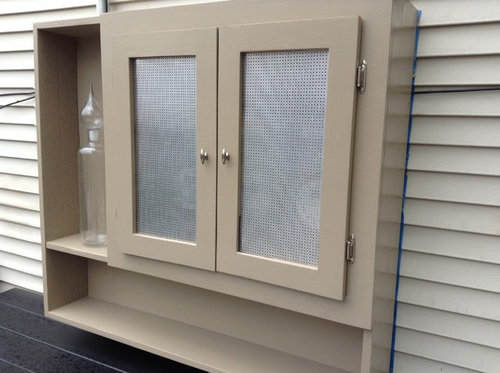
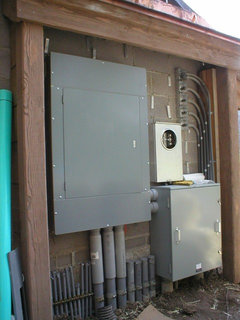
I made this outdoor cabinet to hide electric meters and to add aesthetics and functionality. Cedar construction with stenciled tin door panels allows EZ access to meters and plenty of shelving for BBQ or garden supplies.
Before
After
You like?

Comments (59)

  • 12 years ago
    last modified: 12 years ago
    @chook, even Australia has rules. Whether or not you are getting away with something different is by the grace of the power company. Apparently, it doesn't copy too well.

    Energy Safety Division (EnergySafety) of the Department of Commerce, following consultations with network operators and electrical contracting industry groups in Western Australia, issued this updated version of the Western Australian Electrical Requirements (WAER). Electrical installation designs begun after 1 July 2008 must comply

    Access to switchboard-mounted service and metering equipment enclosures must never be restricted or made unsafe. The location must always be kept clear. Adequate space shall be provided and maintained in front of the enclosure to enable the metering equipment to be operated, maintained or replaced. The space must: •ComplywiththeWiringRules; •Enablethedoororpaneltobeopenedorremoved; •Provideaverticalclearanceofnotlessthantwometresfromtheground,floororplatform; •Provideaminimumhorizontalclearanceofnotlessthan600mmfromeithertheequipment, if mounted on the hinged panel, or the external front edge of the switchboard enclosure, whichever is appropriate; •Whenameterpanelisextendedonitshingetothe90°openposition,aclearanceof200mmis to be maintained between the front face of the panel in its open position and any fixed object; •Ifthepanelisenclosedinotherthanastandardmeterenclosure,aclearanceof175mmfrom the front of the panel to the door is to be provided; •Thebottomofpanelsshallbegenerally900mmfromthefloororgroundsurfacebutinall case shall not be less than 600 mm
  • 12 years ago
    We're in vic.
  • 12 years ago
    @ western, that falls under the part of the code that says the authority having jurisdiction is allowed to make stupid decisions. Whether they are lining their pockets, or caving under political pressure, is beside the point. They would never allow that on the inside of the house. Do notice that your box does not protrude as far as the OP. There are wires in there that do not have a disconnecting means. That makes it the most dangerous place in the house. It will only take one death and a big lawsuit before they stop doing that.
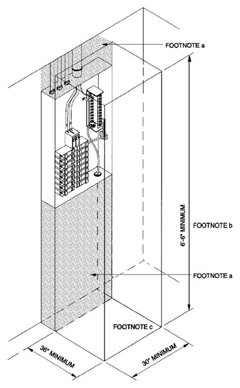
    This is straight from the IRC which is taken from the NEC verbatim

    E3606.2 Working space.

    In no case shall the working space in the vicinity of service equipment be less
    than that specified in Chapter 34.

    http://publicecodes.cyberregs.com/icod/irc/2012/icod_irc_2012_34_sec005.htm
  • PRO
    12 years ago
    I like the look but is it legal where you are living... I am trying to understand how you waterproof that unit?
  • 12 years ago
    last modified: 12 years ago
    @ @chook, I find it hard to believe that a country that won't even allow the homeowners to change out a light switch would have the opposite safety concern about the most dangerous electrical area on the house. I doubt that since the rest of the country doesn't allow it any more, that Victoria is a special case. I am sure that there are plenty out there, grandfathered in, from before they tightened the rules.
  • 12 years ago
    After reading all comments above my conclusion(s) is;
    1) Leave the meters ASIS as installed by the electric supplier
    2) Contact your electric supplier and simply ask them if your design is legal.
  • 12 years ago
    Meters in the UK used to be inside the house, most often in really inaccessible places. Now they are all outside and are fitted in purpose built plastic boxes, generally one for each utility, identified by letters E G and W. It allows utility companies to read them easily without needing access the the house but keeps them dry.
  • 12 years ago
    I love it! Good job
  • PRO
    12 years ago
    I just wanted to be sure that I didn't confuse anyone with the photo I attached before so to clarify...
    The meter socket is exposed and accessible as shown in the photo (note, the clearance does not need to be centered on the device)
    The access to the panelboard (breakers) are to the inside of the structure and have the clearance as shown in Figure E3405.1 that Fred S posted for us. (thanks Fred)
    The panelboard is located directly adjacent to the meter base on the interior so for that reason we do not need an outside disconnect, but if we did then it too would have to be exposed and accessible as the meter is. (Side note: the meter socket acts as a disconnect as well. When working disaster situations such as flooding, we have the power company pull the meters for safety).
    In any case, the photo shown has been approved in Oregon by the state.
    I hope this helps.
  • 12 years ago
    Moral of the story. These things need to be APPROVED. There is much more to a code compliant application than meets the eye.
    Pulling the meter does not shut off the power inside the meter socket. It only shuts off the power between the meter and the main disconnect that is just on the other side of the wall.
  • PRO
    12 years ago
    True, you have to go back to the supply line to the property, but where does the line become dead is a different question than if the interior of the building is live or dead.
    And yes, the most important thing to do in any of these situations is to check with the governing authority and get prior approval. (Interesting thread)
  • 12 years ago
    From the meter to the main disconnect is pretty much back to back in the wall. It has to be for code. The main disconnect must be where the power enters the house. The entire breaker panel has the same chance of being energized by the live wires in the meter socket as the meter socket because they are bonded together.
  • 12 years ago
    It looks amazing. nice job! I know nothing about the legalities.
  • 12 years ago
    Pleasing to the eye trumps legal:)
  • PRO
    12 years ago
    Well Margo, the good news here in Oregon you can have both. ;-)
  • 12 years ago
    Oregon- now that is a good state;) Aren't you taxless too?
  • PRO
    12 years ago
    No sales tax, but far from taxless.
  • 12 years ago
    GOOD JOB, BRILLIANT, AND I LOVE IT. The last time I had an actual person show up and read our meters was over 5 years ago, and never once have I had anyone read here at my new house. It's all computerized, stupid smart meters......not surprised that my previous home which is just across the street, empty, and much larger is costing me over half of what I'm being billed for in the home I live in now....with lots of kids, horse barns, etc. We are being ripped off, BIG TIME, so let them come.....please, and explain this to me! You should be more worried about EMF and try to "cover" your own meters. Will be using this idea, and thank you for sharing. :)
  • 12 years ago
    In our town they suddenly put up a 45m high tower without getting council or neighbour approvals, in order to remotely read all the meters. It is in the front yard of a light industry block,across the road from residential and no one but the property owner knew it was coming. If they mounted a camera on it you couldn't tell, and could see into every yard and many windows in town. It is in front of a beautiful view of the mountains, and is an eyesore.
  • 12 years ago
    Thank you all for your comments. I appreciate your input so much. I admit that my focus was for aesthetics and didn't even consider that I may have constructed this in violation of city code. The entire " box " can be removed in minutes with 3 screws should it come to that. I'll keep you posted when I query
    The local utilities company in the near future.
    Fred S, you're a Hoot!!
    Peace and love to you all
  • 12 years ago
    @blarsibneous,
    I think you should try and sell this wonderful creation to the utility companies! :)
  • PRO
    12 years ago
    This was also a requirement in areas that I have lived in and designed power systems. You could NOT get a meter installed until the meter and main service was enclosed. The service equipment inside was required to NEMA 3R. The fire departmentS and most AHJ enforced this requirement. Below is a typical 120/240 v., 400 amp, single phase, CT metered residential service that we design.
  • 12 years ago
    @ Fred S, Vic isn't the only Aussie state to allow covered meter boxes. It's standard practice in Australia. New homes, old homes, apartment buildings, commercial buildings all have covered meter boxes.
    And besides, they keep the crocs out...
  • 12 years ago
    God I hate rules! I think this is legal .. they have open access.

    Meantime, it looks soooo much better .. great job!
  • 12 years ago
    Sharon, in our district it's not crocs except for the footwear. It is the drop bears chewing through the wires. That is why our meter boxes are covered.
  • 12 years ago
    chook, do the bears get electrocuted? Does it ever cause a fire? *being serious here, folks* I believe in safety first. The box is attractive but scares me.
  • 12 years ago
    Is there a way for bees and wasps to get in there and make nests? What a nasty surprise for whoever opens the box!
  • 12 years ago
    Is it a safety code or a convenience code so that meter reader can access easily. I like it
    and would leave it. If they complain, can always move it. That was hard work
  • 12 years ago
    Inherited wooden boxes in some properties, with no problems. Have metal here, with no problems. So far has been husband and drop bear proof, have a padlock on the letter box to keep out the d.b.s too. More problems with bunyips on the power poles out bush. Cause a lot of bush fires.
  • 12 years ago
    Meter boxes? No wuks, as they say in Oz.
  • 12 years ago
    last modified: 12 years ago
    We used to have a few squirrels cause transformer fires and we'd lose our power for a couple of hours until it was fixed. Reduced the squirrel population. Fortunately we don't have a bear problem in East Texas. :D
  • 12 years ago
    @ Clear Lighting, please explain to these people WHY you don't get a meter until the enclosure is done in an APPROVED way. It is because there are several codes that need to be followed and an enclosure like the OP posted does not meet them.

    The IRC says the same thing as the NEC

    http://publicecodes.cyberregs.com/icod/irc/2012/icod_irc_2012_36_sec006.htm

    E3606.2 Working space.

    In no case shall the working space in the vicinity of service equipment be less
    than that specified in Chapter 34.

    http://publicecodes.cyberregs.com/icod/irc/2012/icod_irc_2012_34_sec005.htm

    The work space shall be clear and shall extend from the floor or platform to a height of 6.5 feet (1981 mm) or the height of the equipment, whichever is greater.

    2. Meters that are installed in meter sockets shall be permitted to extend beyond
    the other equipment. Meter sockets shall not be exempt from the requirements of
    this section.

    It is a matter of safety. As I posted earlier, even Australia has requirements that must be met. You CAN NOT just put something up that does not meet the approval or the AHJ - authority having jurisdiction.
  • 12 years ago
    "Even Australia" has requirements. ROFL. We have plenty of rules, just different to some other parts of the world. Maybe visit us one day Fred S, if you could stand being in such a backwards, hick, unruly place. We even got us some running water and an inside dunny now!
  • 12 years ago
    I would like an outside dunny when doing gardening and having bbqs. Would have to be fully enclosed... We only use electricians . We don't do that stuff ourselves. Why is it good to have more than one electrician on the job? Many hands make light work !
  • 12 years ago
    Sharon, I am referring to the regulations I already posted above, directly from the govt. website. I know it is a bit hard to read, but they are requirements non-the-less. The issue here isn't whether the meter has to stick out like a soar thumb, but that some installations can be dangerous and a permit was not obtained.
  • 12 years ago
    Always best to follow rules.
  • 12 years ago
    Are you crazy Sharon from Foster?
  • 12 years ago
    I am surprised that the power companies allows the conduit to be hidden before it enters the meter with these decorative boxes. I can think of a very good reason the power co. would want the conduit visible all the way to the meter.
  • 12 years ago
    No, I'm crazy Sharon from Sydney.
  • PRO
    12 years ago
    Yes, lots of rules regarding building including the electrical systems. I have over 40 years of experience in using the National Electrical Code and have read the sections regarding this issue over and over. If an enclosure is required by the HOA, power utility, Local or State Codes then you will have an enclosure or you will not have power. Where I lived it was required by the HOA and all other agencies agreed. The enclosure is to hide the ugly electrical equipment on the million dollar and up value of the homes. Who would want to look out of their window or drive up to their home and see a electrical service on their five million dollar home? The 400 amp service image I posted above eventually had two doors installed.
  • 12 years ago
    In my last house, my dining room window over looked my neighbour's electrical service. I mean that's all you could see... a wall, and the electrical meter right smack in the middle of the window. I always wished I could find a way to hide it.
  • 12 years ago
    How about a tree ??!!!
  • 12 years ago
    Put something in your idea book Sharon? I used to live in Sydney. They enclose meter boxes too, keep out the cockroaches, not.
  • 12 years ago
    Happyasaclam, have never found any bees or wasps in the meter box, or any drop bears, so think it must be doing its job. Used to find meter readers. Now their DNA has been collected by scientists as are an endangered species.
  • 12 years ago
    chook, :D
  • 11 years ago
    We just finished building a new house. We had the power company place the transformer and meter some distance from the house, by the barn. I don't like humming noise the transformer makes. Our first night in the house we found that the meter has a bright pulsing light that beams in the direction of our bedroom. We complained to the power company and they told us that we can put something over the meter to get rid of the annoying light. Has anyone dealt with this situation? We are going to see if they will let us put a simple shed around the entire ugly mess. Would that be a safe solution? The company seems quite uninterested in helping resolve this. We live on a remote farm and enjoy the natural darkness and stars at night - no flood lights anywhere. The light on the meter is a major irritant for us, although I guess it would seem pretty trivial to those living in a city.. Any thoughts on this would be much appreciated.
  • 11 years ago
    As long as you follow the clearance requirements from the above link and the National Electrical Code......and several other requirements by the power company, like a non-locking door, then it should be fine.
    The problem starts when you decide to use the "shed" to store other unsightly things like bags of fertilizer. The explosion would be much brighter than the light you are complaining about, and storing anything in it would encroach on the clearance requirements and be against code. Therefore, it may not be allowed by interpretation of the local authorities.
  • 11 years ago
    Thank you, Fred, for the information. Maybe just a box over the meter to hide it, with a door that opens easily would be the safest thing. On a farm any available space has a way of getting things tossed into it during busy periods by those working on the place.
  • 11 years ago
    Yes, on understanding how things get tossed in.
    Technically the "box" would need to be 30" wide on the inside, 6'-6" high, and all the way to the ground, although some utility companies modify the "to the ground" part a bit. If the door is right up against the meter glass, it would normally need to be a standard door of 34" width to actually get the required 30" minimum clear opening. The back end of the meter/panel could be built into the back wall to minimize the space which minimizes the temptation to use it.
Sponsored
Peabody Landscape Group
Average rating: 3.5 out of 5 stars8 Reviews
Franklin County's Reliable Landscape Design & Contracting