Software
Houzz Logo Print
inkwitch

14 years ago
I have the ugliest ceilings -- not only low (7'3"), but heavily stippled. I've scraped some of the "stalagtites" off the stippling and plan to repaint with texturizer to minimize the stippling. (It's got to be better!)

However, for those ceilings that may be beyond my ability and stamina to scrape, is there another treatment that could hide the stippling? Embossed ceiling tiles? Tin ceiling tiles? beadboard? I'd love to paper, but with the patterning, that's not possible. What can I get away with given the low ceiling?

Comments (13)

  • 14 years ago
    Before repainting, I'd call in a professional to resurface the ceiling with plaster.
  • 14 years ago
    Stippling was done in the 1970s and 80s (this house was built in 1960) where heavy plaster was daubed onto the ceiling with a sponge or a special mop. It's worse than "popcorn" ceiling, and they really laid it on thick! When I bump my head against the ceiling, I get punctured from the plaster "stalagtites"!

    So, scraping is labor intensive -- although I've just about completed the living room. What other ceiling treatment could be laid over the ceiling that would not make low ceilings look even lower? I'm open to ideas. I don't want another layer of drywall or luan (even painted, it looks like plywood, and the seams require strips to disguise them).
  • 14 years ago
  • 14 years ago
    I never saw that stippling, thanks for enlightening me. I would keep the stippling. I think most new home owners destroy interesting period design features. Susan Susanka (architect who has written several books), likes ceilings varied from room to room for the sake of keeping the house design interesting, so I think keeping the stippling in other rooms, bedrooms etc would add character. In fact Susanka loves low ceilings so much she often lowers ceilings! Low ceilings (although not currently in vogue) make a room feel cozy. Vertical lines can help. Here is a list I have of things that make a low space appear higher: tall furniture, plant on top of tall furniture, 3 decorative plates above a door, drapes with subtle vertical stripe, drapes to the ceiling, eliminate baseboards, avoid crown molding, avoid hanging lights and painting a ceiling eggshell finish reflects light (Timothy Corrigan does this in some of his designs).
  • 14 years ago
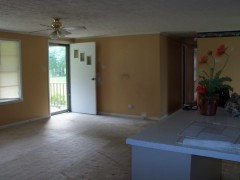
    THis is a photo of the house right when I moved in. Ceiling fan is gone and the walls are painted gray/taupe, carpet (and some of the ugliest linoleum known to man!) is gone to reveal unfinished plank floors! They're nothing special (pine), but I'm going to refinish them. The house will have a rustic/zen-cottage style. But those stippled ceilings are so intrusive. I"m surprised anyone likes them!
  • PRO
    14 years ago
    I wouldn't bother trying to scrape the texture off. Instead, skim over it to smooth it out. We've done it on sand finish plaster several times and 2 coats should get you back to smooth.

    Have you tried sanding instead of scraping? Maybe with 36 or 60 grit sandpaper on a drywall sanding pole? They are a trick to use at first, but allow you to cover much more territory than when working on a ladder. Stand back from where you're working and keep the sanding pole at an angle.

    Or, hire yourself a drywall taper or a painter to take care of it for you. By the time you buy the joint knives, pan, sanding pole, drop cloths,etc you might find it doesn't cost any more money than hiring someone. If you or your friends don't know someone, try talking to the people at your local paint store.
  • PRO
    14 years ago
    Consider installing 3/8" drywall over the existing surface, and tape/block the new joints and screws. This will take a fraction of the time of sanding/scraping and drywall is pretty cheap. Trying to skim two coats over the existing will never yield a smooth surface, unless you get a professional plasterer, and that will cost quite a bit more. Depending on the installation of insulation above, also consider removing the existing drywall and installing new. Sounds like a big deal, but it will take less time than skimming and will be a better finish.
    j
  • 14 years ago
    Now that makes sense! Can't remove the existing as the insulation is blown in, but another layer of drywall would be easier than my original plan of painting the ceiling with texturizer.

    Actually, all it takes is a paint scraper and some elbow grease -- I'm not trying to remove every inch of it, but to smooth it out so the texturizing will minimize the stippling pattern.
  • PRO
    14 years ago
    if your painter can't get a textured ceiling smooth by knocking off the highest pieces and then skimming twice, find a new painter.

    In my own house, we skimmed all the ceilings except two which were underneath a flat roof and had some water damage. Those two we laminated with 1/4" drywall, glued and screwed to the existing plaster. If you choose to add new drywall, make sure to glue it in addition to the screws

    I would find a couple good painters, drywallers, or tapers and ask them to give you a quote for fixing your ceiling. Tell them you want it smooth as silk, and primed (you won't see some of the surface imperfections until primer) and have them tell you how to fix it. Depending on your location and how many rooms you want done, ballpark cost might be from $1.50 sq ft to $2.50 sq ft. A few years ago, most guys wouldn't have touched a small job like that, but there are lots of people looking to pay XMas bills this time of year and might welcome a couple of hundred bucks in their pocket.
  • 14 years ago
    It's always good to know the little tricks when you hire a job done -- who'd have thought gluing was crucial? Thanks for the info!
  • PRO
    14 years ago
    If you hire a good drywall professional, they can do any of these tricks. I have used may. When I returned to Austin from New York I lived in a house where the ceiling looked like popcorn. In this case it was easier to install 1/4" drywall.

    In any case, ask for a Level 5 (or museum, or "slick" finish). If there is natural light oblique to this surface, it will be more difficult to get right. In such a case, you should always uses a field light to see if you got it right before painting. It can be quite challenging in some conditions.
  • PRO
    13 years ago
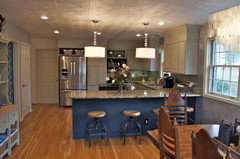
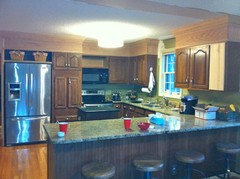
    How about doing something like these folks did.