Software
Houzz Logo Print
irismead

RED TIPS

11 years ago

I have a row of red tips that have grown into trees. Can they be cut back as shrubs? They were here when I bought the house and I really would like a screen.

Comments (23)

  • 11 years ago

    Fraser photinia has by now been spoiled by leaf spot from at least the Gulf States to the Pacific Northwest - if you somehow don't have that on yours yet once you do you will want to replace them with something else anyway.


    irismead thanked Embothrium
  • 11 years ago
    last modified: 11 years ago

    I've cut them back to almost ground level and they all sprouted multiple new stems.

    I don't have any, of course. I cut them in doing yard makeovers a long time ago. They used to be everywhere in the 80s and 90s.

    Personally, I don't like em'. The fast growing, too large for a hedge leaves, and the cheap, shiny red color, put me off right away. Now that it has leafspot in this area, that can defoliate a plant and kill it, no way would I have one. Most hedges in my area are decimated.

    Mike...near Seattle

    irismead thanked Mike McGarvey
  • 11 years ago

    Mine are probably 20-30 feet tall. Can they be cut back to 6 feet shrubs? I want something that can screen the next door yard from mine. I live in Atlanta.


  • 11 years ago

    20-30 feet tall !!!

  • 11 years ago

    Are red tips the red twig dogwood? cornus whatever?

  • 11 years ago

    Red Tips are Photinia X fraseri, most likely.
    The Dogwood is a variety of Cornus stolonifera.


  • 11 years ago
    last modified: 11 years ago

    Yes, that's why I wrote about Fraser photinia (above). As it is half Photinia serratifolia (which is known to reach 50'), it grows more than 30' tall. The 2006 edition of Trees of Seattle by Arthur Lee Jacobson lists 3 specific examples with heights ranging from 32'-34 1/2'.

    These days the North American red-twig dogwood is Cornus sericea.

  • 11 years ago

    Yep! They are as tall as my home. Not my favorite, but I was hoping I could do something with them instead of getting rid of them. Guess I'l think about it some more. Thanks to all.

  • 11 years ago
    last modified: 11 years ago

    Try cutting one back to the ground and see what happens. If it grows back well, then there you go. It may take several seasons to look good. You just need to get some good growth the first year, then train the second. If this doesn't work, do the hard work of removing and replanting something more appropriate.

    And where you live will certainly affect the outcome, which you don't say. The house I refered to earlier had trimmed theirs way back and from two really cold back-to-back winters, all the newer growth was severely damaged. They look terrible.

  • 11 years ago

    Red-tips are trees, not shrubs. Really gorgeous when blooming & wildlife like the berries. Unfortunately leafspot can be a problem, especially if pruned severely like most homeowners & maintenance crews do, not knowing these are not shrubs....also if constantly pruned the interior will start to die. As large as yours are, if you cut these back to the ground it will take 5+ years to recover, if at all. Even going from 20' down to 6' will greatly effect their look & health. Removing them is a BIG job...their roots down 1-1.5ft will be as large as the trunks. If you are wanting a "screen" I would suggest planting evergreen shrubs inbetween..a good one would be Dwarf Wax Myrtle 4ft +/-. Happy gardening! L

  • 11 years ago

    Thanks to all. I didn't know they were trees! With all that info, I think I'll leave them and plant something underneath as suggested. Actually, the birds do like them.

  • 11 years ago
    last modified: 11 years ago

    They grow tall but the habit is consistently and unquestionably shrubby unless they are trained young to have single trunks and elevated crowns. Sometimes they even fall open because there isn't the single, sturdy and dominating trunk of a true tree (without the training to have one in the early stages).

  • 11 years ago

    A number of shrubs can grow into tree-like dimensions height-wise, red tip Photinia being a classic example. English laurel is another. But that does not necessarily designate them as 'trees' per se. That definition typically refers to a plant that grows with a clear, usually single, trunk to a specified height before branching. Photinias, as Ron stated, have a multi-stemmed, low branching habit which puts them in the shrub category, not a tree, despite what significant height they may achieve.


  • 11 years ago

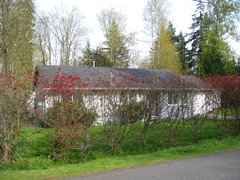
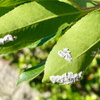
    I thought I might add what Leafspot can do to Photinia in my area near Seattle.
    Mike


  • 11 years ago

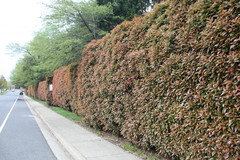
    haven't seen the foliage disorders. This is a typical example of how Red Tip is used around here:

  • 11 years ago
    last modified: 11 years ago

    We have miles of photinia hedge here also but the recent arrival of leaf spot has already spoiled a lot of it - the condition has pretty much become general. Anything bold or gaudy and easily found in quantity on the market becomes heavily planted, we have too much English laurel hedging here as well - another large-growing, large-leaved shrub that forms a coarse-textured, visually dominating background, is usually not kept fertilized enough to be an attractive green - and that in addition is a nuisance weed on wooded lands in and near local cities.

  • 11 years ago

    Leaf spot doesn't seem to be problematic in zone 7 Mid-Atlantic --- yet.

  • 11 years ago

    It's common enough that both Virgina Tech and the MD extension service have issued a bulletin about it.

    And this from a Baltimore landscape consultant; "Photinia x fraseri is badly prone to leafspot funguses in humid summer
    regions and is no longer recommended for the U.S. Mid Atlantic and Deep
    South where it was formerly commonly planted."


  • 11 years ago
    last modified: 11 years ago

    Sam, where is that hedge? Northern suburbs of Baltimore? That must be a lot of work...you sometimes see such labor intensive landscaping in the upscale parts of Towson, Ruxton or whatnot.
    Whether or not affected by leafspot, I've always thought they were difficult to manage, as others have said. Really they want to be a giant shrub, which isn't something most people want in their garden. (well, arguably yews want to be giant shrubs too, but they grow 3X as slowly!)

  • 10 years ago


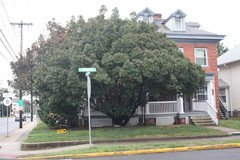
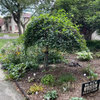
    Nice specimen of photinia. Clearly the homeowner didn't know how big this plant can get. That's not the fault of the plant, its the fault of the person. Clean, evergreen foliage is welcome around here this time of the year.

  • 10 years ago
    last modified: 10 years ago

    Yeah, as bad as this planting is in some ways, at least you could look at this picture and believe you are in a warm temperate/mild climate like New Zealand, SE Asia, western Europe, etc. etc. And not an Arctic tundra climate like Manitoba, which is the way some people around here plant their yards. I'm convinced some people have a bizarre bias against BLEs, I've seen more of them cut down in my neighborhood than deciduous trees. Or maybe it just seems that way. The only camellia in the neighborhood besides mine, for example, was cut down. It was kinda too close to a pathway to a door but it could easily have been trimmed. It bloomed very nicely. That happened before the cold winters so it wasn't because of injury. OTOH maybe some people plant BLEs in "prominent" spots, and subsequent owners don't want (any) plants in those kind of spots.

  • 8 years ago


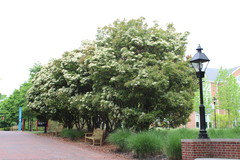
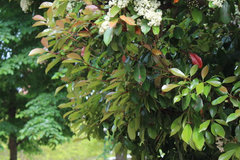
    Red Tip Photinia blooming today in Maryland. These tall shrubs have attractive evergreen foliage. Blooms malodorous but I've smelled worse.