
Search results for "Brittle" in Home Design Ideas
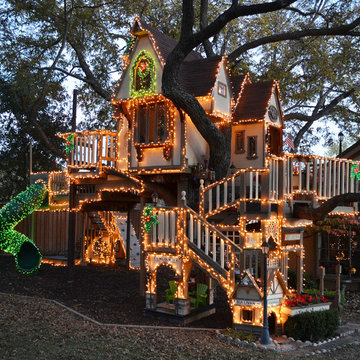
 Sarah Greenman
Photo: Sarah Greenman © 2013 Houzz
Design: James Curvan
Read the Houzz article about this kids' tree house: http://www.houzz.com/ideabooks/20845319/list/A-Magical-Tree-House-Lights-Up-for-Christmas
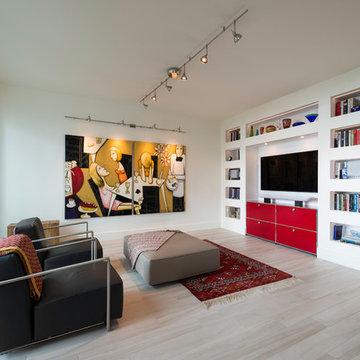
 Lightology
Trendy light wood floor living room photo in Chicago with white walls and a wall-mounted tv
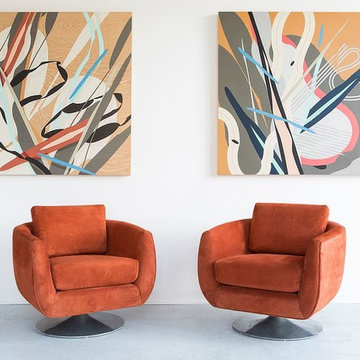
 Matthew Rachman Gallery
Mid-sized eclectic formal and open concept concrete floor and gray floor living room photo in Chicago with white walls, no fireplace and no tv
Find the right local pro for your project
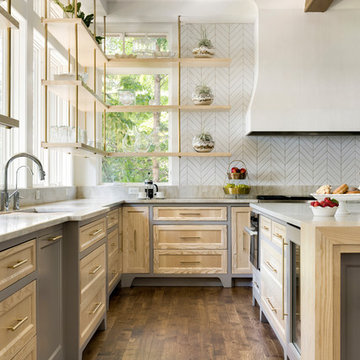

 Anthony J. Musso Architect
Anthony J. Musso, Architect
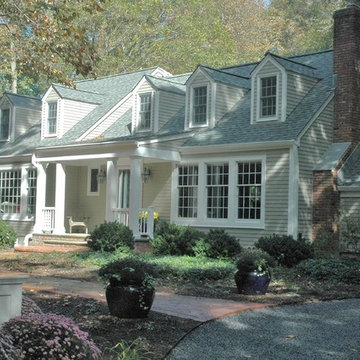
Inspiration for a mid-sized timeless beige one-story concrete fiberboard gable roof remodel in New York
Inspiration for a mid-sized timeless beige one-story concrete fiberboard gable roof remodel in New York
 Avec Interiors
Rick Ueda
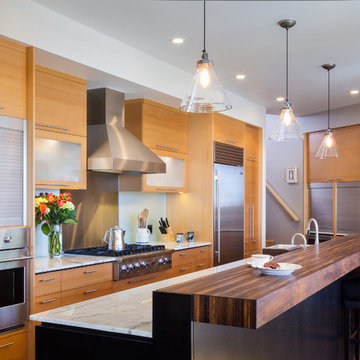
Inspiration for a large contemporary galley medium tone wood floor open concept kitchen remodel in Los Angeles with an undermount sink, flat-panel cabinets, medium tone wood cabinets, quartzite countertops, glass sheet backsplash, stainless steel appliances and an island
Inspiration for a large contemporary galley medium tone wood floor open concept kitchen remodel in Los Angeles with an undermount sink, flat-panel cabinets, medium tone wood cabinets, quartzite countertops, glass sheet backsplash, stainless steel appliances and an island
 Ballack Design + Architecture, LLC
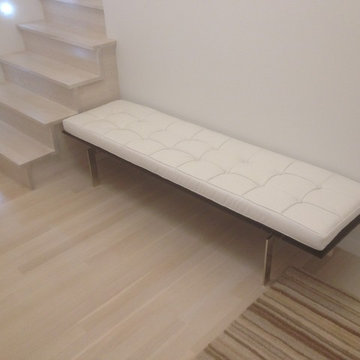
Mid-century modern foyer with white leather bench. The earth-toned wool floor rug creates a nice contrast to the predominantly white material palette. The main staircase seems to "fold" and ascend from the white washed oak floors. LED step lights are used to light up the pathway during evening hours.

 FormLA Landscaping
Silver Encelia farinosa, California Brittle Brush, breaks out in daisy-like buttercup blooms with darker yellow centers in spring.
Photos: Orly Olivier
 Ballack Design + Architecture, LLC
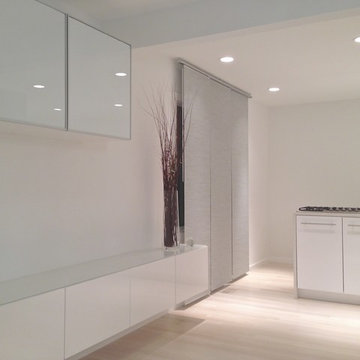
View from dining room looking into the kitchen. The linear storage cabinetry serves as a buffet for the dining room and draws the eye towards the kitchen thus connecting the two related spaces visually. The architectural elements create a dynamic interplay between surface and light.
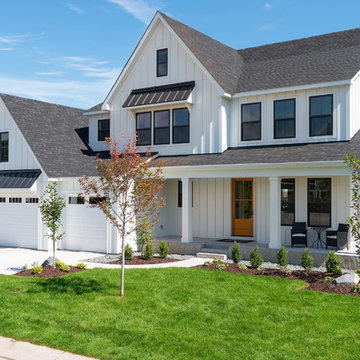
 Hanson Builders, Inc.
James Hardie Arctic White Board & Batten Siding with Black Metal Roof Accents and Charcoal shingles.
Large country white two-story wood exterior home idea in Minneapolis with a shingle roof
Large country white two-story wood exterior home idea in Minneapolis with a shingle roof
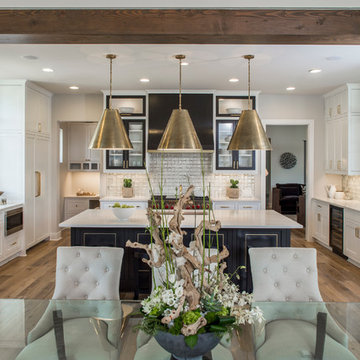
Inspiration for a transitional medium tone wood floor kitchen remodel in Austin with an undermount sink, shaker cabinets, white cabinets, white backsplash, ceramic backsplash, white appliances and an island
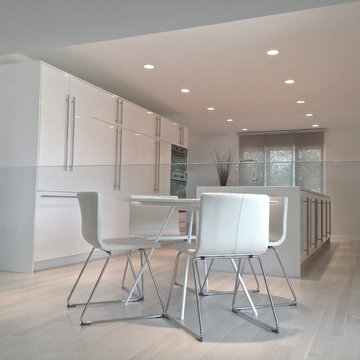 Ballack Design + Architecture, LLC
Minimalist kitchen with food storage wall and oversized prep island. High gloss white cabinetry, white quartz countertops, white washed oak floors, and metallic accents create a serene setting for the space. The glass railing elegantly divides the kitchen from the sunken living room thus allowing the flow of natural daylight and views throughout.
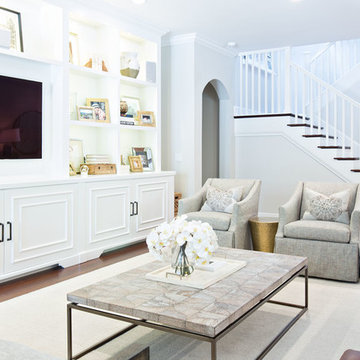
 Shannon Lazic
SHANNON LAZIC
Living room - mid-sized transitional formal dark wood floor living room idea in Orlando with white walls and a wall-mounted tv
Living room - mid-sized transitional formal dark wood floor living room idea in Orlando with white walls and a wall-mounted tv
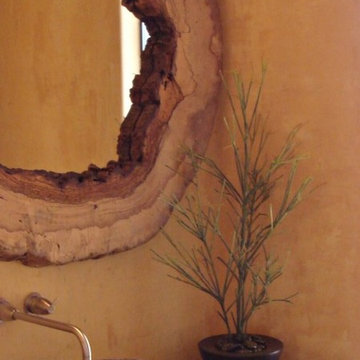
 Karoll Julian Inc.
Venetian Plaster - Three color
Bedroom - small contemporary guest ceramic tile bedroom idea in San Francisco with multicolored walls and no fireplace
Bedroom - small contemporary guest ceramic tile bedroom idea in San Francisco with multicolored walls and no fireplace
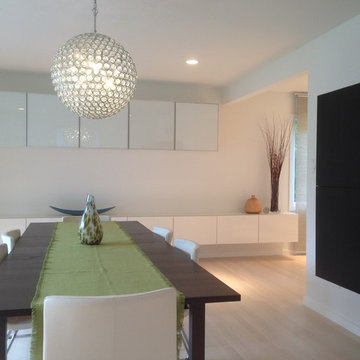 Ballack Design + Architecture, LLC
Dining room. The linear storage cabinetry serves as a buffet for the dining room and draws the eye towards the kitchen thus connecting the two related spaces visually. The dark walnut stained table and wall storage unit create a nice visual contrast to the neutral white palette. The architectural elements create a dynamic interplay between surface and light.
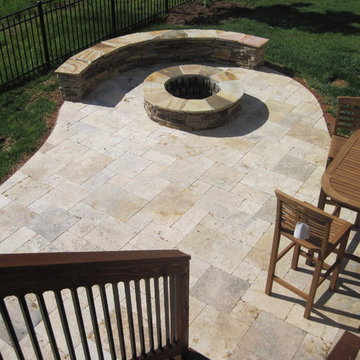
 Archadeck Salt Lake
This Salt Lake city kidney shaped Travertine patio features a custom outdoor fire pit made with stacked stone veneer. The adjoining sitting wall provides space for gathering around a warm campfire while the flagstone capstone on both the wall and the fire pit adds an extra bit of rustic flair.
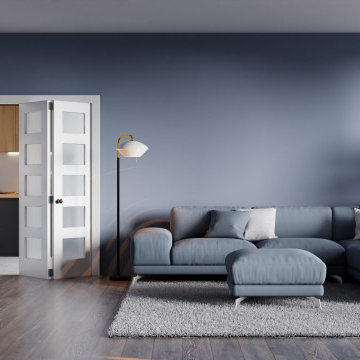
 Almesedoors
FINISH: PRIMED
The advantages of this approach – of this type of interior door finish – are fairly obvious. Pick a color, any color that suits your projects best. Mix and apply. Re- coat whenever you feel it is necessary to do so. Touch it up. It gives you, the proud owner of these interior doors, complete freedom of choice, and the significant savings, especially where it comes to bulk orders, can be a true source of joy.
As Kurt Vonnegut mentions in one of his novels (Bluebeard, unless I’m mistaken … check it out when you get a chance), the thrill of laying on colors is a large part of the artist’s professional satisfaction. In other words, a keen pleasure.
When back in the remote past visual arts became a field dominated by professionals rather than hobbyists, the main problem of “just laying on paint” became obvious: you can’t.
The medium of choice back then was egg tempera, a permanent, fast-drying substance consisting of colored pigments mixed with a water-soluble binder medium, usually glutinous material such as egg yolk. Portraits and ornaments were executed in this medium, and the wood panel was the surface of choice. One of tempera’s interesting features is that it is not as easily absorbed by wood as other mediums. Some sort of primer was necessary, of course, but pretty much any substance that dried evenly could be used.
The drawbacks of tempera, or pintura al temple, as the Spanish call it, only became obvious with the advent of the Renaissance, when the leading representatives of the trade turned to oil (and interior doors suddenly became a great deal less crude, but that’s a story for another day).
Oil painting is the process of “painting with pigments with a medium of drying oil as the binder.” Commonly used types include linseed (highly preferable in art, though not necessarily in interior doors, mind you), poppy seed, walnut, and safflower.
Today, five hundred years later, it is safe to say that oil is more versatile than pintura al temple – by orders of magnitude. Specifically, the contrasts achieved through the former are much greater, the darks are far deeper, and three- dimensional, highly realistic images are much easier to achieve. Next time you visit a museum, take a closer look at pintura al temple portraits. All of them, without exception, come off as a bit “flat” as opposed to their latter-day counterparts.
Also, where glazing is concerned …
Glazing: a painting technique in which a transparent layer, with just a touch of pigment, is laid over a previously painted surface, allowing light to travel through the glaze and be reflected back off of the opaque layer below. Gentle shadows, subtle changes of color, smooth transitions – all these can be achieved through glazing, which was used by all artists up until the middle of the Nineteenth Century, when artist tubes were invented, revolutionizing the field, and other techniques began to be explored.
Tempera enthusiasts (it takes all kinds to make a world) will assure you that glazing is not just possible in pintura al temple but is actually the basis of the whole enterprise. Well, what are you going to do? They’re enthusiasts.
Anyway, la peinture à l'huile, as the French call it, re-introduced the ancient problem of most surface’s propensity to absorb dipingere, as the Italians call the stuff. Wood or canvas, it is all the same: you’re not going to get very far without a good primer.
Experiments were conducted, and soon rabbit skin glue emerged as the least expensive and most effective solution. It was easy to apply. It dried evenly. It made the application of the l’huile stuff on top of it a walk in the park.
There were drawbacks. Today, rabbit skin glue is considered to be a major cause of cracking by most modern conservators. (Remember, when you visited the Metropolitan Museum of Art – and did you see those interior doors? … some of them are quite something … - most “old masters” pictures are completely covered with a cobweb of cracks? There you go). Because the glue is hygroscopic, it continually absorbs moisture from the atmosphere, causing the glue to swell and shrink as ambient humidity levels change. Over many humidity cycles, this repeated flexing causes the brittle oily layers to crack.
To combat this problem, modern primers are made of acrylic materials which are guaranteed not to cause any damage to the dipingere. No bubbling, no cracks. Your interior doors are safe.
 Tellurian Construction
Paul Cleary Photography
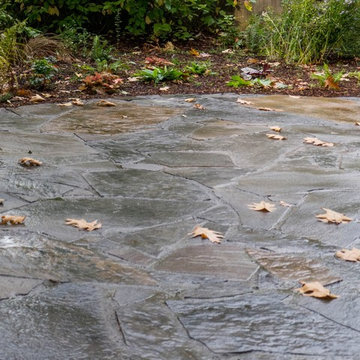
Inspiration for a small timeless backyard stone patio remodel in Portland
Inspiration for a small timeless backyard stone patio remodel in Portland

 EcoHaven
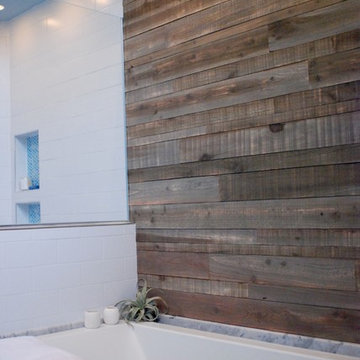
Our designer Rusty Walton first brought up the idea of a wood accent wall to break up the expansiveness of the new 15' high walls that enclosed this portion of the bathroom. It ultimately wasn't in the budget, but the idea of using wood was well-received. Since it didn't cost extra to use it as a tub surround (as it replaced what would have been tile), we hired The Salvage Bee to plane cedar planks to tile width so it would butt up to the tile seamlessly. The goal was to use reclaimed wood, but it was too brittle to be planed down to tile thickness.
1