
Search results for "Effective funds" in Home Design Ideas

 Sweet Smiling Landscape Design
This project was do in collaboration with my friends at Sweetwater Collaborative. Sweetwater Collaborative is a non-profit organization that work to educate the public about water wise and regenerative landscape practices.
Funded by the City of Santa Barbara as well as several other business and agency Sweetwater Collaborative and I worked to installed this project with the help of volunteers. In a hands-on work shop we explained principles of water wise gardening and demonstrated best practices when installing sustainable landscapes.
When the owner of this property decided to build an ADU ( Auxiliary Dwelling Unit) in their back yard they expanded the roof line of their property. In order to be in compliance with new California building the project required that a portion of the rain water coming onto this property must be stored on the property. That is where we came into help. Directing down spouts into basins, or swales in the soil is one of the most efficient and cost-effective way to capture and store rain water on a piece of land.
Calculations were done to determine the volume of water coming of the roof line in a given rain event from the ADU. The calculations go: square footage of roofline times .62 times 1, for 1” of rain. That total gives you the amount of water in gallons. Then divide the number in gallons by 7.48 find the cubic feet in that number of gallons. Then a basin with that holding capacity was designed into the landscape. Then the plantings were chosen. In this project we went with an 100% California Native Plant palette. We did this to help educate people about all the benefits of growing natives and to show case some of the beautiful plants native to Southern California. Sothern California is how to some of the greatest biodiversity of plants in the world. Native Plants are best adapted to thrive conditions from which they are natively found plus they help provide forage to the native fauna such as birds and insects.
Now the tenants in the ADU can look out and enjoy this colorful garden without the home owners needing to pay a huge water bill.
Find the right local pro for your project
 Sweet Smiling Landscape Design
This project was do in collaboration with my friends at Sweetwater Collaborative. Sweetwater Collaborative is a non-profit organization that work to educate the public about water wise and regenerative landscape practices.
Funded by the City of Santa Barbara as well as several other business and agency Sweetwater Collaborative and I worked to installed this project with the help of volunteers. In a hands-on work shop we explained principles of water wise gardening and demonstrated best practices when installing sustainable landscapes.
When the owner of this property decided to build an ADU ( Auxiliary Dwelling Unit) in their back yard they expanded the roof line of their property. In order to be in compliance with new California building the project required that a portion of the rain water coming onto this property must be stored on the property. That is where we came into help. Directing down spouts into basins, or swales in the soil is one of the most efficient and cost-effective way to capture and store rain water on a piece of land.
Calculations were done to determine the volume of water coming of the roof line in a given rain event from the ADU. The calculations go: square footage of roofline times .62 times 1, for 1” of rain. That total gives you the amount of water in gallons. Then divide the number in gallons by 7.48 find the cubic feet in that number of gallons. Then a basin with that holding capacity was designed into the landscape. Then the plantings were chosen. In this project we went with an 100% California Native Plant palette. We did this to help educate people about all the benefits of growing natives and to show case some of the beautiful plants native to Southern California. Sothern California is how to some of the greatest biodiversity of plants in the world. Native Plants are best adapted to thrive conditions from which they are natively found plus they help provide forage to the native fauna such as birds and insects.
Now the tenants in the ADU can look out and enjoy this colorful garden without the home owners needing to pay a huge water bill.


 Prestige Custom Building & Construction, Inc.
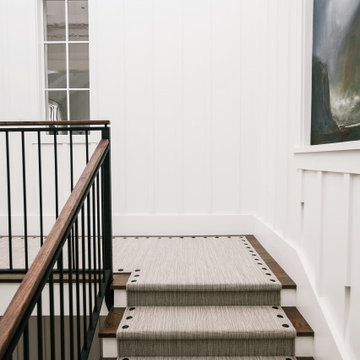
Staircase - mid-sized traditional wooden straight wood railing staircase idea in New York with painted risers




 Village Home Stores
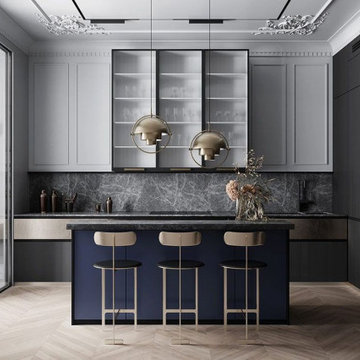
Full-overlay Rustic Beech cabinets in the "Charleston" door style and "Briarwood" finish.
Village Home Stores
Example of a large mountain style kitchen design in Chicago
Example of a large mountain style kitchen design in Chicago



 TRU Landscape Services
Industrial style patio cover lighting. Hearkening back to Thomas Edison, these bulbs and glass fixtures float gracefully under the custom wood patio cover tie-in.
TRU Landscape Services

 Kimberlee Kristine
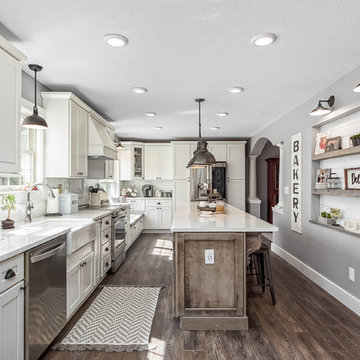
Eat-in kitchen - large transitional l-shaped porcelain tile and beige floor eat-in kitchen idea in Seattle with an undermount sink, beaded inset cabinets, blue cabinets, quartz countertops, white backsplash, marble backsplash, stainless steel appliances, an island and white countertops

 Plaistow Cabinet
Shiloh Cabinetry. Polar White, Inset
Kitchen - transitional kitchen idea in Manchester with white cabinets, beaded inset cabinets, marble countertops, white backsplash, marble backsplash and stainless steel appliances
Kitchen - transitional kitchen idea in Manchester with white cabinets, beaded inset cabinets, marble countertops, white backsplash, marble backsplash and stainless steel appliances
Sponsored
Sunbury, OH

J.Holderby - Renovations
Franklin County's Leading General Contractors - 2X Best of Houzz!

 ULLE Studio
Inspiration for a mid-sized scandinavian wooden straight metal railing and open staircase remodel in Seattle


 L.Bonadies General Contracting
Joseph Narcisse
Mid-sized mountain style enclosed dark wood floor family room photo in New York with beige walls and a wall-mounted tv
Mid-sized mountain style enclosed dark wood floor family room photo in New York with beige walls and a wall-mounted tv

 ROAM Architecture
Detail of LED wall sconce with white glass tile background
Inspiration for a small contemporary kids' white tile and glass tile porcelain tile and gray floor alcove bathtub remodel in New York with flat-panel cabinets, dark wood cabinets, a two-piece toilet, green walls and an integrated sink
Inspiration for a small contemporary kids' white tile and glass tile porcelain tile and gray floor alcove bathtub remodel in New York with flat-panel cabinets, dark wood cabinets, a two-piece toilet, green walls and an integrated sink
Sponsored
Sunbury, OH
J.Holderby - Renovations
Franklin County's Leading General Contractors - 2X Best of Houzz!

 Victor Mulbauer
New Installation of Red Oak Wood, 3 1/4 in width. White-washed Bona Stain was used, Bona Finish, as well as Bona Traffic HD.
**This photo is of the Red Oak Wood (3 1/4 inch) prior to the application of the white-washed Bona Stain.

 T.A. French - Custom Builder
Example of a mid-sized transitional dark wood floor and brown floor double front door design in Austin with gray walls and a black front door


5