
Search results for "Hold loose" in Home Design Ideas
 Wanda Ely Architect Inc.
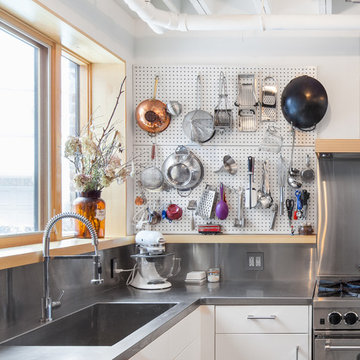
Drawing from one of the owner's experience as a chef, the kitchen is inspired by a commercial kitchen. Walls of durable metal pegboard embody the project's authentic approach in which the tools of everyday life are displayed as objects, while simultaneously making kitchen utensils convenient to use.
Photo by Scott Norsworthy

 The Foxy Garden
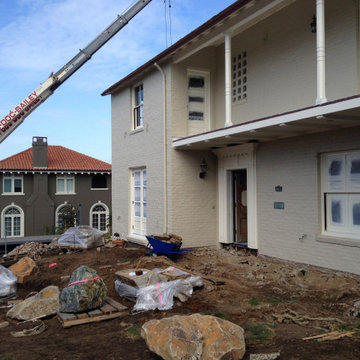
This very large corner site was shrouded in tired and thirsty conventional lawn. Really a bland, uninteresting monoculture—impossible to maintain especially in light of our dwindling resources and our growing understanding about sustainable practices.
We chose to approach this project not with the idea that existing lawn is bad, but with respect for what lawn has historically represented: a socially connective tissue.
Instead of conventional grass requiring endlessly large amounts of water, chemicals and mowing, this lawn conversion shifts to a naturalistic native meadow mix splashed with wildflowers and drought tolerant native shrubs. It was the clients’ desire to be wrapped by a garden attracting native pollinators and beneficial insects. A wildlife photographer, they wanted the opportunity to open windows and doors and feel immediately connected to a coastal native environment.
The handsome new stone walls, stairs and massive boulders became the structural framework containing the loose, coastal sage scrub plant community, holding the landscape together during the dormant months.
As we continue to grow our acceptance of and appreciation for climate appropriate California gardens, and embrace the paradigm shift, let us graciously bid adieu to our home’s unsustainable velvet robe.
Find the right local pro for your project
 Rocky Tops Granite & Marble LLC
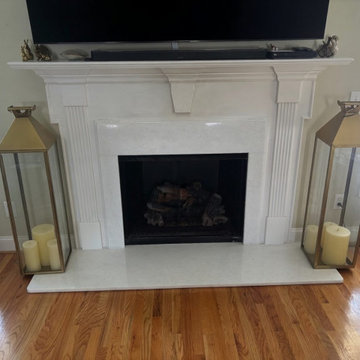
Hanoi White marble makes a fireplace surround the centerpiece of a room instead of just a backdrop for the TV. This one went into a home in Blythewood, and it's the kind of stone that earns that spot. White marble with soft gray veining has been the go-to for fireplaces for a reason: it catches light off to either side of the mantel and gives the whole wall a calm, finished look that paint or tile just can't match.
Marble takes a mellower polish than a lot of other stones, and the veining moves in loose, natural patterns that give it a warmer feel to the eye even though the stone itself stays cool to the touch. For a surround, we're not dealing with knife cuts or hot pans, so the wear concerns people sometimes bring up with marble in a kitchen don't really apply here. It's decorative and structural at the same time, built to frame a firebox and take the heat that comes off it without any trouble.
Fabricating a surround like this means getting the slab selection right before anything else. You want the veining to read well across the face and up the legs, not fight itself at the seams. We templated this one to the fireplace opening and cut it so the pattern carries through cleanly, then set it with an eased edge, simple and out of the way so the stone itself stays the focus. That's really the right call on a piece like this. Anything fussier on the edge would just compete with what the marble's already doing.
Day to day, a surround like this asks for very little. It's not a work surface, so scratching isn't a real concern, and a light sealing keeps it looking the way it did on install day for years. It'll take the ambient heat from the firebox fine, it wipes clean, and it holds up as the kind of feature you don't think about, you just enjoy.
Jobs like this are why we like doing this kind of work around Blythewood and the rest of the Midlands. A fireplace wall is one of the first things people see walking into a room, and Hanoi White marble with an eased edge gives this one a quiet, finished presence that's going to hold up for a long time.
 Ann Maguire Design
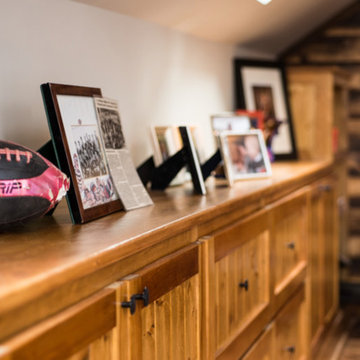
Expansive custom cabinetry constructed of knotty pine maximize professional and personal storage. This solid wall of cabinetry is flanked on either end by wood storage and an open bookshelf. The lower cabinets safeguard important documentation and office equipment. There are extra deep drawers too that hold board games and a vast inventory of loose legos. What every house needs. This cabinetry was designed in a thoughtful manner to welcome family into a professional workplace.
 Rocky Tops Granite & Marble LLC
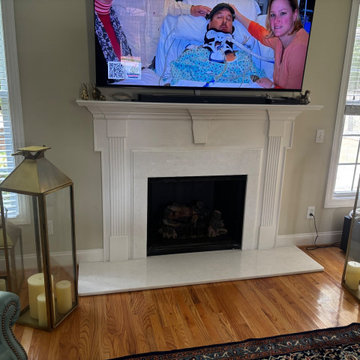
Hanoi White marble makes a fireplace surround the centerpiece of a room instead of just a backdrop for the TV. This one went into a home in Blythewood, and it's the kind of stone that earns that spot. White marble with soft gray veining has been the go-to for fireplaces for a reason: it catches light off to either side of the mantel and gives the whole wall a calm, finished look that paint or tile just can't match.
Marble takes a mellower polish than a lot of other stones, and the veining moves in loose, natural patterns that give it a warmer feel to the eye even though the stone itself stays cool to the touch. For a surround, we're not dealing with knife cuts or hot pans, so the wear concerns people sometimes bring up with marble in a kitchen don't really apply here. It's decorative and structural at the same time, built to frame a firebox and take the heat that comes off it without any trouble.
Fabricating a surround like this means getting the slab selection right before anything else. You want the veining to read well across the face and up the legs, not fight itself at the seams. We templated this one to the fireplace opening and cut it so the pattern carries through cleanly, then set it with an eased edge, simple and out of the way so the stone itself stays the focus. That's really the right call on a piece like this. Anything fussier on the edge would just compete with what the marble's already doing.
Day to day, a surround like this asks for very little. It's not a work surface, so scratching isn't a real concern, and a light sealing keeps it looking the way it did on install day for years. It'll take the ambient heat from the firebox fine, it wipes clean, and it holds up as the kind of feature you don't think about, you just enjoy.
Jobs like this are why we like doing this kind of work around Blythewood and the rest of the Midlands. A fireplace wall is one of the first things people see walking into a room, and Hanoi White marble with an eased edge gives this one a quiet, finished presence that's going to hold up for a long time.
 Windy City Painters
Iron Fence Painting Wicker Park Homeowners Can Trust: A Windy City Painters Case Study
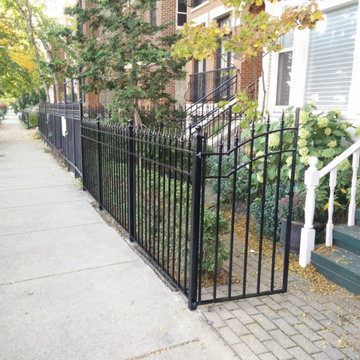
Wicker Park is full of architectural character — ornate 1890s greystone two-flats, vintage brick facades, and wrought iron fencing that has framed these streets for well over a century. However, what iron fence painting Wicker Park properties require is not a simple weekend job. Winters here are brutal on metal, and consequently Windy City Painters has spent years perfecting the restoration process that keeps these fences standing strong. In particular, this case study walks through a recent project completed for a classic Wicker Park property.
Project Overview
The property featured a full wrought iron perimeter fence that had suffered years of freeze-thaw cycling and road salt exposure. Paint had failed across most of the pickets, and oxidation had progressed into active rust at several base rails. Consequently, the homeowners needed more than a fresh coat of paint. They needed a genuine metal restoration, and that is precisely what Windy City Painters delivered.
Materials Used
Windy City Painters selected products specifically rated for Chicago's climate extremes:
Rust-Oleum Professional Rust Inhibitor Primer
Sherwin-Williams DTM Acrylic Enamel (two finish coats)
3M rust converter gel for active oxidation zones
Wire brushes, angle grinders, and detail brushes for precision work
The Process: How Windy City Painters Restores Rusted Iron
Every iron fence painting Wicker Park project follows a disciplined, multi-stage process:
Preparation. Wire brushing and angle grinding remove all loose, flaking, and compromised material. Rust converter gel is applied directly to active oxidation zones, chemically stabilizing the metal underneath.
Repairs. Pitted sections and structurally weak joints are addressed before any coating touches the surface. Notably, skipping this step is the most common reason fence paint fails prematurely.
Priming. A full rust-inhibiting primer coat seals every bare metal surface, preventing moisture from reaching the iron beneath.
Application. Two finish coats of direct-to-metal enamel are applied by hand for even coverage across pickets, finials, and rail joints.
Finishing. A final inspection confirms full coverage, sharp lines, and a smooth, uniform sheen from every angle.
Furthermore, this same process protects the ornate details so common on Wicker Park fencing — decorative finials, scrollwork, and gate hardware — without losing the historic character that makes these properties special.
Advice for Wicker Park Homeowners
Before starting a similar project, homeowners in this neighborhood should keep a few things in mind:
Never paint over active rust. Untreated oxidation will continue spreading beneath the new coating, and the paint will fail within a season or two.
Always prime bare metal before applying a finish coat. Skipping primer is the single fastest path to peeling.
Choose coatings rated for temperature extremes, since Chicago's freeze-thaw cycles are harder on metal than most climates.
Inspect ground-contact areas each spring, as base rails typically rust fastest due to snow melt and road salt runoff.
Budget for prep time. In fact, most of the labor in a quality iron fence painting Wicker Park project happens before a single coat of paint is applied.
Similarly, ask whether the contractor uses rust converter on active oxidation, since skipping this step often shortens the life of the finish considerably.
Moreover, historic greystone properties often have decorative ironwork that requires extra care during grinding and priming so the original detailing is preserved rather than sanded away.
What to Expect: Timeline and Investment
Homeowners often ask how long an iron fence painting Wicker Park project takes from start to finish. In general, prep work — wire brushing, grinding, rust conversion, and repairs — takes up the largest share of the schedule, while primer and enamel application move relatively quickly once the surface is properly stabilized. Cure time between coats also affects the overall timeline, since rushing this stage undermines durability. Consequently, Windy City Painters builds a realistic schedule around weather conditions rather than forcing the job into a tight window. In addition, investment varies based on fence length, the amount of active rust present, and whether ornate detailing requires extra hand-finishing. Homeowners considering this project should request a full on-site walkthrough rather than a rough phone estimate, since rust severity is difficult to judge accurately without seeing the fence in person.
Why Wicker Park Homeowners Choose Windy City Painters
Windy City Painters has become the trusted painting contractor for Chicago's North Side and Near West Side, and iron fence painting Wicker Park residents request most often reflects that reputation directly. In contrast to quick-fix contractors who paint straight over rust, Windy City Painters treats every project as a full restoration. As a result, clients get a finish that holds up through multiple Chicago winters rather than one.
In addition, for related projects, Windy City Painters also offers interior painting, cabinet painting, drywall and plaster repair, and full metal refinishing services for fences, gates, and porches throughout the neighborhood. Ultimately, that range of services is what makes us a true one-stop contractor for Wicker Park homeowners.
See more of our work and request a free estimate at www.windypainters.com.
Ready to transform your Wicker Park home? Contact Windy City Painters for a free estimate — visit www.windypainters.com today. Proudly serving Wicker Park, West Town, Lincoln Park, Roscoe Village, Lakeview, Ukrainian Village, River North, and all of Chicago.

5