
Search results for "Mineral" in Home Design Ideas
 Henry Jones
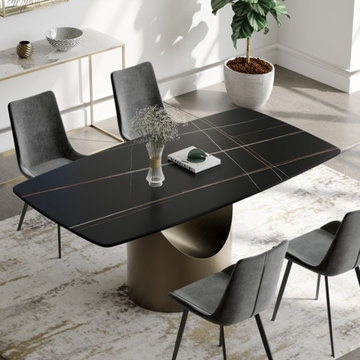
The dining table is the heart of the home, where families come together to share meals, laughter, and memories. As such, it is important to choose a dining table that is both functional and stylish. Enter the sintered stone dining table, the latest trend in dining room furniture that is taking the design world by storm.
Sintered stone is a material made by compacting and heating natural minerals at high pressure, creating a solid and durable surface. This unique material is ideal for dining tables because it is resistant to scratches, stains, and heat, making it perfect for daily use. Its sleek and modern look adds a touch of sophistication to any dining room, and its versatile design can complement any decor style.
One of the best things about sintered stone dining tables is their durability. Unlike traditional wood or glass dining tables, sintered stone tables are highly resistant to damage. Whether it is spills, scratches, or heat, sintered stone can withstand it all, ensuring your dining table will look beautiful for years to come. This is especially important for families with children or pets who can cause accidental damage to furniture.
Another great aspect of sintered stone dining tables is their easy maintenance. Unlike wood tables that require regular oiling or sanding to keep their surface smooth, sintered stone tables simply need to be wiped clean with a damp cloth. This makes it easy to keep your table looking like new, no matter how much you use it.
The design options for sintered stone dining tables are endless. From round to rectangular, from light to dark colors, and from modern to traditional styles, there is a sintered stone dining table to suit every taste. The material itself has a matte finish that provides a neutral background for any design style. And, with its neutral color palette, it is easy to mix and match with other pieces of furniture, making it a great option for those who like to change up their decor frequently.
Combined with its stylish and versatile design, you are able to make it the perfect choice for any dining room.

 KB Studios
Ah, the Luxurious Lodge. Who wouldn't want to relax next to a color palette like this? Inspired by the log cabins in the Hill Country of Texas, where interior designer Kim Bailey grew up, this vignette emits warmth and Southern togetherness. Backsplash: Cementine Antique Foglie, Cabinets: Liberty Boston Cognac, Countertop: Coquina Maestro Quartz.
 Rocky Tops Granite & Marble LLC
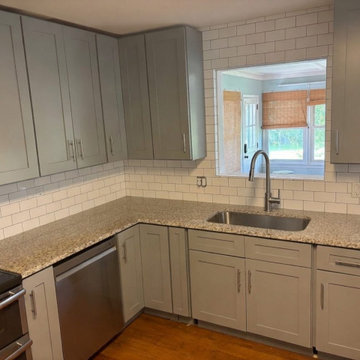
This West Columbia kitchen got new countertops in White Alpes granite, a stone with a light background scattered through with dark speckling and mineral flecks that catch the light differently depending on where you stand. It's the kind of pattern that reads calm from across the room and gets more interesting up close, which is exactly what you want on a surface you're going to be looking at every day.
Granite like this is quarried and cut into slabs, then polished to bring out that natural fleck and depth. It's dense, heat resistant, and about as tough a countertop material as you can put in a kitchen. You can set a hot pan on it without worrying, and it shrugs off the daily knife-and-cutting-board traffic that wears down softer stones. With a good sealer applied at install, it resists staining from wine, oil, and the usual kitchen spills for years before it needs to be redone.
We templated the space to fit around the existing gray shaker cabinets and stainless appliances, cutting the sink opening for the stainless steel sink and squaring up the seams so the pattern in the granite carries through cleanly from one run to the next. That's the part of the job that doesn't show up in a photo: getting the slab cut so the speckling doesn't look choppy at the seam, and getting the sink cutout dialed in so the reveal is even all the way around.
With the backsplash area still open, the countertop is doing a lot of the visual work right now, and it's holding its own. The light background of the White Alpes plays well against the gray cabinetry, and it'll give whatever backsplash goes in next a neutral, textured surface to build off of.
We do a lot of this kind of granite work around West Columbia and the rest of the Midlands. Kitchens like this one are a good reminder of why granite has stayed a go-to choice for so long: it looks good, it holds up, and it doesn't ask much of the homeowner once it's in.
Find the right local pro for your project
 Rocky Tops Granite & Marble LLC
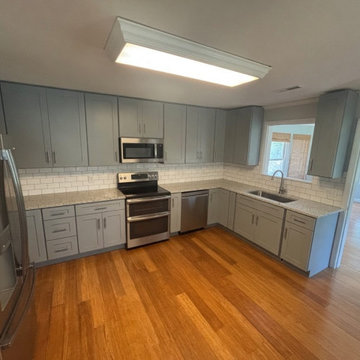
This West Columbia kitchen got new countertops in White Alpes granite, a stone with a light background scattered through with dark speckling and mineral flecks that catch the light differently depending on where you stand. It's the kind of pattern that reads calm from across the room and gets more interesting up close, which is exactly what you want on a surface you're going to be looking at every day.
Granite like this is quarried and cut into slabs, then polished to bring out that natural fleck and depth. It's dense, heat resistant, and about as tough a countertop material as you can put in a kitchen. You can set a hot pan on it without worrying, and it shrugs off the daily knife-and-cutting-board traffic that wears down softer stones. With a good sealer applied at install, it resists staining from wine, oil, and the usual kitchen spills for years before it needs to be redone.
We templated the space to fit around the existing gray shaker cabinets and stainless appliances, cutting the sink opening for the stainless steel sink and squaring up the seams so the pattern in the granite carries through cleanly from one run to the next. That's the part of the job that doesn't show up in a photo: getting the slab cut so the speckling doesn't look choppy at the seam, and getting the sink cutout dialed in so the reveal is even all the way around.
With the backsplash area still open, the countertop is doing a lot of the visual work right now, and it's holding its own. The light background of the White Alpes plays well against the gray cabinetry, and it'll give whatever backsplash goes in next a neutral, textured surface to build off of.
We do a lot of this kind of granite work around West Columbia and the rest of the Midlands. Kitchens like this one are a good reminder of why granite has stayed a go-to choice for so long: it looks good, it holds up, and it doesn't ask much of the homeowner once it's in.

 cobykane
Water Treatment and Wastewater Recycling Plant in Oil and Gas Production
WATERMAN ENGINEERS AUSTRALIA
Introduction
Water is a critical component in oil and gas processing, playing a crucial role in various stages of exploration, production, and refining. However, water handling in such processes poses serious challenges, mainly in connection with treating high TDS and salinity water. The situation is even more serious in oilfield sites, gas field sites, and exploratory sites where the need for water recycling and treatment is always necessary to minimize the impact on the environment and to keep operational costs at a minimum.
The oil and gas industry has seen a growing concern toward water treatment and recycling. These processes underline the sustainability of operations, license to operate, and low environmental footprint. This paper discusses the roles water treatment plants can play in mitigating the problems of high TDS and salinity during oil and gas production by recycling and reusing water to minimize waste and environmental harm.
The Water Challenges in Oil and Gas Production
Water finds its application on a large scale in the oil and gas industry for several purposes, such as in drilling, hydraulic fracturing, cooling, and hydrocarbon processing. The water used in these aforementioned processes frequently comes into contact with a wide array of contaminants, among which are hydrocarbons, heavy metals, several various chemicals, and high concentrations of dissolved salts. This contaminated water, often referred to as produced water, produces a great environmental risk if not properly treated.
Produced water typically contains high TDS concentrations, including salts, minerals, and other dissolved solids. Reservoir location and depth can make the salinity of this water vary widely. For many produced waters, these TDS values are very high and not suitable for direct discharge or reuse without treatment. The presence of salts and other dissolved solids can result in scaling, corrosion, and other operational problems of equipment, pipelines, and storage vessels.
For details visit: https://watermanaustralia.com/water-treatment-and-wastewater-recycling-plant-in-oil-and-gas-production/
 Rocky Tops Granite & Marble LLC
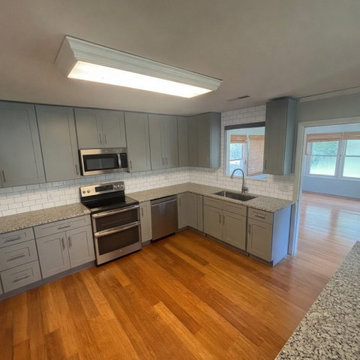
This West Columbia kitchen got new countertops in White Alpes granite, a stone with a light background scattered through with dark speckling and mineral flecks that catch the light differently depending on where you stand. It's the kind of pattern that reads calm from across the room and gets more interesting up close, which is exactly what you want on a surface you're going to be looking at every day.
Granite like this is quarried and cut into slabs, then polished to bring out that natural fleck and depth. It's dense, heat resistant, and about as tough a countertop material as you can put in a kitchen. You can set a hot pan on it without worrying, and it shrugs off the daily knife-and-cutting-board traffic that wears down softer stones. With a good sealer applied at install, it resists staining from wine, oil, and the usual kitchen spills for years before it needs to be redone.
We templated the space to fit around the existing gray shaker cabinets and stainless appliances, cutting the sink opening for the stainless steel sink and squaring up the seams so the pattern in the granite carries through cleanly from one run to the next. That's the part of the job that doesn't show up in a photo: getting the slab cut so the speckling doesn't look choppy at the seam, and getting the sink cutout dialed in so the reveal is even all the way around.
With the backsplash area still open, the countertop is doing a lot of the visual work right now, and it's holding its own. The light background of the White Alpes plays well against the gray cabinetry, and it'll give whatever backsplash goes in next a neutral, textured surface to build off of.
We do a lot of this kind of granite work around West Columbia and the rest of the Midlands. Kitchens like this one are a good reminder of why granite has stayed a go-to choice for so long: it looks good, it holds up, and it doesn't ask much of the homeowner once it's in.
 TOMRUQUE
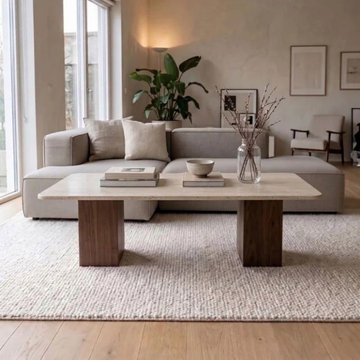
The Wilder Rectangular Travertine Coffee Table brings together the natural character of travertine stone and the warmth of walnut wood in a distinctive architectural design. Featuring a generously proportioned rectangular stone tabletop supported by two substantial walnut wood block legs, Wilder explores the balance between simple geometry, contrasting materials, and sculptural furniture design.
The genuine travertine tabletop displays warm beige, cream, and ivory tones, with subtle mineral veining and naturally occurring pores that give each piece its own character. Softly rounded corners introduce a gentle contrast to the otherwise linear silhouette, making the table feel refined without losing its strong architectural presence. Beneath the stone, two broad rectangular walnut supports create a grounded composition, their rich natural grain adding warmth and depth to the lighter surface above.
Designed for contemporary living spaces, Wilder works particularly well with long sofas, sectional seating arrangements, neutral upholstery, and textured rugs. Its elongated tabletop provides a practical surface for books, coffee cups, decorative ceramics, and everyday essentials, while the open space between the two wooden supports gives the design a balanced visual rhythm. The combination of natural stone and wood makes it especially suitable for architectural modern, organic modern, Japandi, and warm minimalist interiors.
Handcrafted and made to order, Wilder is available in nine width and depth combinations, ranging from 28" × 20" to 54" × 32", with height options of 14", 16", 18", and 20". Custom dimensions are available upon request. The natural variation of travertine and walnut ensures that each finished table has its own individual appearance, bringing together thoughtful proportions, authentic materials, and everyday functionality.

 The Pool Shoppe
David Charles Media
Pool - large transitional backyard stamped concrete and freeform pool idea in Toronto
Pool - large transitional backyard stamped concrete and freeform pool idea in Toronto

 contact7524
This stained glass window was created as part of our signature Aspen Stained Glass line. These windows look beautiful in cottage style or contemporary homes and are a great way for outdoor enthusiasts to celebrate their love of nature. The textured appearance of the glass provides the homeowners with a high level of privacy and comfort.
 Tile Doctor Ltd
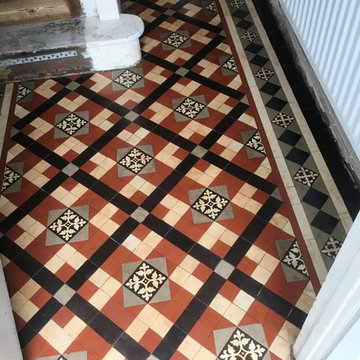
The owner of this house in Chaplefields near Coventry had bought this property as an investment and was keen to improve its appearance. As part of this work he had lifted the vinyl tiles in the hallway and discovered a lovely Edwardian tiled floor. Unfortunately, whoever had laid the Vinyl tiles had decided to use Tar as an adhesive and this had left a black mess all over the floor.
Realising the potential value an original feature such as this could add to the property he was keen to restore the tiles but not so keen to deal with the Tar, so we were asked to deal with the problem and restore the floor as close to its original condition as possible.
To get the tiles clean and remove the horrible tar I applied a strong dilution of Tile Doctor Remove and Go, which as its name suggest is great for removing coverings from tiles. I applied the Remove and Go with a mop, left it to soak in for a few minutes and then worked it in using a rotary machine fitted with a black scrubbing pad. The soil was extracted off the floor using a wet and dry vacuum and then the process repeated until I was happy all the tar was gone.
I then gave the tiles an acid wash using Tile Doctor Acid Gel; this serves to break down alkaline mineral deposits such as cement and grout smears, it also counters any efflorescence problems which can be an issue with these old floors where no damp proof membrane has been installed.
Finally, the floor was given a rinse with clean water and a steam clean to remove any trace of cleaning products and to neutralise the tiles in preparation for sealing.
I left the floor to dry off overnight and returned to the property to seal the tiles the next day. To seal the tiles, I used three coats of Tile Doctor Seal and Go which is a water based sealer that leaves a subtle sheen finish and being water based doesn’t leave a smell as it dries. The sealer will provide durable protection going forward preventing dirt from becoming ingrained into the pores of the tile and ensuring it remains easy to clean and keeping its appearance for some time to come.
The floor now looks fantastic and gives a great impression when you come into the property which is exactly what the owner wanted.
Mick Gayton
Warwickshire Tile Doctor
 Neumann & Rudy Architecture
**I. Spatial Composition & Architectural Volume**
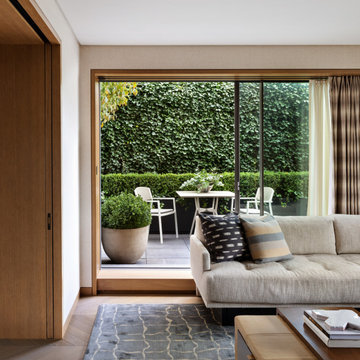
This interior operates on a strategy of framed extension, in which the room's perceived volume is borrowed from the garden beyond rather than asserted through internal grandeur. The composition is governed by a rigorous orthogonal discipline: a full-height sliding glazing system, set within a deep oak-lined reveal, functions as both aperture and proscenium, its slender mullions dividing the exterior into a triptych of vegetal planes. The generous depth of that reveal — expressed as a substantial threshold plinth and continuous jamb casing — reads less as trim than as tectonic gesture, giving weight and thickness to the enclosure and reinforcing the sense of a pavilion pressed against a green wall. To the left, a floor-to-ceiling pocketing door of book-matched, quarter-sawn oak establishes a monolithic vertical counterpoint, its recessed flush pull the only interruption of an otherwise uninflected plane; the shallow return of the wall beyond it creates a compressed entry sequence that releases into the primary volume. The flat, shadowless plaster ceiling maintains a neutral lid over the composition, while the furniture plan is deliberately low-slung and horizontal — a deep sectional set parallel to the glazing, a leather-topped ottoman, and a low occasional table — so that no element rises to compete with the sightline. Circulation is implied along the wall's edge, funnelling toward the terrace and its al fresco dining vignette, which acts as the room's terminal focal point and extends the interior axis outward.
**II. Materiality, Color & Texture**
The palette is a study in low-contrast tonal layering, calibrated within a narrow band of warm neutrals and animated almost entirely by the saturated chlorophyll green of the ivy screen. Rift-cut white oak, finished in a matte oil that reveals rather than glosses its medullary figure, provides the room's structural warmth — appearing in the joinery, the window surround, and the herringbone parquet, whose fine chevron rhythm introduces a subtle graphic pattern at foot level. Walls are treated in what appears to be a woven grasscloth or linen-effect wallcovering in a pale oatmeal tone, its faint horizontal striation catching raking light and lending textile softness to the perimeter. Against this, the seating is upholstered in a tightly woven, undyed linen-cotton blend with a biscuit-tufted seat platform, its slubbed irregularity a deliberate foil to the precision of the millwork. The cushion program provides the composition's only chromatic incident: an indigo-ground ikat or *kasuri* resist-dyed weave, with its blurred weft-broken banding, paired with a heavier blanket-stitched wool in glaucous blue-grey and buff stripes. Underfoot, a hand-knotted silk-and-wool rug in slate and mineral grey carries an attenuated ogee lattice, its lustrous pile providing cool relief beneath the warmer wood tones. The plinth-mounted travertine or reconstituted-stone planter — matte, porous, faintly chalky — and the honed grey stone paving beyond introduce lithic gravity, balancing the prevailing softness with a mineral edge.
**III. Lighting, Atmosphere & Style Profile**
Illumination here is almost entirely diurnal and indirect: north-oriented or hedge-filtered daylight arrives diffuse and green-cast, washing the space in a soft, even luminance that suppresses hard shadow and privileges texture over drama. The ivory sheer, hung on a discreet recessed track, tempers glare while retaining silhouette legibility, and the adjacent pinch-pleated overdrape in a taupe-bronze silk-blend — with its subtle vertical striation and slight sheen — offers the option of full blackout while contributing a note of drapery-weight formality. Artificial sources are conspicuously concealed; no decorative fixture interrupts the ceiling plane, implying a scheme of recessed low-glare downlights or perimeter cove washing designed to sustain the daytime ambience after dusk. The resulting atmosphere is one of composed reticence — quiet, tactile, and deeply oriented toward the garden. Stylistically, the project synthesises Japandi restraint (the pocketing timber plane, the shadow-gap detailing, the reverence for the framed view) with the material sensuality and drapery conventions of European Soft Modernism, yielding a warm minimalism in which luxury is communicated through joinery tolerance, textile hand, and the disciplined editing of the palette rather than through ornament or statement furniture. It is an interior conceived as a calm neutral ground — an armature for light, landscape, and the slow accretion of daily life.

 Fiorito Interior Design
After living with the average master bathroom designed by the development company of their condo, my clients decided they had had enough. Longing for something sleeker, more modern, and with some style and flair, they hired me to create a space that would feel welcoming but unique. At their request, we removed a rarely-used bath tub and replaced it, and the adjacent small standing shower, with a much more spacious wet area. Both a vanity scaled for the room and its undermount sinks make the counter area seem roomier as well. New LED light fixtures, and mirrors outlined in oil-rubbed bronze to coordinate with the faucets, shower hardware, and vanity handles and towel bars bring a crisp, clean-lined sense. A deep, moody color on the walls and a fascinating, mineral-like wallpaper in the water closet serve to make this new master bath feel like a suite in a dramatic, contemporary hotel in New York or London. Photos by Bernardo Grijalva
 Tile Doctor Ltd
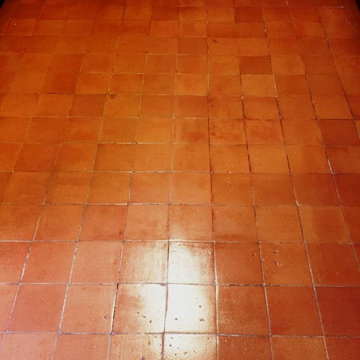
Not too long ago I visited a client who had just moved into a lovely old cottage in Milton, Oxfordshire. She wanted to restore many of the antique features of the building, including a fantastic Quarry tiled floor in the kitchen.
Quarry is typically a robust, hard wearing stone, but in a high traffic area like a kitchen, the tiles will need regular maintenance. These tiles clearly hadn’t seen a thorough clean and fresh seal in a long time, and so I was called in to provide just that.
On the first day of work, I gave the Quarry tiles a deep clean using a strong solution of Tile Doctor Pro-Clean and water. Pro-Clean is a versatile alkaline cleaner that also helps to break down any old and no longer effectual sealer remaining on the tiles.
The solution was applied evenly to the floor and left to dwell for half an hour, allowing time for it to seep into the stone to get underneath and lift out the ingrained dirt. I then removed the dirt by agitating the solution with a scrubbing pad fitted to a rotary floor scrubber. I worked in small sections at first, and gradually finished the entire floor.
After completing the initial clean, I rinsed away the soiled solution and vacuumed up the excess moisture using a wet-vac machine. I then scrubbed the floor an acid wash using a dilution of Tile Doctor Grout Clean-Up to remove grout smears and other mineral type deposits. The resulting solution was then removed in a similar fashion using a wet-vac.
The final step in the cleaning process was to rinse the floor with Tile Doctor pH Neutral Cleaner to remove any trace of product helps to tackle any remaining dirt and reset the pH balance of the tiles before sealing.
After leaving the floor to dry overnight, I returned the next day to the house to seal the floor with Tile Doctor Seal & Go, a water-based topical sealer which gives the floor an aesthetically pleasing sheen and a robust surface seal.
The photos demonstrate the results better than this short account can, needless to say the floor is now transformed.
Barry Woodward
Oxfordshire Tile Doctor
 Tile Doctor Ltd
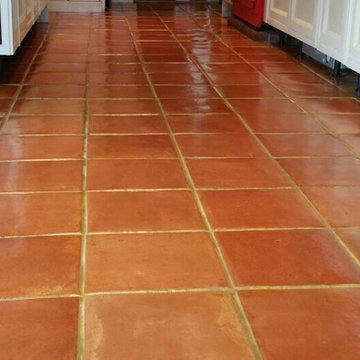
Here’s an interesting job I completed recently in the town of Lymington which is a lovely costal town within the New Forest and on the west side of the Solent. This Terracotta tiled floor was installed in the kitchen and was suffering from an efflorescence issue due to an ongoing leak which resulted in the salts in the water becoming deposited on the surface of the tiles as the water evaporated leaving a white bloom on the surface.
This process is more commonly known as efflorescence and is particularly common in old properties which have no damp proof membrane under the floor and white staining by the cupboards is especially visible in the below photograph.
My client was eager to have the problem fixed, and so enlisted Tile Doctor to get the job done.
To remove the efflorescence, the Terracotta tiled floor was acid washed using a mild dilution of Tile Doctor Grout Clean-Up which is primarily sold to remove grout smears but is equally effective at removing mineral deposits such as the white salts left behind by efflorescence.
The solution was scrubbed into the tiles using a stiff scrubbing brush and was successful at removing the white staining. Naturally it’s not advised to leave acid too long on any surface so the floor was treated in sections and then rinsed off with water and the residue removed using a wet-vacuum.
Following this, the floor was power-scrubbed in combination with a diluted solution of Tile Doctor Pro-Clean. Pro-Clean is a versatile cleaner that also contains stripping properties, allowing it to break down and remove old sealers, it also does a nice job getting the grout clean.
With the efflorescence treated and the floor now clean I was now happy with the condition of the tiles and give them a final rinse under pressure to ensure the floor was neutralised and any trace of products removed.
The Terracotta tiled floor was then left to dry overnight and I came back to seal the floor the next day. To seal the tiles I used three coats of Tile Doctor Seal & Go Extra, which provides a robust surface seal, and is recommended for internal floors with the damp issues.
Hopefully this quick report has offered some useful advice on how to treat efflorescence which is quite a common problem; naturally if you have further questions Tile Doctor does offer a free advice service so do get in touch.
Charles Okwechime
Hampshire Tile Doctor

 Flooring Supply Shop
AFRICAN TEAK WOOD MAT FLOORING
and
TEAK SQUARE BENCH
Premium African TEAK GRADE-A
Teak Oil Finish
Lifetime Solid Teak.
We offer a wide range of standard sizes and styles plus we can create just about any size, shape or design that you can imagine. Whether you want to add a non-slip surface by your tub or totally surround your shower with a rich, custom mat, we can do it. Best of all, these mats can be used inside the shower as well as outside!
Feature
Ideal for indoor or outdoor use
Stainless Steel Screws will not rust
Made of natural solid African teak wood
All screws are countersunk into the bottom supports and into the top slats
Ideal for use in or out of the shower and or high-moisture areas
Slip and bacteria resistant
Battens are 1/4" rounded on the edge of each top batten to assure comfort
All mats are built on 3/4" x 3/4" solid teak supports
Premium African TEAK GRADE-A
The Teak Tree, or Tectona, is one of the tropical hardwood birches, included in the family Verbenaceae. This tree is originally from the plantations of South East Asia, and can grow to a height of 30 - 40 m. As part of its life cycle, this tree sheds its leaves every year at dry season. Its longevity is very great, the Teak tree often living to an age of 100 years. Teak is especially noted for its capacity to withstand changes in the weather and season. One of the reasons for this is the ability of the Teak to bend, but not break, in the face of high winds.
Minimal Maintenance Required
While Teak is naturally resistant to bacteria and mildew; you may still see a buildup of soap residue and mineral or other impurities from your water. Therefore we strongly recommends performing routine cleanings when you clean your shower or bathroom.
FSC Certified/Sustainable The teak we use is grown in West Africa and is FSC Certified.
 Blue Sound Construction, Inc.
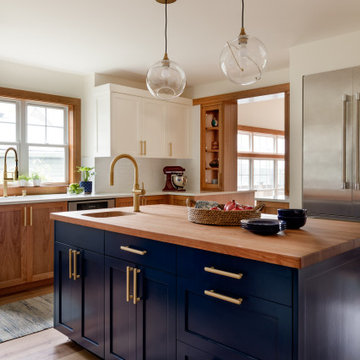
KItchen remodel with cherry cabinetry and butcherblock island countertop. Part of our Seattle Remodel and Addition on Capitol Hill of a 1904 Dutch Colonial that had been significantly remodeled in 1980, with Miriam Larson of Story Architecture and Photo by Miranda Estes.
Winner of a REX Award for Excellence in Remodeling 2023 from the Master Builder’s Association
Winner of an Excellence in Remodeling Award for Historic Renovation/Restoration 2023 from the Building Industry Association of Washington
 Rocky Tops Granite & Marble LLC
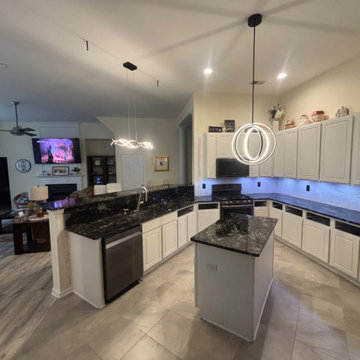
Blue Fantasy granite is one of those stones that stops people in the kitchen doorway. It's got that deep blue-gray base with soft movement running through it, flecks of white and darker gray scattered across the surface, and enough depth to it that it reads different depending on the light hitting it. In this Irmo kitchen it works as the anchor for the whole room, the kind of stone that doesn't need anything else dressing it up.
Granite like this comes out of the ground with real mineral variation, and that's part of why we like working with it. Every slab has its own character, so when we template a kitchen like this one we're not just measuring cabinets, we're looking at how the pattern will fall across the counters and figuring out where the seams need to land so the movement in the stone keeps flowing instead of getting chopped up at a corner. That's the part of the job that takes patience more than anything else.
Blue Fantasy is a hard, dense granite, and that's exactly what you want in a kitchen that gets used every day. It shrugs off heat, it resists scratching better than most surfaces you'll put a knife near, and it holds up to the kind of daily abuse a real kitchen dishes out. We sealed it before we left so it stays easy to wipe down and keeps its color from picking up any staining, and that's about the only maintenance it'll ever ask for. We kept the edge eased on this one, simple and clean, which lets the stone itself do the talking instead of competing with it.
Jobs like this are why we like working around Irmo and the rest of the Midlands. Every kitchen brings its own layout, its own light, its own slab pulled off the yard, and getting it right means paying attention to the details that don't show up in a photo, tight seams, a level install, an edge that doesn't fight the stone. This one came together the way we like to see them, a granite with real presence doing exactly what a kitchen counter should do for years to come.
 Rocky Tops Granite & Marble LLC
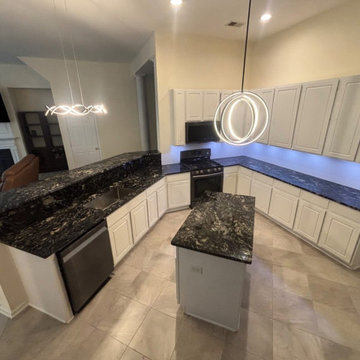
Blue Fantasy granite is one of those stones that stops people in the kitchen doorway. It's got that deep blue-gray base with soft movement running through it, flecks of white and darker gray scattered across the surface, and enough depth to it that it reads different depending on the light hitting it. In this Irmo kitchen it works as the anchor for the whole room, the kind of stone that doesn't need anything else dressing it up.
Granite like this comes out of the ground with real mineral variation, and that's part of why we like working with it. Every slab has its own character, so when we template a kitchen like this one we're not just measuring cabinets, we're looking at how the pattern will fall across the counters and figuring out where the seams need to land so the movement in the stone keeps flowing instead of getting chopped up at a corner. That's the part of the job that takes patience more than anything else.
Blue Fantasy is a hard, dense granite, and that's exactly what you want in a kitchen that gets used every day. It shrugs off heat, it resists scratching better than most surfaces you'll put a knife near, and it holds up to the kind of daily abuse a real kitchen dishes out. We sealed it before we left so it stays easy to wipe down and keeps its color from picking up any staining, and that's about the only maintenance it'll ever ask for. We kept the edge eased on this one, simple and clean, which lets the stone itself do the talking instead of competing with it.
Jobs like this are why we like working around Irmo and the rest of the Midlands. Every kitchen brings its own layout, its own light, its own slab pulled off the yard, and getting it right means paying attention to the details that don't show up in a photo, tight seams, a level install, an edge that doesn't fight the stone. This one came together the way we like to see them, a granite with real presence doing exactly what a kitchen counter should do for years to come.
 Tile Doctor Ltd
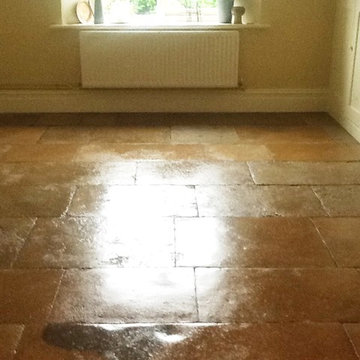
This property was situated in the tiny, yet picturesque village of Grafton Underwood in Kettering, Northamptonshire. The village has only a population numbering a few hundred and, interestingly enough, is the childhood home of the famous ‘Bridget Jones’ character. I have previously worked on a number of floors in Grafton Underwood, and on this particular occasion I was called to complete the job through a recommendation – which is always welcome!
This particular customer had two floors that needed re-finishing; the first was a polished Limestone tiled conservatory (which I will cover in a separate post as the process was different) and the second a Flagstone tiled living room; so on a rather dull day in November, I began my work.
The sealer on the Flagstone tiled living room had failed in certain places, resulting in the floor becoming difficult to clean due to dirt becoming ingrained in the stone. The decline in the sealer is not uncommon, as they do wear down over time – especially in an area of high traffic like a living room. To resolve this issue, the old surface seal needed to be stripped back and re-sealed.
To remove what was left of the old sealer, I applied a dilution of Tile Doctor Remove and Go and scrubbed it into the floor using a rotary machine fitted with black stripping pads. I then gave the floor an initial rinse, before paying special attention to scrubbing the stubborn spots, making sure all of the sealer was removed.
I then gave the floor an acid wash using Tile Doctor Grout Clean-Up in order to remove grout haze and other mineral deposits which were evident. Due to its acidic properties, you have to be very careful with this product on any type of stone, so I didn’t let it dwell for too long and made sure the floor was thoroughly rinsed down afterwards, with all solutions extracted using a wet-vac machine.
The floor was left to dry for more than 24 hours, before I returned to re-seal it using Tile Doctor Seal & Go. This product provides both a stain resistant surface seal and the durable low-sheen finish requested by my client. Seal & Go is suitable for use on internal unsealed, porous surfaces.
I guess the photographs don’t really do the transformation justice however the freshly re-sealed Flagstone living room certainly brightened up what was a very dreary autumn day!
Phil Vissian
Northamptonshire Tile Doctor
 Rocky Tops Granite & Marble LLC
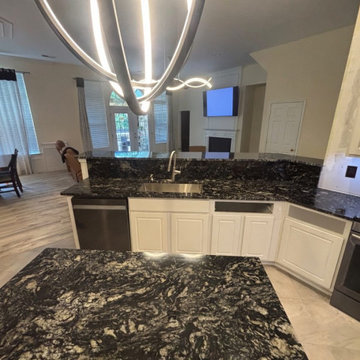
Blue Fantasy granite is one of those stones that stops people in the kitchen doorway. It's got that deep blue-gray base with soft movement running through it, flecks of white and darker gray scattered across the surface, and enough depth to it that it reads different depending on the light hitting it. In this Irmo kitchen it works as the anchor for the whole room, the kind of stone that doesn't need anything else dressing it up.
Granite like this comes out of the ground with real mineral variation, and that's part of why we like working with it. Every slab has its own character, so when we template a kitchen like this one we're not just measuring cabinets, we're looking at how the pattern will fall across the counters and figuring out where the seams need to land so the movement in the stone keeps flowing instead of getting chopped up at a corner. That's the part of the job that takes patience more than anything else.
Blue Fantasy is a hard, dense granite, and that's exactly what you want in a kitchen that gets used every day. It shrugs off heat, it resists scratching better than most surfaces you'll put a knife near, and it holds up to the kind of daily abuse a real kitchen dishes out. We sealed it before we left so it stays easy to wipe down and keeps its color from picking up any staining, and that's about the only maintenance it'll ever ask for. We kept the edge eased on this one, simple and clean, which lets the stone itself do the talking instead of competing with it.
Jobs like this are why we like working around Irmo and the rest of the Midlands. Every kitchen brings its own layout, its own light, its own slab pulled off the yard, and getting it right means paying attention to the details that don't show up in a photo, tight seams, a level install, an edge that doesn't fight the stone. This one came together the way we like to see them, a granite with real presence doing exactly what a kitchen counter should do for years to come.
205