
Search results for "Soil quality" in Home Design Ideas

 Urban Ecosystems
This is an example of a mid-sized asian shade backyard landscaping in Portland with decking for spring.

 Colwynn Garden Design
This section of the front yard was excavated and filled in with drainage rocks to create a Rain Garden. This is situated in a spot that captures storm-water flow coming down the hillside and provides a basin to store rainwater that normally would have run straight off the slope.
Blue River Rocks cover the area and create an illusion of water when wet.

 User
Discover thousands of ideas for Palm Beach County landscapes on Pamela's web site, pamela-crawford.com. Pamela designs landscapes, container gardens, and outdoor living areas throughout Palm Beach County, FL, including Boca Raton, Delray Beach, the town of Palm Beach, Palm Beach Gardens, Jupiter, and Wellington. She provides beautiful, custom designs that include professional installation of beautiful plant material, planters, and outdoor furniture and accessories.
Find the right local pro for your project

 Linda Estrin Garden Design
MEDITERRANEAN, TRADITIONAL, CALIFORNIA, LOS ANGELES, MALIBU, CALABASAS, SANTA MONICA, THOUSAND OAKS, SHERMAN OAKS, WEST HILLS, PACIFIC PALISADES, NORTH RANCH, AGOURA, AGOURA HILLS, SOUTHERN CALIFORNIA, SUCCULENTS, ECLECTIC, OAK PARK, DECOMPOSED GRANITE, AUSTRALIAN PLANTS, CALIFORNIA NATIVE, CALIFORNIA NATIVE PLANTS, SUSTAINABLE, RAIN CAPTURE, SOIL HEALTH, RUSTIC, ENGLISH GARDEN, DROUGHT TOLERANT, DROUGHT RESISTANT, LAWN REMOVAL, WATER CONSERVATION, WATER CONSERVING, WATERWISE, LOW MAINTENANCE, CLIMATE, FRONT YARD, BACK YARD, BACKYARD, PATIO, POOL, SOUTHWESTERN, ASIAN, WALKWAY, SUCCULENT POTS, GRAVEL, EDIBLE, LANDSCAPE, POOL, GARDEN, GARDEN DESIGN, SUCCULENT GARDEN, SUCCULENT POTS, REBATE, SUCCULENT WALL, LIVING WALL, DRAFTING, HARDSCAPE, HARDSCAPING, LIGHTING, FOUNTAIN, WATER FEATURE, LOW WATER, DRIP IRRIGATION, FIRE PIT, SANTA BARBARA, OXNARD, VENTURA,

 Father Nature Landscapes of Birmingham, Inc.
Inspiration for a mid-sized modern partial sun front yard concrete paver driveway in Birmingham for summer.

 CRASH Industrial Supply
A rustic handmade work bench.
Inspiration for an industrial shed remodel in Los Angeles
Inspiration for an industrial shed remodel in Los Angeles

 T.A. French - Custom Builder
Example of a mid-sized transitional dark wood floor and brown floor double front door design in Austin with gray walls and a black front door
Sponsored
Fredericksburg, OH

High Point Cabinets
Columbus' Experienced Custom Cabinet Builder | 4x Best of Houzz Winner


 Super-Sod
Photo taken by Harold Riddle of Redshed Creative.
Inspiration for a huge transitional partial sun front yard landscaping in Atlanta.
Inspiration for a huge transitional partial sun front yard landscaping in Atlanta.


 CSDesign llc
We designed and installed this 15 years ago, before digital camera's....so I'm looking for a picture of it running! :)
This is an example of a contemporary landscaping in Seattle.
This is an example of a contemporary landscaping in Seattle.

 Louisiana Horticulture Services
This home owner didn't want to keep mowing his back yard. So we came up with a shade garden design that eliminated his grass and added beauty and function to his back yard. We used mature Natchez Crape Myrtles, Asian Jasmine, Variegated Hostas, and Autumn Fern.

 Mark S. Garff, Landscape Architect
A small space was reimagined for clients on Lake Washington by Landscape Architect Mark S. Garff. In this photo a gabion basket wall holds back the steep slope, creating a flat garden area for viewing. A new horizontal board fence adds privacy and creates an intimate seating area at the water's edge.
Photos by Mark S. Garff.
Sponsored
Fredericksburg, OH
High Point Cabinets
Columbus' Experienced Custom Cabinet Builder | 4x Best of Houzz Winner

 Home & Garden Design, Atlanta - Danna Cain, ASLA
Beautiful perennial combination for spring color. The Hardy Ice plant continues to bloom thru the summer and into early fall. Both plants are very easy to grow if given full sun and adequate drainage. Very drought tolerant, fast growing, lovely spilling over boulders or edge of wall. Attracts pollinators too. The creeping phlox "Emerald Blue" has lovely green foliage year round. The ice plant will die back somewhat in winter pending the temperature.

 Red Berm
Newly built house needed a landscape. So from dirt sprang a usable backyard with a firepit, barbeque, retaining walls, and lawn area for the dog.
Photo of a mid-sized contemporary drought-tolerant and partial sun front yard gravel garden path in Los Angeles for summer.
Photo of a mid-sized contemporary drought-tolerant and partial sun front yard gravel garden path in Los Angeles for summer.

 Texas Ponds and Water Features, LLC
Ecosystem Ponds are the crown jewel of the Water Feature world. They soon become the centerpiece of your landscape. These low-maintenance, natural-looking water gardens work with Mother Nature, not against her, to stay clean and clear without using chemicals or UV sterilizers or anything artificial. The key is the symbiotic relationship between the Pond Fish, the beneficial bacteria, and the Aquatic Plants.
There is no sound in nature quite as relaxing as moving, falling water. It soothes away your stress at the end of a long day and you instantly start to feel more relaxed. Watching the Koi and other Pond Fish gracefully swimming around and nibbling from the underwater rocks and gravel can be almost hypnotizing. A variety of birds come to drink and bathe in the stream and colorful dragonflies flit here and there on mosquito patrol. Water lilies bloom in almost every color you can imagine and you'll soon see that frogs really DO sit on lily pads! Having one of these Ponds in your landscape is like coming home every day to a private vacation retreat right in your own backyard!
Texas Ponds and Water Features creates some of the most beautiful and natural looking Ecosystem Ponds and Water Gardens in the Austin and Central Texas area. We also work in the Houston, Southeast Texas area and almost anywhere in between. Working with only natural stone, our specialists craft waterfalls and ponds that look as if they had been carved by the hand of nature. Our two main pond guys have over 27 years of experience between them. We are at the Master level of Certified Aquascape Contractors--among the best in the world at what we do. Contact us today to get started on your own backyard paradise.

 Teach ‘em to Fish Landscaping
Photo of a mid-sized traditional partial sun front yard concrete paver landscaping in Chicago for summer.
Sponsored
Fredericksburg, OH
High Point Cabinets
Columbus' Experienced Custom Cabinet Builder | 4x Best of Houzz Winner

 threshold interiors
Location: New York, NY, United States
This Loft was tastefully renovated back in the '90s, but was due for an update and an expansion of the kitchen and dining areas to accommodate the client's cooking skills and entertaining needs. EnlargIing the island and adding cabinetry to delineate the office, bar and dining areas was a priority. The bathroom was updated to feel like a tranquil spa with beautiful new tile, plumbing fixtures and cabinets. Our biggest challenge was coordinating the entire renovation while our client was out of town for the Summer!
Photographed by: James Salomon

 TreHus Architects+Interior Designers+Builders
Example of a large classic u-shaped dark wood floor eat-in kitchen design in Minneapolis with a double-bowl sink, recessed-panel cabinets, white cabinets, white backsplash, stainless steel appliances, an island and black countertops
 gardenaar
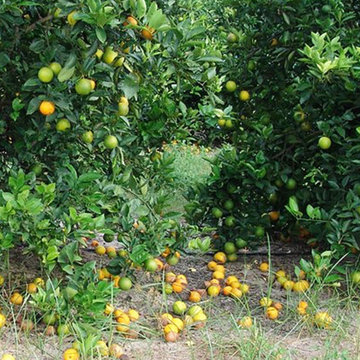
Does your orange tree drop its fruit before it reaches full size, or worse, does it drop flowers before the fruit starts to form?
Trees photosynthesize to produce carbohydrates like sugar which they store as a source of energy. They can maintain a limited amount, which is used to drive the growth of new leaves, branches, roots and stem. Fruitfulness requires the tree to divert its limited energy sources away from these vital functions to the production of flowers, blossoms and fruits.
Fruit development involves maturity followed by fertilization, growth, maturity and maturity. This process takes between 6-7 months in warmer climates, which requires a large number of tree energy sources as a result.
Trees are able to manage their resources, and will also divert them to emergencies ...
Fruit Drop and Crop Depression
In regions where oranges produce one crop per year, they go through a series of growth stages as follows:
Sprout formation and flower launching (mid-winter)
Flowers and fruit set (early spring)
Fruit growth - cell division (late spring to early summer)
Fruit growth - cell proliferation (mid-summer to early autumn)
Fruit ripening (autumn to late winter)
The difference is in the regions where most citrus crops are produced year-round. In these cases, the different stages of development will take place simultaneously.
The orange tree can handle its plant load well, and it will bear as much fruit as we can support. It is natural for all citrus trees to produce too little fruit and too little flowers in early spring to prevent overproduction. There is no need to worry too much about flowering, as an orange tree needs only 1% to 2% of flowers to produce a good crop, and sometimes even less than 1% is enough.
If a tree is depressed because it does not get enough water in hot, dry weather, and if it dies of nitrogen starvation because it is not given enough fertilizer, fruit set will be very difficult in the spring. There may also be a small number of fruit losses in the summer under stressful conditions.
Solution: Provide enough water, and water often in hot weather and strong winds. Orange feed with moderate fertilizer in early spring (September in Southern hemisphere, March in the Northern Hemisphere)
Fruit Drop and Lack of Potassium Nutrient
When orange trees are heavy, the decline in fruit can be exacerbated by low potassium levels.
Potassium, also known as potash (represented by the chemical mark K on fertilizer labels meaning N-P-K or nitrogen-phosphorus-potassium ratio) is a major macronutrient needed for flowering and fruit formation. Next to nitrogen, plants absorb more potassium than any other nutrient. Without potassium, the trees stop flowering and fruiting, which is what happens if they are not fed regularly.
Before any smug horticulturist declares to you that potassium has no direct effect on flowering and fruit set, let me say that as a horticulturist and biochemist, plant chemistry, like the chemistry of all living things is complex, but some input it is necessary to produce certain results. , and the references I have made to the end of this article support what I am saying!
Entering science, Potassium (K) is essential for water, nutrients and the movement of carbohydrates in plant tissues. It also activates enzymes that facilitate the synthesis of complex chemicals within the plant - such as starch, protein and adenosine triphosphate (ATP) production. The role of ATP is to transport the energy needed for all cellular metabolic activities to all living things, and in plants ATP production can regulate the level of photosynthesis.
Potassium also helps regulate the opening and closing of stomata, holes or cavities under which oxygen and carbon dioxide are exchanged with the atmosphere, and respiratory losses are controlled. It increases root growth which increases the absorption of nutrients and improves drought resistance, and increases resistance to frost, pests and diseases. High potassium levels produce similar maturity and fruit growth rate, as well as better nutritional quality, taste and range.
Agricultural extension agencies suggest that large amounts of potash are needed in many crops, and that potassium deficiency or macronutrient deficiency leads to reduced crop growth and reduced yields, and that potassium levels not only affect yield, but fruit size, juice. quality and shelf life.
Since potassium plays an important role in water regulation, deficiency can clearly increase the pressures associated with the declining fruit mentioned in the previous section.
Solution: Make sure that the orange trees are fertilized with the right fertilizer as previously discussed. Extra potassium can be brought in using seaweed extract (which is not a fertilizer but contains a good amount of potassium), wood ash (used in small quantities only as it is very alkaline), or potash sulphate (potassium sulphate) - all this is guaranteed. as acceptable in a natural garden.
Never use potassium chloride as it can be harmful to plants, it is a very inexpensive alternative to fertilizer manufacturers to save money!
Even if there are sufficient levels of potassium in the soil, it may not be accessible to plants, unless we make some improvements.
16