Software
Houzz Logo Print
pavexparquet

Wood flooring design - what to chose?

12 years ago
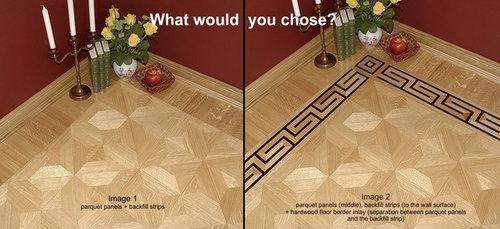
Hi. From the two options in the image what would you chose for your floor? Image 1, image 2 or none?

Comments (23)

  • 12 years ago
    İmage 2, defines the floors better (my opion) :)
  • 12 years ago
    Unfortunately, both options look dated to me.
  • PRO
    12 years ago
    The design depends on the style of the room.
  • PRO
    12 years ago
    @njschaefer78 - maybe you want to say ”the look is outdated”. What you see there is a high end parquetry flooring. It has roots in hundreds of years of parquetry. In the end it is a matter of taste if you like it or not. Is a Duesenberg outdated. Yes it is. Is it a fascinating car? Absolutely!
  • 12 years ago
    I don't like the design in the second. It takes away from the beauty of the parquet.
  • 12 years ago
    Image 1 is more classic. Image 2 marries what looks like a thin laser cut with the classic design, but the eye isn't used to seeing such thin complex work mixed with a chunkier wood, even if the Greek key design is thousands of years old.

    Including the decorative objects in the photos was a good idea to show scale, by the way.
  • 12 years ago
    last modified: 12 years ago
    They're both too fussy and busy. Definitely #1 if you have to choose. The Greek key design is overly formal and dated looking.

    A defined border can make it difficult to place a rug or other furniture.
  • 12 years ago
    Is it going to be stained? I think the contrast of the Greek key pattern is too much.
  • 12 years ago
    I love both, but the inlay is the best. The black greek key next to the dark red wall gives an awesome bold and mildly gothic vibe.
  • PRO
    12 years ago
    @smo123 - no it is not going to be stained. It could be if the decision is taken. Matter of taste.
  • 12 years ago
    Select hardwood , I like the first two images you posted.

    The OP parquet is outdated to me and I much prefer high end solid hardwood. I had parquet ripped out of a room in my home.

    I l
  • PRO
    12 years ago
    @wickedxx...
    Thank you for the comment.
    Not sure what you mean by "OP".
    And ALL of our parquets are fully integrated T & G constructed SOLID hardwood (unless specified to be engineered).
  • 12 years ago
    OP means "Original Poster."

    I like image 2.
  • 12 years ago
    You're welcome Select Hardwood... I would probably never select parquet floors if I were replacing a floor. However, if they were already in a home I would not rip them out unless there were problems like loose pieces that fall out, or severe warping going on. My ex-sister in law had parquet floors that were ruined when her pipes froze and flooded the house. They'd been glued somehow directly to the concrete slab and were one of the worst jobs I've ever dealt with to remove afterwards. Even though the water damage caused them to warp and pop up, many of them stayed attached and we had to bust them off the concrete with scrapers.
  • PRO
    12 years ago
    I agree with Jessica as far as being reluctant to tear out an existing parquet floor. As far as liking the look - it really depends on whether or not it fits in with the house. If the rest of the house is extremely modern then parquet might seem out of place. But there are many other inlay options that are not outdated and would fit right in. Eliza Osenbaugh-Stewart - I too like the greek key border next to the red wall.
  • 12 years ago
    Honestly, parquet has its place in certain era homes. It can be gorgeous. We toured an embassy in an old building with the most gorgeous parquet floors - it made me want them! I do think the greek key design might be something that you regret later if you ever change the rest of the design in the room. The parquet is part of the dressing of the house, but the greek key starts to decorate the room itself. Not sure if that makes sense, but image 1 is what I would recommend.
  • PRO
    12 years ago
    Image one! More versatile and the better option for reselling a house!
  • PRO
    12 years ago
    It would be more helpful to see the furniture layout and color scheme of the rest of the room/house. Image one will leave you with more options for furniture layout while image two could limit your freedom.
  • PRO
    12 years ago
    last modified: 12 years ago
    I've found that the term "parquet" has become an almost generic term that brings to mind (for many) the old simple fingerblock & unit block stuff that was used in a more utilitarian fashion, because it could be glued down over concrete in both residential & commercial applications decades ago.
    Agreeably... not too impressive.

    The result being that "parquet" gets a bad rap, because when people hear the word, they immediately envision the aisle ways at Macy's (done my share), and the blah looking 9"x9" 4-slat units that were used in the fifties.
    Which is why I typically reference our offerings as: "European Style Parquet"... it's not intended to sound "stuffy", but an attempt to differentiate the concept, and stimulate thinking "outside the box".
    Having been in the hardwood floor biz for a LONG time, I've endured similar conditions when only a few years ago... if people heard the words: "hardwood floors"... they immediately got a mental picture of the old fashioned 2-1/4" strip floors that grandma had.
    FINALLY, that stigma has been laid to rest... whew!

    But, IMHO, parquets offer a WIDE range of choices in patterns ranging from simple to intricate. And they can set the "tone" of the décor by lending a traditional, formal, contemporary or even rustic influence by the nature of the design & finish style employed.
    Granted, some patterns go to a rather "dizzying" extreme in an effort to appear intricate.
    My favorites are actually the patterns which have a balance of interesting geometry combined with a simple theme.
    Herringbone, Chevron, Bordeaux, Fontainebleau, & others.
    And the size of these patterns is essential to maintain an attractive "scale" to the areas involved.

    I agree with some, that the setting is what determines just how much & what you can use... but we see a nice balance in using the "parquet" to highlight key areas such as Foyers, Library/Offices, Formal Dining, etc., and tying it in with plank in the same style, specie, finish elsewhere.
    Just another 2 cents...
    And my apologies to Pavex Parquet SRL... (OP) for almost commandeering their post with my opinions...
  • PRO
    12 years ago
    Select,
    I have started a discussion with a precise theme here. You have entered the discussion and published your images distorting it. That's not very nice from your side...
  • PRO
    12 years ago
    last modified: 12 years ago
    I'm terribly sorry Pavex, if I interfered with your "marketing exercise"... that wasn't my intention.
    I was merely trying to reinforce your presentation of PARQUET patterns as a popular choice, which is what the theme was (or so I thought).

    I was unaware of the likelihood that I'd be construed as a person who is "not nice"... although I've been referred to in much worse terms. (haha)
    I'll cheerfully remove any & all of my comments if I can, and let you get back to your sales pitch.
    Once again, my humble apologies.
  • 10 years ago

    I don't know what the one on the left is supposed to be. Not much of a border. The one on the right is the L meander that was very popular around 1900, mostly due to it being simple and cheap to make. But it isn't quite right. The proportions are not the same.

    Hey Pavex. You haven't seen my website in the past year. I now have over 200 pictures of floor borders. All but one are old. They are the way they were, and they way they should be copied today.

    See them all at: http://floorborders.com/

    (I have nothing to sell. I do list Pavex as one of the vendors of parquet floors, but I prefer American firms using American woods.)