Software
Houzz Logo Print
courtneysgarden

Hairy kale??

12 years ago
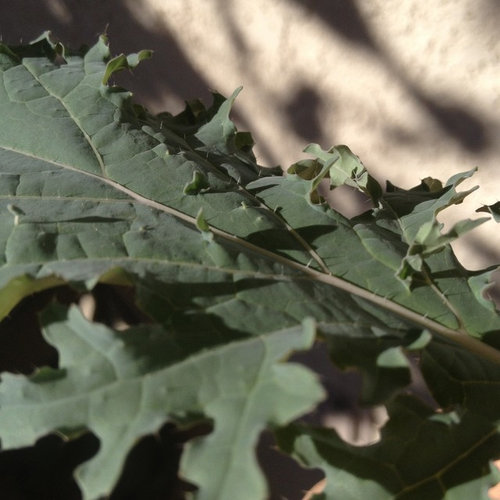
I have a Russian kale plant I grew from seed and it has some sharp hairs along the stem in the center of the leaves and some on the tops of the leaves- they hurt to touch them. I was wondering if this is a normal characteristic of Russian kale or if maybe the seed I grew it from was cross pollinated with another plant and it is not a pure kale plant? I have cooked and eaten it and its fine but would like to use it fresh. If I buy Russian kale from a different seed source will they possibly not have the sharp hairs? Or is this normal for this type of kale?

Thanks!

Comments (9)

  • 12 years ago

    I guess it's pretty normal (see link). I don't know about eating raw kale though, I only eat it cooked like collards, simmered with a ham hock for a few hours. That's sure to render any spines useless ;).

    http://forums2.gardenweb.com/forums/load/cornucop/msg0616073222150.html

  • 12 years ago

    This looks more like a leaf of solanum to me than anything else.

  • 12 years ago

    It looks exactly like the Russian kale that I have growing, but I never had any issues with it hurting me when I harvested or cleaned it. But leaf shape, color look the same as what I have. Weird...maybe you have a sensitivity to it (as I do to zucchini leaves)?

  • 12 years ago

    Thanks for the responses-

    ZachS thanks for the link- wow mine aren't nearly as spikey as those thank goodness! I love kale both raw and cooked. The curly & lucinato kale doesnt have the sharp hairs and tastes good in salads. Kale is also great sautéed with a little olive oil & garlic, or kale chips yum!

    Ceth_k hmm it looks like kale but maybe is that solanum something it could have crossed with? I found a picture of a solanum on google image search similar looking but that plant had a hairy main stem and little white & yellow flowers and actual thorns on the top and bottom of the leaf whereas my plant has the same growth habit as my other kales as far as a stalk-like non-hairy main stem and such, and hairs on the top of the leaves only not thorns. Very interesting.

    Shermthewerm yeah it looks the same as my friend's russian kale too but I don't remember hers having these sharp hairs. I might just be sensitive- zucchini leaves hurt me too if I remember correctly, and definitely cucumber & pupkin leaves/stems. I may try again with a slightly different variety or different seed supplier. I just really like the russian kale because it doesnt seem to get bitter & tough in the summer like other kale varieties tend to. Actually I planted several seeds from the same russian kale packet a few weeks ago and the new seedlings just started getting their first true leaves- I just checked them and noticed they all look like they also might have the same hairs on them too, they are actually fairly fuzzy at this young stage but the hairs are too fine to be sharp. Experiments in gardening!

    Thanks all!

  • 12 years ago

    I might try sautéing it, even kale chips don't sound too bad, but I don't like it raw (although that red Russian is supposed to be pretty tender, so it might be good...sans spines anyways).

    So, I just found some interesting information: red Russian and Siberian are completely different species of kale then their European cousins. the former are Brassica napus ssp. pabularis while the latter is Brassica oleracea. Interestingly, the Siberian or Russian kales are the same species as rutabagas and rape/canola. This might owe to the fact why your red Russian kale has spines while your other kales does not.

    To answer your other question, Solanum (as I understand the term) is a genus in the order Solanales (family Solanaceae). On the other hand kale (as well as mustard, broccoli, cabbage etc.) is a Brassica, a genus in the order Brassicales (family Brassicaceae). I could continue into lesser clades but that's (nearly) enough taxonomy for one night. Solanum and kale does merge until the higher clade of plants known as eudicots which is little more then a description of three microscopic little lines on their pollen grains. Eudicot's include everything from tomatoes to witch hazel to possum wood.

    So, after all the totally unnecessary (but maybe fascinating if your nerdy like me) jibber jabber, Solanum and Brassica are far too distant of relatives to mix.

  • 12 years ago

    Thanks ZachS, i stand corrected.

  • 12 years ago

    Yes thank you ZachS, very scientific, interesting info!!
    Appreciate it.

  • 12 years ago

    No problem. Although I do have to correct myself (this is pretty common theme in my life....)

    I was doing some research the other day on some other biology stuff and I came across in one of my other books a much better description of a eudicot then the one I had before. It seems I have forgotten more things then I ever actually knew...

    Eudicots (meaning "true dicots") does indeed refer to plants which have three openings on the pollen grains (monocots have only one) but there are several other traits that differentiate the two. The number of "seed leaves", or cotyledons, and their structure (the fact I didn't remember THAT when its in the darn name is really embarrassing), Eudicots have two cotyledons, monocots have only one sheath-like cleoptile from which the flag leaf emerges. The cleoptile also serves to protect the seedling as it pushes through the surface. In eudicots, this function is preformed by way of hypocotyl, gently pulling the seedling through the dirt. The root structure is also different as monocots generally lack the tap root of eudicots. Leaf structures and vascular tissues are also different.

    So, not that any of that is important or really relates to the post, I just wanted to correct my previous mistake.