Software
Houzz Logo Print
rajesh77054

Container Watering

21 years ago

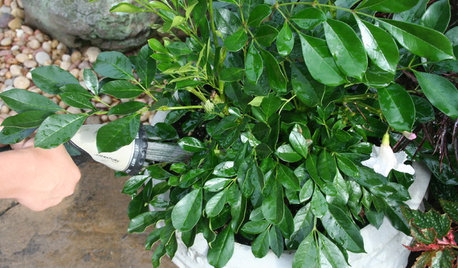
I've been trying to stick to the watering recommendations listed on the tags of the nursery plants but they still seem to dry out to soon. Someone recently told me to ignore those recommendations as water all my containered plants liberally until water runs out the bottom and then water again a few minutes later. He said that the nursery's watering guide assumes you go home and transplant the plants to the ground. What do you guys think? does this sound reasonable? i don't want to ruin my plants with root rot by over watering.

Comments (10)

  • 21 years ago

    What plants are you speaking of? Some tolerate being very dry, while others like evenly moist, but no water is worse than too much, though both are undesirable.

    It is good practice to use a container soil that you can water freely & have water run from the pot bottom quickly, even if it means more frequent watering (it follows that fertilizer needs will increase with soil porosity as well). If the soil dries lower than about 30% moisture content, it can be difficult to rewet (the soil actually becomes water repellant). Under these conditions it is helpful to water once and then again about 10 minutes later. In any case, you should be sure that the soil is evenly moistened with no hidden dry spots. The typical plant reaction to portions of the soil being allowed to dry completely while other parts are moist is death of parts of the plant. E.g., A maple with dry spots in the soil will usually show individual branches dying while the remainder of the plant remains viable. Other plants might show similar reactions.

    Al

  • 21 years ago

    I just starting putting those water holding crystals in my containers. Of course they need to be added at the time of planting so that they are near the bottom of the container. I also mulch the top of any container that is prone to drying out quickly, such as terracotta pots. Any plant that requires more moisture gets the crystals and the mulch and hopefully a plastic or resin pot that does not dry out too quickly. Any plant that can tolerate dry soil still gets the crystals, but I usually do without the mulch. Eash one is watered by what the weight of the pot feels like rather than on a strict schedule. Some of my pots get watered everyday while others may only need watering every other day. If you have alot of wire hanging baskets with cocoa liners or spaghnum moss liners, they may need to be soaked in water once a week. Also, plants that are watered more often will require more fertilizer since many of the soils nutrients are washed away with the draining of the water.

    Again, as Al stated, this all depends on the type of plants that are in containers. Cacti need far less water than a petunia, so it will help if you can tell us what types of plants are in the containers.

  • 21 years ago

    Thanks for the responses. I have herbs in two hanging baskets...basil, thyme, spearmint, and some others i've since forgotten what they are but they're also herbs. I have one basket with a bougainvilla. I have a planter with two tomato plants and another smaller one with two pepper plants. I have an 12.5gal container with a hibiscus that initially bloomed well but now is sparse on the buds. I have another 12.5gal with a yellow bell. I've got a rosemary in a 1gal and a strawberry in a 1gal. All are plastic containers except for the basket bougainvilla which is wire and coconut fiber lining.

  • 21 years ago

    Your bougie is going to want to dry out (I just repotted mine last weekend and am training it up a teepee rather than have it as a hanging plant - it even has the nerve to be getting ready to bloom on the end of one of the stems). The herbs generally like to dry a little between waterngs, although the mint likes somewhat moist soil (mint can take more moist than the others).

    Peppers like to get fairly dry before being watered again but the tomatoes will need more water - particularly once they start fruiting. The strawberries can dry a bit before watering again but note that too wet can rot their crowns. The hibiscus should dry a bit before watering, but try to be consistent with your watering of it or it will react by yellowing and dropping leaves (eg., if you keep it slightly moist for awhile and then suddenly let it get too dry, etc).

    You have to watch your plants and note that many of the ones that you mention will droop a bit if they are thirsty. After awhile, you'll be able to judge when to water before they get to the drooping point.

  • 21 years ago

    Jenny, thanks for the good info. By the way, I goofed...change the sizes of all of those containers to quarts, not gallons. lol. I'm getting a better feel for the plants water needs...the basil i've noticed needs water every day but not some of the other herbs it's potted with so that makes for some tricky business. The Texas sun gets most of the potted plants dry be the end of the afternoon so i'll continue with the daily watering schedule so long as they see to get along well.

  • 21 years ago

    Yeah - the basil has those big floppy leaves and can wilt pretty quickly if it is hot and windy, some of the small-leaved or thicker-leaved varieties are a little tougher. You might want to try potting some of the plants into slightly bigger containers or even sinking the smaller pot in a bigger one. Smaller pots can dry out pretty quickly. Also you might be able to create some afternoon shade for your babies (whether using other bigger plants to put the smaller ones behind or even erecting shade cloth) and that might help reduce the watering need too.

  • 20 years ago

    Can these water crystals be purchased locally (like from a garden center?) or should they be purchased directly from the manufacturer. I will be growing most of my roses here in containers but I sure as heck don't want to have to be watering them every other hour, especially during the summer months!

  • 20 years ago

    I haven't seen the subject of water crystals and Al's soil mix (pine bark/peat/perlite) come up yet, but maybe I've missed it. Is adding water crystals antithetical to the purpose of this well-draining mix? Or could they help preserve a nice, moist level for a day or two more between waterings?

    I will be gardening on a Chicago roof deck this summer and am trying to figure out the best way to keep things moist AND well-drained. I'm going to try various combinations of Al's soil mix, drip watering, self-watering, and perhaps water crystals.

    Any thoughts?

  • 20 years ago

    Peggy I've seen the water crystals sold at most garden centers around here (Chicago/Milwaukee). It's chemical name is cross-linked polyacrylamide. The brand I've seen the most often is called Soil Moist granules(JRM Chemical Inc. Cleveland OH) and they come in various sized containers. There seems to be 2 kinds of this product sold; one without fertilizer and the other with fertilizer added. I have not used these products as a growing aid yet but I have played around with the non-fertilizer containing one some and it is an interesting product. In plain tap water it swells up to hold about 140 times its weight in water; whereas in water containing fertilizer (such as Peters 20-20-20 at 1 tsp/gal) it swells up to hold 100 times its weight in fertlizer-containing water. The package recommends adding to potting soil at a rate of 2 tsp per gallon. The recommended usage rate doesn't seem to be proportional because it also recommends adding 3 tsp Soil moist to 3 gallons of potting soil. It is also recommended that you not add it to the top 2 inches of the potting soil. I don't know why though.

    Hope this helps you some.

  • 20 years ago

    I don't use them because the soils I use are even more open than I suggest here, so I must water almost everything daily anyway. I think the frequent exchange of air in the soils from daily watering is a benefit. That said, it's certain that everyone can't water every day or perhaps they just don't want to because of other priorities. I haven't heard much negative about the water absorbing products, so I think they surely have some usefulness in containers.

    Remember though - "dry to you" isn't necessarily "dry to the plants". Plants with established rootage are pretty efficient at extracting water from soils. Plants don't sip water like we do. Instead, they absorb water through cell walls molecule by molecule, absorbing it from a microscopically thin layer on soil particles. Ideally, soil is at no time wet and soggy; rather, it is ideally moist when it is barely damp to well-dampened.

    Al