Software
Houzz Logo Print
duajones

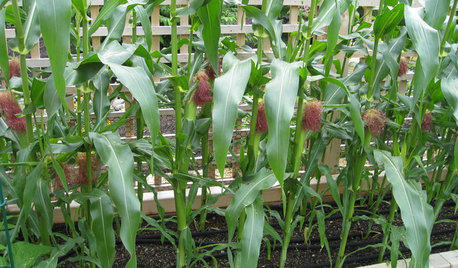
Growing Corn for the first time

17 years ago

And wondering if you folks that grow it do anything to help in pollination. Tassles are coming along and I am just starting to see the silks at the top of baby corn

{{gwi:55192}}

{{gwi:55193}}

Comments (15)

  • 17 years ago

    I cant offer advice on the pollination question...but Wow, that looks pretty! How far apart did you plant them? I had feared that I planted mine too close but from the looks of yours, I may be ok.

  • 17 years ago

    give each stalk a gentle shake should be all you need to do and give them a little blood meal there heavy feeders oh and protect the ears from worms those things had as much corn as I did last year

  • 17 years ago

    I agree. Corn is pollinated when the wind blows the pollen from the tassels on top onto the silks of plants closeby, so a gentle shaking helps distribute the pollen. I never did it and the corn pollinated just fine in the breezes, but some people do it just to make sure.

    Corn ear-worms can be foiled with a small drop of mineral oil placed right where the silks enter the ears if you don't want to spray the ears with insecticide. I've heard some people use other cooking oils, but you can Google it to see what's best.

  • 17 years ago

    THanks for the replies so far. Anney, I had not even given pests a thought at this point. Thanks for the heads up about the mineral oil. Will BT work as well?

  • 17 years ago

    duajones

    Yes, BT is sometimes recommended for corn ear-worms. Check out the link for some other ways of preventing the damage they can do, too. I'm not sure how much of a problem they'd be since your corn is growing in containers and the ear-worms live in the soil -- they'd have to get to your uncontaminated container soil.

    Maybe someone else who's grown corn in containers can give you an opinion about whether they're likely to attack your plants.

  • 17 years ago

    Thanks again. The raised bed that the corn is in is three years old now, I just freshen it up a bit each year.

  • 17 years ago

    If I understand it correctly, The function of the tassels(male) is to provide pollins to silks(female). What you can do is cut some ready tassels and shake them over all the silks. Do this more than once (the more the better)
    Of course if you had an acre or more of corn, hand pollination would not be practical. That is why they say you have to have some minimum nmber of rows to assure pollination by breez / wind.
    I had bottle gourd vines last year and I hand pollinated almost all of them. I had to because their flowers open after sunset, when all the bees and most insects have already called it quit and gone home, except some moths. But what if there were't any moths? So then as a gardener sometimes you have to become an insect, or mabe wind too (hehe)

  • 17 years ago

    The corn earworm is the larva of a moth (Heliothis zea). Unless your conatianers are located in a protected area, which bars the moth from laying her eggs, you will be as susceptible as anyone. The south is especially good for them because this moth is also the tomato fruitworm and cotton bollworm. Lots of hosts here. For a small planting like yours mineral oil is probably your best bet. It is tedious to apply, and I would not want to do a 10 acre field with it. Bt is a stomach poison and difficult to get where the larva do most of thier feeding. Results are somewhat iffy.

    Here is a link that might be useful: Corn earworm

  • 17 years ago

    Looks like I need to pick up some mineral oil. So you apply it right below the silks, just a drop or two?

  • 17 years ago

    Duajones

    I apologize. Your pictures are right THERE, and for some reason I saw your planting space as a container! So if you have "earth-soil" plus amendments in those raised beds, the corn ear-worms could certainly find your plants.

    I believe the mineral oil is applied right where the silks enter the corn husks, not down toward the ends that get pollinated.

    Here's more on the Corn Ear-Worm, pretty much as described by Farmer Dee:

    CORN EARWORM

    Location
    The Corn Earworm, aka Tomato Fruit Worm, Tobacco Budworm, Cotton Bollworm, is such a successful pest that it lives practically everywhere in the world between the parallels of 50° north and south latitudes. That's from the bottom half of Canada to almost the tip of South America.

    Appearance and Habits
    The earworm winters as a pupa in the soil. A brownish-olive moth coming out in spring to lay 500 to 2500 eggs, one at a time, on various host plants, including weeds. The eggs are dirty white and dome-shaped. After hatching, the caterpillars grow to nearly 2" long, have yellow heads, and vary from yellow to brown to green with lengthwise alternating light and dark stripes. There are several generations in a season; in corn, first-brood larvae eat into developing leaves, while larvae of later broods start at the silk and bore into the tip of the ear, eating the kernels down to the cob and piling up moist castings of excrement. In tomatoes the worms feed on the partially ripened fruit, restlessly moving from one tomato to another; pods of lima beans are sometimes invaded.

    http://www.organicgardenpests.com/organicpestcontrol3.html
    =====

    So usually their first sign is holes in the leaves of the corn. Some become the dreaded Spotted cucumber beetle.

    =====
    The spotted cucumber beetle, aka Southern Corn Root-worm or Budworm, belongs to the same genus as the striped beetle but is a much more general feeder. As an adult, it works on at least 200 vegetables, flowers, weeds and grasses, and as a larva, feeds on roots of corn, beans, small grains, wild grasses. An almost identical variety, often called the Diabrotica beetle, is an important flower and vegetable pest in California.

    [Same link as above.]
    =====

    I have to battle the corn-worms AND their next cucumber beetle stage!

  • 17 years ago

    Different insects, not stages of the same insect. Corn earworm is Heliothis zea, the spotted cucumber beetle is Diabrotica undecimpunctata) also known as the corn rootworm. The budworm is Heliothis virescens.

    Here is a link that might be useful: spotted cucumber beetle

  • 17 years ago

    Yes, you apply a couple of drops of mineral oil right where the silk enters the husk.

    George
    Tahlequah, OK

    >>So you apply it right below the silks, just a drop or two?

  • 17 years ago

    FarmerDee

    Information?

    The "Corn Budworm" -- you're saying it isn't another stage of the Southern Corn Rootworm as stated in the quote I posted, right? One almost needs to be an entymologist to keep them straight! I have to say that I've never come across the description of a Corn Budworm nor have I heard anybody talking about them. Maybe some lump them all together because of their feeding habits.

    I've had the striped and spotted beetles in my garden, though more spotted ones since there's a cornfield right next to it, so in my mind, the corn-cucurbit connection between the presence of Southern Corn Rootworms and Spotted Cucumber beetles is strong. I don't know where the striped beetles come from.

  • 17 years ago

    The budworm in corn is usually just a hungry corn earworm. The budworm is a close relative but prefers tobacco. Ear worms seldom damage the plants much here. The stalk borer (Elasmopalpus lignosellus) is the greater problem here. Usually they bore into the stalk at whorl and the emerging tassel is weakened and falls over. They leave a trail of sawdust so are pretty easy to identify.

    Here is a link that might be useful: Budworm

  • 17 years ago

    Not to resurrect an old thread, but my corn is looking exactly like the pictures in the first post as far as silk. I just noticed the silks for the first time last night. Is it time to pollinate yet? Or do I wait a few days?

    I only have 12 corn plants in a 4x4 square so I plan on hand pollinating. Not to mention, only a few plants are showing silks, others are a little behind.