Software
Houzz Logo Print
v1rt

Do I have room for sugar maple?

18 years ago

Hi folks,

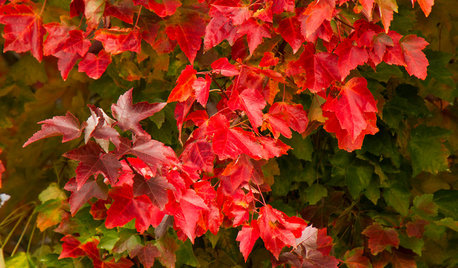
My wife and I really want to have a sugar maple tree or something that has phenomenal fall colors. However, with the backyard design I have, do I still have room for it?

I put my sunburst honeylocust on craigslist but I haven't received any emails yet. :P hehehe

{{gwi:50152}}

Comments (19)

  • 18 years ago
    last modified: 11 years ago

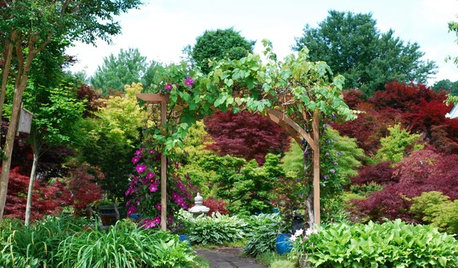
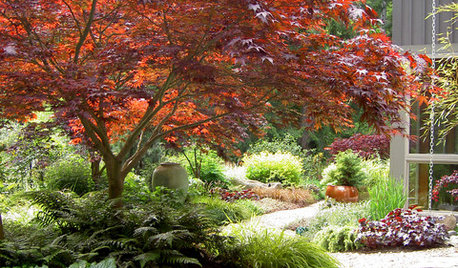
    Why not incorporate fall color into your beds? Japanese maples make great specimens. There's always burning bush, too. There are hundreds of shrubs that have spectacular fall color to choose from. I get excited, personally, by a red next to an orange, or an orange and a yellow--that incorporated into a -mixed border is more exciting to me than a single specimen try off by itself. :-) Sedum "Autumn Joy" and some mums with it, with ornamental cabbage in front and purple fountain grass and some great evergreens behind, and I'm doing back flips.

    If you go with something as big as a sugar maple, you're going to have problems with shade interfering with your plantings or your house.

  • 18 years ago
    last modified: 11 years ago

    Perfect ideas! I never thought of that! :D

    I read though somewhere last year that Japanese maples are marginal in zone 5a.

    Can you please give me an example of specific plants when you mentioned "red next to an orange, or an orange and a yellow--that incorporated into a -mixed border is more exciting to me than a single specimen try off by itself."?

    Thanks for saving me! :D

  • 18 years ago
    last modified: 11 years ago

    Sugar Maple... mmmmm. Looks like you have the room, but do you want the trade off in some extra maintenance for the lawn or having to build raised bed because of extensive fiborous root competition and water hogging by the SM.

    For fall shrub color PG hydrangeas put on a show and they have dried bronze "winter flowers", depending upon your snow fall.

    There is of course cornus shrubs like mid-winter flame that can serve as border fillers and then witner color against your evergreen backdrop.

  • 18 years ago
    last modified: 11 years ago

    I agree with going for more color by adding shrubs - or small trees - with good fall color. Two of my favorite fall color shrubs are Fothergilla (either the larger F. major or the smaller F. gardeniii) and highbush blueberries. Fothergilla also has sweetly scented white flowers in spring and blueberries also have pretty spring flowers and, of course, the summer fruit. Serviceberry trees have great fall color plus wonderful spring flowers and summer fruit (which the birds usually get before I have a chance to get some!) Flowering dogwood also has very nice fall color.

  • 18 years ago
    last modified: 11 years ago

    Rhodium framed it correctly--you have "room" in terms of canopy and so forth for a tree, but it will change (over time( what can be planted under and around it, so you can't just plop it into your existing design. So your decisions involve issues of height, caopy spread, form, color, underplanting and other things in order to decide which plant species you want to put where.

  • 18 years ago
    last modified: 11 years ago

    >I read though somewhere last year that Japanese maples are marginal in zone 5a.

    You can either plant it in a very sheltered spot or go for another mini-maple that does well in such conditions--hedge maple or amur maples might be able to be pruned to a good shrub height, and both would do well there. I had two Japanese maples, both more than 20 years old, in zone 5b, so it's possible with babying. :-) But they did have an unusual amount of dead wood.

    Stuff that should do for you:

    Red foliage
    Alpine currant
    Purple leaf plum (nice, not AMAZING--if not overdone in your area)
    Burning bush

    Red & orange
    Many barberries (AND many are purple in summer, so that make me love them double!)
    Witch alder

    Yellow
    dwarf willows
    (I had aspen when I was in zone 5 :-)--not gonna work for you!)
    witch hazel

    There's a bunch more--get a good garden guide and just flip through and see what's supposed to do in your zone!

    Also, don't forget about berries! Shrubs that make purple, orange, yellow, red, and white for winter are all available. :-)

  • 18 years ago
    last modified: 11 years ago

    For winter color I enjoy the red-twig dogwoods. they have many cultivars that are variegated or green/yellow leaves. Also there are yellow colored dogwoods. Another choice would be Kerria Japonic for a green colored bark.

  • 18 years ago
    last modified: 11 years ago

    Yep, I love my red-twig dogwoods as well. I have 6 or 7 of them in the north wall beside the garage.

    I went to the nursery today. I saw Green Mountain Sugar Maple. It's like 12 or 14 ft for $75. The caliper was like 2 inches. My wife told me last night that it won't grow that big in few years. It will take many years before it becomes wide. By that time, she said, we might have move to a new house. So, if I am going to push thru with planting this maple tree, in which part of the drawing should it be planted?

    Thanks!

  • 18 years ago
    last modified: 11 years ago

    Does your maple produce lots of viable whirlies (seeds)? Because if so, I find that a real nuisance in or near a regular garden. I would consider things that don't make lots of sprouts to pull. It also depends on how you see the garden areas and how you envision you'll be maintaining them.

    This from a person who saw that the more I improved my gardens, the more the silver maple seeds sprouted and thrived. However, the sugar maple has some more redeeming features that might make some nuisance seedlings tolerable.

  • 18 years ago
    last modified: 11 years ago

    I have 2 red maples in front of my house. They're like 15' tall. About a month ago, I had thousands of seedlings all over my lawn. I just mowed my lawn. They never came back.

    I learned something this year about my maple. My neighbor beside me has the same maple cultivar. It was planted by the builder at the same time. Mine has more bronze and his has very little. The only thing I remember is that, I watered 3 a month and I never missed any. I don't like color bronze though. :( So, I guess if maple tree gets more water, it will put more show. Is that true?

    So do you have any suggestion where to put the maple if I ever get one? Should I'm thinking of putting it northwest corner of the house where the NESW symbol is. However, if I do that, I won't take advantage of the shade.

    Here is a better picture with the correct orientation of my lot.

    {{gwi:50223}}

  • 18 years ago
    last modified: 11 years ago

    Hi reyesuela,

    I get excited, personally, by a red next to an orange, or an orange and a yellow--that incorporated into a -mixed border is more exciting to me than a single specimen try off by itself

    I like your idea. Can you suggest some small shrubs/perennials that I can put in front of my viburnums? I'm looking for fall interest like you mentioned. I'm looking for colors yellow, orange and red. Or maybe not too much of those but a color that will contrast well. Right now, the viburnum is bright burgundy.

    Please tell me the names of the plants and how I should lay them out.

    Thanks!

  • 18 years ago
    last modified: 11 years ago

    I forgot to ask to everyone. Do I really need to put more dirt so that it makes a hill or mound? Do they really look better that way? Or once the plants are planted and thick, the hills doesn't really help with the looks anymore?

    Thanks!

  • 18 years ago
    last modified: 11 years ago

    You might be interested in looking for this.

  • 18 years ago
    last modified: 11 years ago

    That is nice!!!

  • 18 years ago
    last modified: 11 years ago

    That's the exact shape I was hoping that there would be one! Where can we buy them? Are they available?

  • 18 years ago
    last modified: 11 years ago

    Some of the common homeowner mistakes make that might apply to you ...

    1. Planting a tree over or under a utility. (Where is your house sewer?)

    2. Planting a tree at an elevation that is not compatible with a future hardscape element. (Will there be a patio? at what elevation? Grade and drainage?)

    3. Planting a tree that shades steps or drives in winter or fails to shade at the right place and time during a hot summer.

    4. Failure to make a needed soil amendment at planting. Example: Some trees have a root structure that tends to run above the soil surface. This habit is aggravated by compacted soil and can often be mitigated by making the top two inches of the soil very permeable with a mix of 70% sand.

    To avoid these errors, complete your plan.

  • 18 years ago
    last modified: 11 years ago

    Some other trees and shrubs to consider...hmmm so many choices...a great situation to be in ;)
    Acer ginnala comes in both a fairly compact single or multi-stem form as well as shrub form in a couple cultivars...fall color can be quite nice... and is really a deserving tree under utilized. Other viburnums particularily trilobum have nice fall (and winter)interest with foliage and colorful drupes. Cotinus also might offer an interesting option with nice fall color and a nice summer performance too. Also rugosa roses can be spectacular in the fall, I'm never dissapointed.
    Sumac also offers a great color and can be fun in the other seasons as well Rhus glabra and its cultivars.

  • 18 years ago
    last modified: 11 years ago

    J. Frank Schmidt is a huge operation, some of their introductions have become widespread. Probably the maple is being retailed somewhere back there or soon will be.

    >Some trees have a root structure that tends to run above the soil surface. This habit is aggravated by compacted soil and can often be mitigated by making the top two inches of the soil very permeable with a mix of 70% sandMost roots occur near the soil surface anyway. This is where most of the air is. Such behavior is not peculiar to certain kinds of trees. 70% sand is a good way to make a soil prone to leaching and chronic excessive dryness. Modification of a soil for a tree also requires amending a huge area - the entire potential rooting area for many years. Choose a tree adapted to the existing soil instead.

  • 18 years ago
    last modified: 11 years ago

    Any of the plants I listed above should do well. Mix in some small evergreens, arrange by size, texture, and color, and confirm that everything does well in your soils and climate, and you're set. As for making a specific design... I've never tried to make a bed for your type of Zone 5. Mine was at 6,500 ft elevation on the top of a high mountain with lotsa windsheer and extremely alkaline soil--extremely different conditions! I've gardened in Central TX, too, and am now experiencing the joys--and occasional frustration--of an extremely easy growing climate with acidic soils and a real but mild winter in the Mid Atlantic region. So there's only a limited transfer that I can make to your climate. There are LOTS of people here who know many times what I do about what will do there. Saypoint, in CT, is a much better bet. Isabella in MA and Laag both will know much, much more that I do, too. If I had time to research it, I could come up with something, but I don't have the "mental rolodex" of plants that someone familiar with a more similar climate would have, and so the results would not be as good. Gotta know my areas of ignorance. ;-)

    I can tell you, though, as someone who's had to start from a blank slate of knowledge so many times, what I've done to learn about what plants do in an area when I've got no experience or knowledge to go on!

    First, I got a general gardening guide for the region. I LOVE the state-by-state ones by Cool Springs Press (http://www.coolspringspress.net/products/index.php). Sunset Gardens has a really good Top Picks book for each region, too. Combine that with something quite comprehensive, and you have a bit of a start. The one that saved me for this area was Plants for Every Season. It's not so good for colder than zone 5 or places that have brutal conditions--very alkaline soil, high risk of sun- and windburn, very dry conditions, etc. Would have been worthless in NM and near worthless in central TX, but where you live (and where I live now), it's great. (I tend to amend soil and bring in topsoil, etc., to some extent, but I've found that laziness is its own reward in gardening--rather than fighting the climate and conditions by trying to make big changes in your garden, you'll tend to have much, much better luck and a much prettier garden if you go with it, instead.)

    Once you have a basic working knowledge of plants that might do locally, start paying attention to commercial planting and people's yards. Commercial plantings will usually consist of the easiest-to-grow, most failproof cheap plants in your area. They might feel stale and overdone, but they can still be great workhorses in the garden when mixed with other things. What other people plant in their yards has a lot to do with availability, but if you also pay attention to what tends to look healthy and what always droops, you'll have some great working knowledge to start with, too. Then, hit the specialty, locally owned gardening centers and see what they're carrying. They tend to be much better than big box stores for choosing appropriate plants for the area. Talk to other people who have great gardens, if you can. And ask on GW or Dave's Garden whenever you get stumped. :-)

    And then be brave. :-) The ONLY way to get a real working knowledge of plants--and your own yard--is to plant it. When I first started working on designs and I tried to make the beds full and lush, year-round, from the get-go, I failed miserably. This plant wouldn't fill out as much as I thought it would. That plant would bloom later or earlier because of the microclimate conditions of the site. This other plant wouldn't leaf out as early as I thought it would. On and on... But as soon as I made it a work-in-progress, these problems fell out as I tweaked the beds. Not enough early spring color? Bring on the super early bulbs! This area drab in fall? But something with great fall color there! Whatever. As long as I rooted it well with the fundamentals--evergreen and deciduous shrubs, with the emphasis in that order--everything else was tweakable.

    BTW, sumac where I lived was GORGEOUS in the fall--BUT it needed a root barrier or a location where naturalizing was okay. :-)

    I apologize if I don't reply again. I had a baby last week--hence the delay in reply so far. :-) I was actually just swinging by--first time in several years--to ask some questions about some shrubs on the shrub forum, as last year was my "watching" year and this is the first year I'm really doing things in this new climate. (I feel like I've landed in a gardener's paradise! WOW, it's easy to grow things here--and the SELECTION!!!)