Software
Houzz Logo Print
gumby_ct

How to move bumblebees?

19 years ago

While moving a lawn & leaf bag near my compost pile I stumbled upon a nest of what I think are bumblebees. They appear to bee (ha) in a collection of grass clippings that were inside the bag. I understand the concern about harming any pollinators.

My question is - What can I do to convince them to move elsewhere? Peacefully? Anyone have any experience with this?

They do not appear to be agressive but now that I have exposed their hive and have to walk within 2ft of it, I am concerned they might think I am trying to harm them. Will spraying a stream of water so their home is soggy convince them to move elsewhere?

Any ideas are certainly welcome.

Thanks,

Gumby_CT

Comments (18)

  • 19 years ago

    I'm not sure about bumblebees (large black with some striping?), but honeybees are not aggressive while swarming.
    You might want to call your local extention office to find out how best to handle it.
    With the decline of honeybees this year, you definately do NOT want to kill them!
    A local beekeeper will be happy to come and collect them.
    HTH Nancy

  • 19 years ago

    If you can identify them a little more specifically, it would be helpful in deciding what to do with them.

    As someone pointed out, bumble bees are the large black and yellow striped bees. Except when swarming, Honey bees will be building a honey comb and storing honey in addition to laying eggs and having larvae in some cells.

    Ground bees look very similar to honey bees, but are smaller, and nest in the ground or piled up leaves. Their nest more nearly resembles a paper wasp, red wasp or yellow jacket's nest and does not have any honey stored anywhere, just larvae in the cells.

    I was able to deal with some of the ground bees at night, flooded out their nest a couple of times. Be careful with thm though, their sting is very painful. Perhaps you could dress in heavy, protective clothing, flood the bag at night, rip it open and scatter the leaves, then check it in next light to see what you have left.

    There are probably many sites with better pictures of bees than this and of course a google search will bring up tons of info on bees.
    Keep us posted on the situation, gumby.
    Bill P.

  • 19 years ago

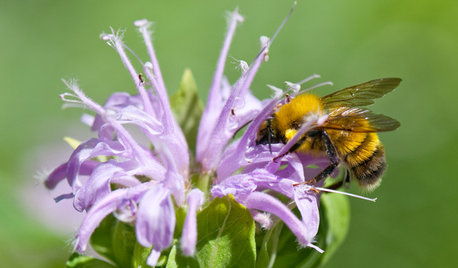
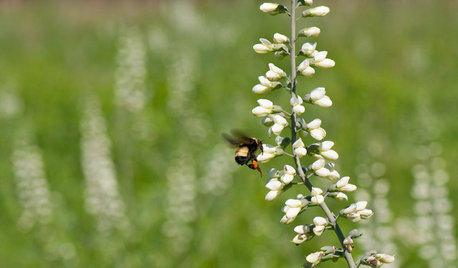
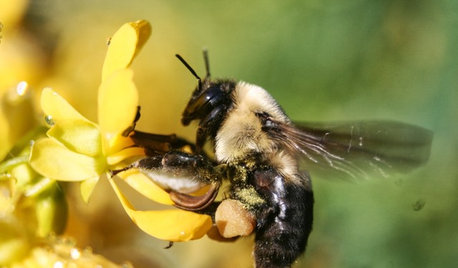
    They are very large, black and yellow striped bees. The kind that hover while they look you over and seem to be guarding something. I called them bumblebees cause that's what they looked like when I searched.

    American Bumblebee Bombus pennsylvanicus
    {{gwi:60692}}

    {{gwi:60694}}

    Thoughts?
    Gumby_CT

  • 19 years ago

    Yep, looks like a bumble bee. I do not think that a bag of leaves and grass clippings would be their first choice of a home. Their sting is also painful.

    I still think that to dress in protective clothing as well as possible run water in the bag to flood it, and dump the bag out at night might be your best bet if you do not want to call an exterminator or bee person. Bee people are usually only interested in Honey Bees which they can probably get the queen and move the whole bunch. Keep us posted. Someone else may have a better suggestion. Smoke will affect honey bees and make them less aggressive, but I do not know if that will work on Bumble Bees, or not.
    Bill P.

  • 19 years ago

    Is it me or are these things just outright cute?

    Clock

  • 19 years ago

    If they are inside the bag maybe you can just sneak up at night and close the bag and move it. Like the lady says, anything that is doing the pollenating needs to be left alone.
    Just my 2 Cents W

  • 19 years ago

    Hehe, I am picturing this poor guy dressed as the Hamburgler sneaking up on the bag in the middle of the night, just as the cops respond to his neighbor's 911 call about some lurking gestalt near their fence...

    Clock

  • 19 years ago

    The bag was torn open when I moved it. The nest is now exposed and you can see the bees walking on the surface of the clippings. No I won't be putting the bag back over it, for any reason ;-)

  • 19 years ago

    If, repeat if, you can remain calm they are quite harmless. I had some in a raised bed and worked beside them. I was weeding and they were doing their thing. Several seasons. No problems.

  • 19 years ago

    Who's afraid of a little bumblebee?

  • 19 years ago

    Or a few cuke beetles, or squash bugs, or the SVB?
    Just so you know these bees are the size of hummingbirds with a nasty sting. Do yours sting?

    Tho I have not noticed any shortage of pollinators yet, I will likely leave well enuff alone. They do seem quite docile just nosey & scary when they buzz by you.

    Through the years I have never had any problem because the bees are just busy working (doing the Lords work) and have not yet bothered me while working in the garden. I have seen bumblebees around in previous years but had no idea where they nested. This year & last I had thought they were up on the roof somewhere cuz I see them there often. There is likely another nest somewhere cuz I don't really see all that many walking on or leaving this nest.

    This bag was new (OPL's) & just placed there last fall. The nest is now fully exposed but I will keep an eye on them.

    Thanks for the thoughts and kind words.
    Gumby_CT

  • 19 years ago

    Here is more info from from Iowa State. The link is below.


    "Bumble bees are big, fuzzy insects recognized by almost everyone by their robust shape and black and yellow coloration. The common species are 3/4 inch in length or more. Like honey bees, bumble bees live in a colony where the adults care for the young (larvae) produced by a single queen. Bumble bee nests are small compared to honey bees, as each nest contains only a few hundred individuals. Also, unlike honey bees, a bumble bee nest is annual and is used only one year and then abandoned. Bumble bees may re-appear in the same area from one year to the next but they do not reuse an old nest. Bumble bee colonies are usually underground in a deserted mouse or bird nest though they are occasionally found within wall cavities or even in the clothes drier vent.

    In the spring, each new queen selects a nest site and starts a new colony. She lines the cavity with dry grass or moss and then collects pollen and nectar to produce a stored food called "bee bread." Her first brood of offspring, (5 to 20), will all be workers (daughters) who take over the colony responsibilities of nest enlargement, food gathering and storage, and feeding and caring for the larvae. The queen continues to lay eggs throughout the summer. By late summer, new reproductive males and females (kings and queens) are produced. These mate on the wing and the fertilized females move to hibernation sites in the shelter of loose bark, hollow trees or other dry, protected places to lie dormant through the winter. The males and workers still in the colony die with frost or the first hard freeze.

    If the vicinity of a bumble bee nest can be avoided, then leave them alone and wait for them to die in the fall as the preferred "management" option. Live-trapping bumble bees for relocation is not practical and covering the nest entrance does not usually solve the problem." http://www.ipm.iastate.edu/ipm/iiin/bbumbleb.html

    Here is a link that might be useful: Bumble Bees

  • 19 years ago

    This is a good spot to identify bugs and learn about them.

    Here is a link that might be useful: What's that Bug

  • 19 years ago

    It looks like they are gone from where they were, now do I have to worry about where they moved to? Another lawn/leaf bag? Which I still have many of.

    I think spraying them with water (before I posted) a couple nights followed by a couple heavy rainstorms made the clippings wet enough they up & went.

    I noticed I hadn't seen them in a couple days, so I went and poked around with a loooong stick, no sign of the bees, who had been just milling around on the surface of the grass clippings.
    Thanks,
    Gumby_CT

  • 19 years ago

    Just so you know, you can buy or make "bee houses" for bumblebees. The most common design I've seen is a coffee can with the lid off, holes drilled all over the bottom, holes drilled in one side bottom, windowscreen covering the top except for a hole that's to small for birds, and "nesting" material (anything soft and fluffy that won't catch their legs or irritate them) in the can. You then mount the can sideways -- the can bottom toward a wall or tree, the windowscreen facing away from what you mount it to, and the holes on the side of the can toward the bottom.

    The main thing that the bees want is somewhere dry (so disease won't spread) and sheltered (so they feel that they could defend if if they needed to), with good ventilation.

  • 19 years ago

    Thanks Karen but I had a bit of trouble following the description.

    I am not opposed to setting bees up, in fact I have 2 butterfly houses (in the graden) they usually set up in and an old mailbox out by the compost.

  • 19 years ago

    It is great to have bumbles in residence-but not where you might accidentally tease them. Bumbles sting as well as bite. DH accidentally got attacked while cleaning a horse waterer that was set on blocks.

    I adore them in the blueberries-along with the mason bees-and found they have a nest under some cardboard that I set between rows of new plantings this spring...all I need now is some yellow tape-crime scene or construction.

    In the spring (before our major 5 day freeze), I moved slowly and weeded the blueberries amidst hundred of bumbles. I have a bee sting allergy-and a great respect for these wonderful creatures. Plan to make both bumble and mason houses for next year...great plan Karenrei.
    cella jane