Software
Houzz Logo Print
anney_gw

What caterpillar is this?

16 years ago

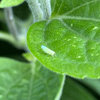
This guy was chomping away on my Fortex pole bean leaves, and I saw a beige moth with symmetrical brown markings on the wings fluttering among the leaves not too far away. If I can get an ID on the caterpillar, maybe I can ID the moth, too.

The caterpillar is perhaps a looper of some kind.

{{gwi:64975}}

I have Bt if I find more than a couple of them.

Comments (13)

  • 16 years ago

    I've never seen one like this. It's actually quite pretty with that color and those markings, but I sure don't know what it likes about my beans. It's beige or pale tan with what look like purple-brown markings on the bottom margin of the wings. If it wants to lay eggs among my beans, I'd like to know if it's a pest or beneficial.

    {{gwi:64976}}

  • 16 years ago

    It's too large for Bt to work. That stuff works only if the critter is half grown or less.

    Further, doesn't really matter which caterpillar it is. It's a leafeater. kill it- physically. Step on it or drop into soapy water.

    If you're into garden science, keep it in a covered container, feed it, and allow it to complete its life cycle. When the adult moth emerges, post that image. It's sometimes easier to ID the adult moth than the caterpillar. Then you'll know who the adult is.

    PS: the moth you photographed isn't the parent.

  • 16 years ago

    jean

    I put this one in the driveway for the birds, but I may do that save-and-feed and let it become a moth to ID the next one.

    As a last resort, maybe I can find an entymologist at the U of GA who would be willing to ID the moth via email and the photo. I'm still going to look online for an ID, first, and maybe someone here will know just what it is. You never know!

  • 16 years ago

    You could try the pests or butterfly forum too...

  • 16 years ago

    It's too large for Bt to work. That stuff works only if the critter is half grown or less.

    Really? The first year I got tomato hornworms I didn't Bt them until they were monster-sized. The next day there were disgusting monster-sized CORPSES hanging off my tomato plants. It was weird that when they died, the back legs stayed attached to the plant. Pretty macabre, really.

    Further, doesn't really matter which caterpillar it is. It's a leafeater. kill it

    My sister was awful sad when I told her those worms that were all over her parsley that she squished were swallowtail butterflies.

    Anyway, I may be a big softie (or maybe just a wildlife geek), but I don't usually go into KILL MODE unless a bug is proven to be harmful. Have even left some caterpillars alone when there weren't many of them so they didn't do much damage to the plant (tomato hornworms are different since those guys can EAT).

    Anney, you're on the right track trying to ID it, especially if it isn't doing much damage to the beans (but again, I'm a wildlife geek, so I'm biased). If it is doing a lot of damage then go ahead and Bt it, but it's still interesting to find out what they are.

    Unfortunately, I'm no good at identifying plain green caterpillars like that, so I can't really help you specifically. :-/

    Trying the university might help, especially if they have an agriculture department. My former boss when I worked for parks and wildlife had a really good field guide for butterflies and moths that had both the adult and the caterpillar. It was amazing what pretty butterflies came out of such UGLY caterpillars (or vice-versa, some really bizarre looking caterpillars turn into the most boring brown moths). I really need to hunt down that book and buy a copy for myself.

    Maybe you can try your library or bookstore and see if they have a similar guide. There are a lot of buttefly guides that just have the adults, but I like to see the whole story.

  • 16 years ago

    instar8

    Great idea! I posted the moth picture on the butterfly forum, thinking maybe they might be able to ID it.

    neohippie

    I'm a wildlife geek, too, and let those terrific caterpillars on my parsley keep on eating until they spun cocoons. They really don't eat that much.

    Hornworms on tomatoes are a different story, as you say. If I have to dispatch them, I'd rather toss them out where they can be recycled, where birds will eat them!

    One of the most exciting miniature garden dramas I ever saw was one of those tiny predator wasps trying to get to a hornworm to lay its eggs on it. The hornworm was battling for its life, rearing up and whipping-twisting back and forth to avoid the wasp's attack. It went on for several minutes before I left so I didn't see the end of the action. That's when I realized hornworms are not passively ignorant of the risk those tiny wasps are to their well-being!

  • 16 years ago

    Well, I don't think my extension service is staffed with very knowledgeable people. Here's the email I received back from the office I emailed today:
    The caterpillar is either a forge looper or a corn earworm (yes, it is found on beans). Catepilars can be controlled with 5%spinosad mixed 2 oz to 1 gal of water. There is a 3 day waiting period between spray and harvest. The moth is associated with either caterpillar.

    That moth is absolutely NOT the moth form of either loopers or corn earworms. I think the caterpillar is a looper of some kind but not a corn earworm.

    Tomorrow I may ask the person at the extension service who emailed me to send pictures of the corn earworm or forage looper she says the caterpillar is, along with a picture of the moth that "accompanies" either caterpillar.

  • 16 years ago

    Jean,
    Do you live in Athens? I do. Care to swap a few days of organic garden care this summer? I'm looking for help tending to my garden for a couple of trips I have planned. I'd be glad to offer the same! Just a long shot! :) Ally

  • 16 years ago

    Btw, I meant to say, I found two different kinds of caterpillars in my garden today. Grrr. I killed them (sad!:-(), but I just wonder how many more there are. I haven't seen a green one like that in my veggie garden, however, I have seen them on some of my flowers. I'm not sure what kind they are.

  • 16 years ago

    Ah! Here it is, a lace-border moth. The pupa is an inchworm.

    Instar8, thanks again for the suggestion to take it to the butterfly forum. A couple of people there IDed it.

    I suppose it could be a pest if I had lots of them, but with a sighting of just one moth and one caterpillar, I'll keep an eye out but won't pull out the Bt yet and will hand-pick any that I find.

  • 16 years ago

    My thinking is this: lots or random insects accidentally end up in the veg garden, including weird life forms blown from the trees. I am not in charge of them. I do not need to know them all. I do know the problem species, very well!

    To counteract the randomness, we have lots of bird perches / trellises everywhere, and it's amazing to watch the robins work over the garden every morning, nabbing everything that moves.

    We use lots of row covers and now and then I'll use spinosad, but mostly wild birds are the pest control ticket for us.

  • 16 years ago

    Looks like it is pretty common in Missouri. Interesting that you found the moth so far away from it's usual home.

    planatus, i have a bird bath in my vegetable garden to attract the bug patrol. Mostly they poop on my veggies and poke holes in my tomatoes but i like to pretend that they eat a few insects too ; )

  • 16 years ago

    MR

    I'd certainly never seen a moth like that on my beans before, that's for sure. And maybe never a caterpillar like that either. They must be migrating East!

    At any rate, I was glad to get an ID on it. It really is a pretty little insect, even if it is a pest.