Software
Houzz Logo Print
wild_forager

Persimmon leaf problem

18 years ago

I'm beginning to see signs of a problem with my persimmon leaves that I had last year. By the time the leaves get about 3/4 inches long the tips turn brown and that stays with the lea until it is mature, causing the leaf to curl and look funky. About half of the budding leaves have this now. Not all of them. Last year some of them made it almost to maturity before they began to have the same problem.

I figured it was an overwatering issue last year, and I still think that might be the case. The container holds alot of water though it ha good drainage and the tree seems to use very little. It rained for about a week a few weeks ago and I'm worried that it got overwatered again.

Could this be something else? Like a disease or nutrient deficiency? It's only a few millimeters of the the tip that have turned brown. And it doesn't really do much to the rest of the leaf through it's life.

Comments (15)

  • 18 years ago

    http://ressources.ciheam.org/om/pdf/a58/03600154.pdf

    This is the only thing I can find that resemles what I am describing. Otherwise I can't find anything like this. But the symptoms are identical, aside from fruit production since the tree is only a year old and I haven't had any fruits yet.

  • 18 years ago

    I was going to respond yesterday, but I thought I'd wait to see if anyone else did first.

    The link you provided referrs to a disease of loquats, not persimmon. While its possible that the same (or a similar) disease miht affect persimmons, with the number of persimmon grown one would likely see a reference to it somewhere.

    I had a similar problem (though I don't recall browning of leaves overall) with leaves curling and an insect being involved last year. I think I identified the problem as persimmon psylla, and were I you I would search for damage related to p. psylla and see if it matches what you are seeing.

    ~Chills

  • 18 years ago

    I've looked both years for the psylla and found none. Also, I wouldn't think they'd attack leaves so you. Are they prone to attack the young leaves? Maybe I should look harder.

  • 18 years ago

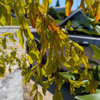
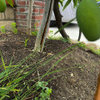
    Ok, I took some pictures.

    This first one is the entire tree (it's small)

    {{gwi:89635}}

    This is a close up of some early damage.

    {{gwi:89636}}

    These are undamaged leaves.

    {{gwi:89637}}

    And these are more advanced leaves that have begun to curl because of the brown tip.

    {{gwi:89638}}

  • 18 years ago

    That looks like some minor frost/freeze damage to me, but overwatering is a definite possibility, considering the description you've given of it occurring later into the season.
    It's not what you'd see with psylla - which I have and see every year, but they don't cause enough damage to my trees that I've even remotely considered taking any steps against 'em.

  • 18 years ago

    Persimmons love Magnesium
    They show deficiencies especially if you add Potassium Fert

  • 18 years ago

    In what would you reccomend I add a supplement? Any specific product in mind?

  • 18 years ago

    It could also be herbicide drift. Definitely not psylla. In any case so little of the leaf surface is involved that I would not call it a major problem at this point.

    Scott

  • 18 years ago

    I was just worried that whatever it is might affect the fruit as well. I guess there's only one way to find out. When I recieved the tree from Florida last year it came with a few green leaves and flowers and the leaves were already fully grown and curled up. So whatever it is it's been with this plant from the start.

  • 18 years ago

    "In what would you recommend I add a supplement? Any specific product in mind?"

    Epsom Salts contain Magnesium Sulphate, MgS04 is very soluble and can be moved around the plant easily, so soil application is a good way to get Mg into your plant.
    MgS04 is easily leeched out of the soil/potting mix so a slower release might be better I think MgCO3 might last longer in the soil.
    In those pots a teaspoon would be more than enough of MgS04

  • 18 years ago

    I don't know about persimmons loving Magnesium(Mg)- that's news to me - but at one time, Manganese(Mn) deficiency was proposed as a possible cause of Kaki Sudden Death Syndrome in kaki(Asian) persimmons grafted onto D.virginiana understock.
    So...I'm wondering if miketrees might have his 'M' micronutrients confused. A tsp. of MgSO4 probably won't hurt a thing, even if Mn is the mineral of concern. Heck, the rose enthusiasts recommend sprinkling a CUP of epsom salts around each hybrid tea rose plant!

  • 18 years ago

    It appears bothe Manganese and Magnesium deficiences can lead to problems. Please see information below for more on Leaf problems caused by Nutirent disorders

    NUTRIENT DISORDERS
    To date, nutrient disorders observed in New Zealand grown persimmons are restricted to deficiencies of Mg, Mn, Ca and Fe; the former two in orchards, the latter common in seedlings grown in planter bags.

    The leaf symptoms for Mg deficiency (Mg Manganese deficiency (Mn Leaves with Ca deficiency (Ca The most severe and widespread disorder however is "Green Blotch", a problem brought about by excess manganese (or inadequate Ca) which creates a Ca/Mn imbalance within the fruit. Although the concentration of Mn in leaves may be elevated (Mn > 1000 ppm) symptoms of the disorder are confined to the fruit only. Indeed, concentrations of Mn as high as 6800 ppm have been observed without symptoms of Mn toxicity being present in leaf tissue. Prominent green blotches appear at the distal end of affected fruit in mid March. If the blotches have not disappeared by harvest, as can occur, the appearance of the fruit makes it unsuitable for export even though the interior flesh remains unaffected.

    Corrective measures, while simple in theory, have not proved to be entirely satisfactory. Increasing the pH to 6.5, particularly at depth, is necessary to both increase Ca, and to decrease the availability of Mn. Alternatively, if the pH is already adequate addition of gypsum (CaSO4) is advocated. Foliar sprays of calcium nitrate applied around fruitset may assist in correcting Green Blotch. At present however the concentration, number of sprays, and their timing is still experimental.

    Here is a link that might be useful: Fertiliser Recommendations

  • 14 years ago

    I have two persimmon trees and I do not even know if they are persimmon. The persimmon tree that I had before (it died, the leaves were thick, shinning like a wax leaves. The two persimmon trees I am having now do not have thick, shinning like wax leaves. I wonder if you have information about persimmon leaves. I like to confirm this information before I dig them up before they are getting too big. Thanks.

  • 14 years ago

    I have problem with my new Giboshi persimmon. On some leaves there are whiter parts, creating tubercles or pimpleur structures? Can it be the symptom of KSDS or some micronutrient defficiency? I am wondering, if it can be sunburning also, I put plant on sunny spot by window.

    Here is the link for picture http://postimage.org/image/6ynto31zl/428a0ec5/

    Here is a link that might be useful: picture leaves

  • 10 years ago

    Hi Indicente,

    I just got 2 new grafted asian persimmons & the leaves look like they have acne, too!

    Did you ever figure out what the problem was with your new giboshi? Did it "outgrow" it?

    I'm worried about putting in my new persimmons, in case they "infect" my other persimmon trees.

    Help!