Software
Houzz Logo Print
bart1_gw

Planting garlic without 'paper' wrapper?

16 years ago

As I separated my garlic cloves from the bulb, some of the "paper" wrappers came off. When this happened, it was only on one side of the clove. Will these still grow?

I planted them anyway as this seemed to happen on the largest cloves, but I'm wondering if that was a mistake.

Thanks,

Bart

Comments (22)

  • 16 years ago
    last modified: 11 years ago

    They're much more likely to rot than those whose wrappers are intact.

  • 16 years ago
    last modified: 11 years ago

    Bart,
    If you didn't plant them, they would certainly not grow! As NYgardener said, the "paper" contains something that helps the bulblet to grow.
    I've had the same thing happen during planting, and planted the almost bare nekkid bulblets anyway. I may have lost a few, but can't really be sure.
    If this is your first time planting garlic, you are in for such a treat in the spring! Home grown garlic is NOTHING like store-bought.

  • 16 years ago
    last modified: 11 years ago

    this may well explain why 100 plus bulbs I planted 2 years ago, NEVER grew. I waited and waited and nada. I wouldn't bet the family dog on it, but I'm pretty sure I took the paper off before planting them. which would explain why they did not ever come up.

    I'm getting garlic this year from a lady in GA who advertised them on the market bulletin. $8 a pound plus shipping she has 6 varieties. Should be here this week, which is perfect as we have just had some good rains and the ground will be nice and soft.

  • 16 years ago
    last modified: 11 years ago

    Well, we have to establish this whether or not those wrappers will mak a difference. To do this, tomorrow I will plant 10 cloves, 5 with and 5 w/out wrappers. This mini experiment should settle the issue. I personally think that there will be no difference if the cloves are planted NOT TOO DEEPLY. Those wrappers are not true bariers for anything,; moisture, insects soil chemistry etc.
    Anyone of you can do a similar experiment and report the findings right here.

    I will report the result of my experiment when became available.
    Cyrus.

  • 16 years ago
    last modified: 11 years ago

    I don't know why, but when I plant garlic or any other bulbs (tulips, daffodils etc) I tend to give them a quick rub to remove any flaky, loose 'wrappers' and leave the healthy layers which are well attached to the bulb. I seem to have a feeling that old dry loose coverings may tend to rot. But it's only a hunch. By the way both my garlic and my flowering bulbs do fine.

  • 16 years ago
    last modified: 11 years ago

    Thanks everyone!

    I have planted garlic many times before and in the past I haven't planted any bulbs without a perfect wrapper, but this year I was a little short so I planted some that were missing part of the wrapper. Unfortunately, I don't know where they are in the bed!

    Cyrus - Please keep us posted on your experiment. It's a great idea. I don't know why I didn't think to plant all the imperfect ones in a row just to see what happens.

    Thanks again,
    Bart

  • 16 years ago
    last modified: 11 years ago

    This is my third year growing garlic. I always remove the 'paper'. The instructions on the website from which I purchased my first garlic for planting specifically recommended soaking the garlic to remove the 'paper'. My garlic is grown in an EarthBox and I have fantastic results.

    This info is on the Gourmet Garlic Gardens website. Preparing the Garlic for Planting and Planting the Garlic

    Garlic is subject to fungal diseases and pest infestations that can be virtually undetectable until they strike. Prevention is the best way to deal with them. In our experience, garlic that is soaked in certain solutions and with the clove covers peeled off have a better chance of growing free of pathogen or pest.

    When your soil is fully ready to be planted, take the bulbs you want to plant and break them apart into their individual cloves (Being sure to keep each variety separate from others. Soak each varieties' cloves in water containing one heaping tablespoon of bicarbonate of soda (baking soda) and liquid seaweed per gallon to protect them from fungus as well as give them an energy boost. Leave the cloves in the soda water overnight or long enough for the clove covers to loosen so the liquid comes into contact with the surfaces of the cloves. Garlics clove covers can contain fungal spores, or conidia or the eggs of pests such as mites and are best discarded rather than planted since the first thing the cloves do is to shed them, anyway. The baking soda helps neutralize the fungi. Commercial growers don't have time to peel cloves bare but gardeners do.

    The cloves should then be soaked in rubbing alcohol or 100 proof vodka for three or four minutes and then planted immediately. The alcohol kills pests and pest eggs and any pathogens the first soaking missed. Every time I have done this, the treated garlic turned out better than the untreated control group. Alcohols are on the National Organic Program accepted list and baking soda is accepted under part 205.605.

    Here in central Texas, we plant about 2 to 3 inches deep, with larger varieties going a little deeper in the ground than the smaller varieties. We put them in by hand so we can be sure each clove is properly bedded down. It's a lot of work on our hands and knees, but it's the best way to get the best results. Garlic does not lend itself well to automated planting technology due to the irregular size and shape differences in the cloves. Our beds are 6 in. high and 24 in. wide, we drip irrigate with T-Tapes and cover all with a 3 inch deep mulch to protect from weeds and to hold in the soil moisture, more to act as a barrier to direct sunlight on the soil than for temperature protection. Garlic survives cold quite well as it was designed by nature to grow in the fall, rest in the winter and bulb out in the late spring or early to mid-summer.

    Across the northern tier of states garlics leaves do not usually emerge from the ground until spring, although in a warm winter, they will emerge an grow in the winter just as they do in the South or in California. Garlic loves the cold weather but it can be frozen out if the temp drops 10 or 20 below zero-F and stays there for a couple of weeks, but it is rare. During those times when we actually get snow down here, it's a beautiful sight to see all those lush deep green spearlike leaves shooting up abruptly out out of the stark white snow. When you walk out to make sure they're OK, you can almost hear them laughing and frolicking in the snow and singing their song of joy. The garlics allow the grower to join the party, but no one else - it's a private family affair. (((end of quote from GG)

    Link below.

    DL

    Here is a link that might be useful: Gourmet Garlic Gardens Planting Info

  • 16 years ago
    last modified: 11 years ago

    I'm all for a scientific experiment. I was told to leave the wrapper on by my gardening elders and never tried planting without. I figured it gave the clove some "breathing room" from direct contact with wet soil (ours is quite clay-ey) until the clove sprouted.

    Here is another account from a gardener who peels and treats her cloves before planting.

  • 16 years ago
    last modified: 11 years ago

    I've done it both ways and have never noticed any difference except for the extra work involved in removing all the paper. I used to remove it before soaking in 5% bleach solution but a garden buddy never did. I've decided to skip the extra work. I started growing garlic 35 years ago and got serious about it 25 years ago. I only plant 80-100 cloves, my friend plants 3x as many. His garlic are bigger than mine but mine are bigger than many I saw for sale at the local garlic festival.

    I suspect it's something else that is preventing germination.

  • 16 years ago
    last modified: 11 years ago

    Bart, as I said, I planted 5-6 cloves with and 5-6 cloves without wrappers the following day. Unfotunately the temperatures have gotten way down here(low 40s-mid 30s at night) and it will take longer to see them to GROW/OR NOT TO GROW.
    i WILL KEEP YOU POSTED, for sure.
    I pesonally though think that wrapper should be advantageous but that is just an opinion. The garlic wrapper serves as a retainer for keeping moisture in and prevent from drying out. with a moist soil and cool weather I do not see any role for the wrapper to play. But we shall see how wrong or right I am.

    cyrus

  • 16 years ago
    last modified: 11 years ago

    As long as the basal plate is in good shape, it shouldn't matter too much. If rot becomes an issue, just raise the bed soil level somehow or try fusarium-resistant strains. Most bulbs don't like continuously wet soils. I'm planting it like crazy right now, but I'm too lazy to try all that in dancinglemons' post.

  • 16 years ago
    last modified: 11 years ago

    Thank you Cyrus,

    There is a difference in what ya'll are calling the paper and the clove wrapper itself. Leaving the clove wrapper on probably does protect the clove a little from attack if there is any little critter in the soil. I have planted a few cloves over the years both wrapper on and off...they all came up.I don't worry about all that anymore, I don't have time to peel each one down before planting and I personally thing leaving it intact is a good thing.

  • 16 years ago
    last modified: 11 years ago

    Bluesqual.
    You are right. the paper is the one that wraps all cloves.
    What we have been talking about meant "clove wrapper.

    Right again. Wrapper can be benefitial. So why bother to peel it off. It is even difficult to to peel them off when you want to use cloves in cooking. I am 100% with you; leaving clove wrapper is the logical thing to do. I just did this experiment to verify that planting with or w/out wrapper does not make significan differece.

    Cyrus

  • 16 years ago
    last modified: 11 years ago

    Just a little tidbit here from something I noticed. I was out poking around in a section I planted 5 days ago, I dug up one chesnok clove to find the roots growing already. The interesting part is that clove had half of the wrapper taken off down by the basal plate and the roots on the removed side were three times longer than the cover side.

  • 16 years ago
    last modified: 11 years ago

    wouldnt it be reasonable to assume that once the paper/wrapper has deteriorated, that the roots will catch up?

    I got my order from the lady in Ga and the instruction sheet's they suggest (indicated as optional) to remove the outer shell or paper and plant the "naked" bulb

    they also suggest (again optional, but worth the trouble) to soak the cloves in a solution consisting of a gallon of water, 1 tbsp of fish emulsion, 1 tbsp of bicarbonate of soda and 1 tbsp of molasses (to promote root growth) and/or 1 tbsp of vinegar (states this kills microbes carrying fungus or disease).

    Finally it says (again optional) to place cloves in rubbing alcohol for NOT MORE than 5 minutes just before planting...

    any thoughts?

  • 16 years ago
    last modified: 11 years ago

    Rjiga, do some experiment for yourself and observe the results. I think that planing with or w/out wrapper will not make significant difference. The flesh in the clove is the food for the ambrio to get nutrient from it and grow roots. The roots then will get nutrients from the medium.
    After the roota grab on the soil then it does not make any difference as how you planted them. The genetic program and the growing conditions will be the detemining factors.

  • 4 years ago


  • 4 years ago

    I grow several types of garlic, and the only type which commonly has loose clove skins is rocambole. That may contribute to their poor storage life. I normally plant only the cloves with intact skins; but when I received 2 new rocambole garlic varieties last year, I couldn't afford to waste any cloves, and planted even those with damaged/missing skins. All of the cloves came up the next year.


    I should mention that rocambole garlics have one more troublesome trait: the tendency to frequently form double - or even triple - cloves within a single large skin. You can verify this by examining the basal plate of the clove for divisions. If those over-sized cloves are planted as-is, they will form a cluster of small bulbs, rather than a single large bulb. If the cloves are loose beneath the skin, they can be separated & planted as naked cloves; if joined together, they are best used for food.

  • 4 years ago
    last modified: 4 years ago

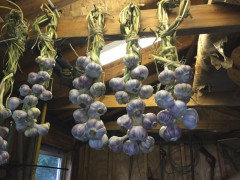
    Been planting the same garlic for 74 years it frist came from italy in 1947 the year i was born and my dad planted it taught me how when he passed i keepet up the tradition gave some to my cousin in illinoise now that same strain is growing in two parts of this country. l l know that garlic was grown for many years in italy . we don’t do anything special we prepair the soil like for anyother crop seperate the cloves paper on or off never noticed 3 inches deep cover with soil and harvest on july 4 let dry for a few days braid and hang in the shed


    . they are a hard neck and the scapes make slades even better

  • 4 years ago

    Very nice harvest, Ermio.

  • 4 years ago

    I’m in the peeling camp.


    Peeling is tedious and requires care to not damage the cloves, but allows you to see what condition the cloves are really in. I had to discard quite a few cloves of seed garlic this year because of spots. In most cases the damage wasn’t apparent until I peeled off the clove wrappers.


    i realize folks who make big plantings may not have the time to peel.


    Also, the clove wrappers may serve more of a purpose in northern gardens, where the garlic “sleeps” for the winter. But down here in North Florida garlic starts growing immediately after planting, and actively grows all winter. Since the garlic breaks out of the clove wrappers immediately, they are not offering much (if any) protection.


    Also, since I have so little winter, I vernalize my seed garlic in the fridge for several weeks before planting. Many of the cloves have started to sprout and have broken open their clove wrappers by the time I take them out of the fridge for planting.