Software
Houzz Logo Print
misterpatrick

New Garden - Row Width

15 years ago

Hello all,

just got a new house this year and I rehabbed an old garden and it did really really well. So the past few weeks I've been expanding the garden. It now has 2 x 12 beds and I just got 4 cubic yards of soil brought in. The total size of the garden is now 24' x 24'. Tomorrow I'll be shredding and mulching in all the oak leaves covering the yard and moving the new soil to the garden.

I'd like to establish the rows now before the snow falls so I can cover everything with straw and have an easier time with things in the spring. I do have a rototiller so this is making things go pretty quickly.

Here's my big question now. I am mostly going to be growing tomatoes along with some summer squash, peppers, Brussel sprouts, some beans and peas and lots of lettuces, greens and herbs. Tomatoes will definitely be taking up most of the space. I am trying to figure out good row and path widths. From what I've read it looks like 3' is a good path width, but what about for the various vegetables? For example, how wide should I go with tomatoes since they tend to sprawl and other than basil I'm not sure what I could actually have share a wide row with the tomato plants. So maybe 2' for tomatoes and 4' for greens and lettuces? Maybe 2' for trellised squash, beans and peas?

Just looking for some ideas as I draft everything out on paper.

Also, any other tips for preparing the garden? I started to transplant the sod from the new expansion of the garden but that got old real quick, so I just tilled everything into the soil. I was thinking of just throwing in some bonemeal, the mulched leaves along with all the new garden soil and calling it a day. I'm figured covering the whole deal with straw over winter and then black plastic in the early spring should help keep existing weeds and grass from sprouting. Anything else to recommend?

We've got nice and dry weather this weekend so I'm hoping to get a lot done.

Thanks for any and all tips!

Comments (19)

  • 15 years ago

    Get a soil test done before the ground freezes so you can make any needed additions next spring.

  • 15 years ago

    You can save a lot of space with tomatoes by caging them.

  • 15 years ago

    Thanks for the tips. I do cage my tomatoes, but this year, they were huge even with cages. A couple of my plants were close to five feet high and almost all of my plants were great producers. But should I go wider with the tomatoes or stick to something like 2'?

  • 15 years ago

    Grow your tomatoes on the outside edge as they are a space hog on both sides of their row. Keep unplanted paths to 12 inches wide and utilize the soil for veggies.

  • 15 years ago

    Do a search on pruning tomatoes. Lots of folks do it and I never had till this year. Works well, we grow San Marzano's and they'll eat all available space and then some, caged or not.

    Good Luck,

    Ev

  • 15 years ago

    I'm a little confused about your overall garden design. You talk about raised beds. Are these enclosed with edging or are they soil you have piled up? You talk about rows, though, too. And paths. Typically, raised beds are planted a la Square Foot Garden style (french intensive method). The plants are put into the beds with minimal spacing, and the beds are surrounded by 3 foot wide paths. The gardener never walks into the bed. You stand on the path and reach into the garden to plant, weed, harvest, etc. Therefore you use less space for maximum yields.

    Rowed gardens have to have enough space for the gardener to move among the plants without doing damage. Most seed packets will tell you how much row space each crop needs. Don't scrimp on it or picking and weeding will be very difficult. Farmers make very wide rows so they can get a tractor (or tiller) in to cultivate without doing damage to the plants. You have to know how much space you need for this and plant accordingly.

    This is not to say, though, that you cannot do a combination of the traditional row garden and french intensive. Is that your idea?

    I would highly advise you to go with three foot paths between raised beds or block plantings. This is the minimum space you can get a wheelbarrow through. At the height of summer, you may have some plants sprawling into the path, but it's best to allow them enough space in their row or bed so that sprawling is minimal.

    Now, the tomatoes. Even if you are caging and planting them in raised beds, you will need at least 2 feet between plants and four feet of width in the bed (assuming a single row of plants within the bed). The type of tomato you plant will make a difference too. Determinates typically need less space. They grow to a certain size, flower, fruit, and are pretty well done. You might get away with 3 feet of width in the bed with 2 feet between the plants. Indeterminates and some cherries will need the full 4 feet of width, with a 3 to 4 foot spacing between the plants to get best results. For edging, you could try lettuce, onions, carrots, basil, etc. In other words, small plants that won't mind being shaded by the tomatoes part of the day. Marigolds are often planted at tomato feet to ward off pests like nematodes.

    It sounds like you are doing a good job of thinking your plan through, and you have good soil to work with. That's a big plus! I would caution you about one thing. That grass you are tilling into your new area is going to want to sprout, grow, and run again come spring. Once your tilling is done, I would advise you to cover the entire area with cardboard or ten sheet thicknesses of newspaper and leave it on at least throughout the winter. To be sure, I just might cut small holes in it and sow seeds in the holes come spring. Fighting grass among veggies is no fun.

  • 15 years ago

    Thanks for the great responses. This is my first garden so I'll try being a little clearer. The garden I did last year was done with rows with narrow paths between them covered in straw. This year, I reshaped the garden slightly by eliminating the section that was getting a bit too much shade and did not produce well and then extended it out another twelve feet. Then I surrounded the entire garden with 2" x 12' x 12' boards sunk in a several inches on the higher end of the garden,and only a bit on the lower end. I mulched lots and lots of oak leaves this morning and have started moving the new top soil into the garden.

    One reason I the garden with boards is it will make it easier to set up my poultry wire fence in the spring as I live near a nature preserve and abut a park so there are alot of critter around here. Last year a combination of the pountry wire, an electric wire, blood meal and marigolds kept all the critters away so I'll repeat that next year but will be able to keep things a little tidier with the walls.

    The plan is to create high rows with paths between them. I don't really need to get a wheelbarrow in the garden as I usually just use a basket which is why I was thinking two feet for the paths.

    So I'm not sure what this type of garden is. The beds are rows and the entire garden is slightly higher than the surrounding yard, so maybe a hybrid raised bed french awesome kitchen garden. Who knows.

    I was going to lay out rows tomorrow. I'm sure I'll have to clean them up in the spring, but it'd be nice to get things sorted out a bit while the soil is still easy to work with.

  • 15 years ago

    misterpatrick,

    If your garden is one solid 24ft. x 24ft., You can make narrow paths of one foot wide...throwing the soil on the beds between the paths. Most like 3 or 4 ft. wide beds so you can have 5 "raised" parallel beds in your enclosed area. You don't need boards inside your outer enclosure. Save as much room as possible for planting.

  • 15 years ago

    i like 30" wide beds and 18" wide paths between. i can reach the whole width of the bed from one side. some of my beds have 12" between which is kind of tight.

  • 15 years ago

    I use much wider beds myself and I am not afraid to step on the beds some.

  • 15 years ago

    I think your garden looks great. I use wood chips from a tree service between my growing rows as they last longer than straw. My raised beds are 16x16 boxes which allows for 39" growing rows and 12" walking rows. There are 4 grow rows and three walk rows. The dimensions are based on 8' lengths of lumber which is less expensive than 10' or 12' lengths. I plant large plants in the middle of the grow rows and small plant on the outside of the grow rows. By the time the large plants take over the space the small plants have been harvested. I also plant gaglic and onions any where I can throughout the rows as I feel the nematodes and moles do no like the garlic and onion roots, which may or may not be true.

    I use concrete wire for my tomatoe cages. the cages are abot 30 ' in diameter and the plants are 3' apart. I prune the suckers off and keep the vine trimmed fairly close to the cage. Next year I will stop the growth at 6' as my plants were all together about ten feet long this year. I get two harvests from the same plants. The first ends in july. The second starts in November and ends about mid december. The green tomatoes I wrap in newspaper and store them in crates in the garage and I have red tomatoes into March when I plant again.

    Your beds and rows look great and you should have no trouble with whatever you plant. My growing rows are a little wider than yours and my walk paths are narrower which maybe gives me a little more growing room but what the hey you will eat well. I will build bird netting supports over my tomatoes this year. I put yellow bowels with soapy water between the cages. The yellow attracts bugs and the soapy water gets them. It is amazing what flies, crawls and slithers into the yellow bowels.

  • 15 years ago

    That looks great! I'd worry more about the summer squash sprawling out of bounds than the tomatoes, though.

  • 15 years ago

    Those beds look good and healthy. I designed my beds to be 30" wide with 6" slopes down to the walking paths which are 18" wide. I can just get my wheelbarrow down the rows and also step over my beds.
    For small, tight spaced stuff like carrots, lettuce, beets, and bush beans I have thought of making wider beds to get more yield. For the bigger stuff that is single spaced I have thought of making more narrow rows, but then again the plant roots probably appreciate the wider growing area. The key for me is to make them "work friendly."

  • 15 years ago

    Your beds look good. But you should take out the (acid) oak leaves if most of your plants are going to be tomatoes.

  • 15 years ago

    That is a very nice looking design. The soil looks extremely well worked and in great shape. Lots of work, but it will pay dividends! The width of your rows is going to strictly depend on your preferences and the type of crops you plant. Lettuce, greens, onions, even snap peas can go with quite narrow rows, especially if you're a "stooper" or "bender" when you harvest. If you're a hands and kneees person, I'd go a minimum of two feet wide, but again, it's up to you.

    As stated above, vining crops (cucumbers, melons, and squash, in particular) are going to wander, and if your rows are narrow, there won't be much space for you to stand, bend, stoop, or kneel in them without doing harm to the crops. However, if you plant bush varieties, and don't mind playing Twister as you pick or weed, you can do just fine with eighteen inches. Personally, I am a kneeler, and am fast approaching sixty. I like some space.

    The advantage you have is you don't have walls or edges. So, if next year, you want to re-space things, it won't be very difficult to do at all.

  • 10 years ago

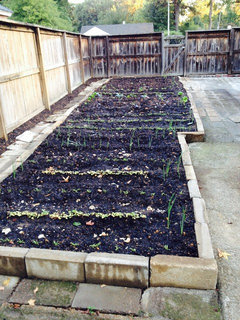
    All comments so helpful. I'm a first timer with my garden. Shared one with family awhile back but didn't do any of the planning. Now I have an 8' x 36' space. I want all organic and mainly tomatoes, peas, cucumbers, squash and peppers. Beds are now prepared for winter. Looking for companion plants for these? row and bed widths? and/ or planting style ideas? Picture from earlier in the fall.


    Approx. 1/3 of the garden is partial sun about 4 hrs early morning and not sure what to plant there.

  • 10 years ago
    last modified: 10 years ago

    "Approx. 1/3 of the garden is partial sun about 4 hrs early morning and not sure what to plant there."

    What does it have the rest of the day? Full shade, sun?

    What is the width at the near end of the pic. It looks like it bumps out... is that where it become 8' wide?

    At first glance I think I would run boards or some sort of stepping stones across the width and break it up into 4' x 8' beds. That though would depend on the course of the sun. Where is E., and where is S.?

    I don't know your neighborhood, or the reasons it's there, but if the fence is causing shade you cut down the height. .

  • 10 years ago

    First of all, think about the width of your paths and the future. I started with 1 8x8 box (before finding this forum and researching!) I now have 4 3x8s (I split the 8x8) , 2 3x6s and 2 3x3s plus a few raised up beds in another part of the yard! Because we didn't plan into the future, it is very difficult maneuvering wheelbarrows of compost, soil etc around the beds without stepping into the other beds to do that!

    Also, be sure to research your herbs before planting! Some, like basil will die at the first frost. Some in our area are perennials and turn into bushes (rosemary). I planted one of the 3x3 beds many years ago with herbs, willy nilly, not knowing what was what. They all grew together and I didn't know what anything was (I do now) I still have lemon verbena in that bed and it is popping up in another!

    Most of my herbs have been moved to a potted herb garden in order to keep them under control! Nancy