Software
Houzz Logo Print
caterwallin

Help with Red Beets

14 years ago

I tried to grow red beets the past 3 years and I have trouble getting them to grow. I know that our soil is clay and all 3 years I added compost to the soil (peat moss, leaves, and sand) to make it looser for the root crops. It's nice and loose, but year after year I have to replant a few times and then the ones that I do end up with aren't very big. I've tried Detroit Dark Red and Early Wonder and have the same problem with both kinds..plant, replant, replant, small to medium sized (at best) beets. I feel like I have to cover up the beets when they're growing because the biggest part of them ends up growing on top of the ground. Is this normal?

Cathy

Comments (15)

  • 14 years ago

    Big tops with small roots is usually a sign of too much nitrogen in the soil. Root development needs potassium and some phosphorous (which most soil has plenty of naturally) but excessive nitrogen gives you big bushy tops and small roots.

    Soil pH can be another problem. If out of whack due to lots of acidic additives then the nutrients in the soil are bound up and unavailable to the plants.

    And there is no need, nor any recommendation for "covering" them. The majority of the beet root develops above the soil level so make sure you aren't planting them too deep.

    Hope this helps.

    Dave

  • 14 years ago

    Do you mean big greens or the roots are above the soil?

  • 14 years ago

    Hi Cathy,
    Beets are fickle for me too, rarely get over 2" in diameter which is average. But this year was pretty good. I was at Montecello last summer and saw how Jefferson planted his so tried it out (for the fall crop). His were planted in 2 narrow rows down a wide row. In the past I'd just seed them haphazard down the wide row but they always got too crowded later on, even after thinning. Jefferson's 2 single lines of beets in a wide row helped them expand better. Since you are in Z-6 you may be limited to a spring crop? Do you incorporate any fertilizers other than what you listed? I find that organic ones work best for me and I use lots of homemade compost (mostly grass clipping, leaves, kitchen scraps, etc) but still amend the soil with one of the more balanced organic blends around 5-5-5 or so. Till it in 2 weeks prior to seeding. Hope that helps!

  • 14 years ago

    Dave, Then it sounds like I have too much nitrogen in the soil. They do have big tops and small roots. I'll have to hunt for something with potassium and phosphorus. I thought that the fertilizer that I used had that, but I don't know how much. Aren't those the numbers after the nitrogen number on a bag of fertilizer? I actually don't know organic fertilizer from inorganic, but I'd rather go with organic if possible. Now, I wonder how I'd have gotten all of that excess nitrogen?? I don't remember what the bag said that my dad gave me. Hmmm...I don't know our soil pH and don't have money to have it tested. Okay, no covering of roots then.

    tracydr, I have big greens and small roots (some are medium, but none are big), and mostly everything is above the soil except for the long root that goes down into the soil and a tiny bit of the red beet(edible part).

    vgkg, Yes, I'm limited to one crop a year unfortunately. By the time I get done replanting, half the summer is over. I think I must plant similarly to Jefferson's place because I plant small rows in a wide row, only I have four. The whole space is probably about a yard across and within that space I put 4 rows of red beets. I did it basically to save space.

    I've tried fertilizing and not fertilizing and I think the results are basically the same either way. Is there a special place where you get your organic fertilizer? I don't think any of the ones that I've used are. My dad gave me a bag this past year, but I don't know the proportions (i.e. nitrogen, etc.). I'll try to look for 5-5-5 this coming spring, only maybe mine should be 0-5-5. lol

    Thanks everyone for your help!
    Cathy

  • 14 years ago

    Beets are not that difficult, but you certainly do not want to cover the roots. They prefer a neutral soil and they do not like to be crowded. They need about 3 inches on all sides. They are not heavy feeders, but balanced amendment approching an NPK ration of 1-2-2 would be optimal.
    {{gwi:27618}} {{gwi:27620}} {{gwi:27621}} {{gwi:82366}}

  • 14 years ago

    It is almost certainly the pH. The fact that peat is used to top dress further gives it away. Lime or wood ash, and the beets will improve.

  • 14 years ago

    Are you sowing seed or planting out young plants? Over here it is received wisdom that beetroot( or any root crop) doesn't transplant well and should be direct sown. My personal experience is that direct sowings do better and are less likely to bolt before bulbing. But from these forums I know many US gardeners transplant beets so maybe we are just wrong - but it could be a factor worth considering.

  • 14 years ago

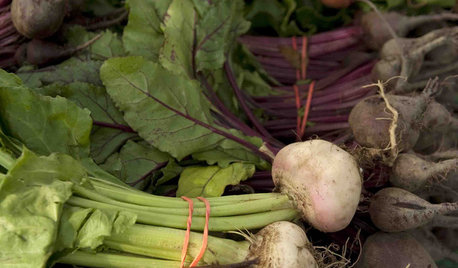
    Oh, those beets look wonderful. That would be a nice batch of roasted beets, now wouldn't it? Along with some fresh cooked beet greens?

  • 14 years ago

    Spacing is important. If you direct seed them don't wait too long to thin them.

    I had success starting mine by soaking the seeds overnight and then growing them in 50-cell flats for 4 to 5 weeks. Beets also like plenty of moisture.

  • 14 years ago

    I added lime to the soil last year because I had read that peat moss would make it more acidic, but I'll add more this year.

    I always direct sow my beet seeds. I never even knew that some people transplant them. They even recommend on the packages to direct sow.

    When I sow the seeds I always space them apart from the beginning how far they should be after thinning (but I don't need to thin). So no problem there, I guess.

  • 14 years ago

    I never ever fertilize beats. They really don't need it, as the soil provides plenty of nutrients for them (as long as you practice proper rotation). If you do fertilize 9 times out of 10 it is going to create problems. Just try it without anything at all, and then decide what changes need to be made. Though I will say, I always dust a little lime anywhere I am growing root crops as it helps them to become sweeter and more tasty (carrots, beets, radishes, and turnips)

  • 14 years ago

    Well, that eliminates the possibility that it's the transplanting which is the problem, Caterwallin.

    Beet 'seeds' are not single seeds but a cluster of seeds, so even if you space the clusters well apart, they will produce a clump of seedlings and still need thinning. (Unless you are using one of the mono-germ beets like 'Moneta')

  • 14 years ago

    Cathy, espoma products are my preferred organic fertilizer, generally these are naturally slow release and I use the one below for most crops. It can be found at most garden centers.

    Here is a link that might be useful: {{gwi:133735}}

  • 14 years ago

    Cathy, yes, indeed direct seeding is strongly recommended, few if any tap-rooted vegetables transplant well. I did not produce good beets or chard (the same plant really) in the first 4 years of gardening, and they really started producing well after repeated applications of wood ash, over two years. Large amounts, probably 2 pounds per 10 square feet total (lime is more potent than ash, but you get the point). In the case of chard, the leaves became a lot greener without extra N (and much bigger of course), and also the stems became flatter. Now that I have a clue, I prefer to grow chard in soil that is as acid as possible (probably pH of 6-6.3), I think it tastes better although the plants may be a bit smaller. But for beets you have to be generous with wood ash every year.

  • 14 years ago

    direct seed. And thin out well. Beetroot, in my experience needs plenty of room to max out.