Software
Houzz Logo Print
midwest_dave

starting large apple trees

18 years ago

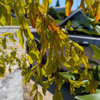
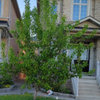
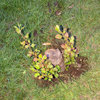
So, the local nursery had it's fruit trees on sale for $10 a piece and I picked up this {{gwi:125205}} and a {{gwi:125206}}. They stand 8' tall and it looks like they need some good pruning and/or branches spread.

They came in #5 containers and because of my heavy soil I dug deep and wide and filled the bottom of the hole with 50/50 compost/original soil. I planted them 2 weeks ago and a few inches high to compensate for settling. The stakes next to them are half inch 10' galivinized poles sunk 2' into the ground for support. The nursery didn't know the rootstock but labeled them as dwarf.

Any advise on pruning/training these? Most of what I've read is geared towards the bare root whips. Not sure where to start or if there's any hope for them.

Thanks,

Dave

Comments (7)

  • 18 years ago

    Dave:

    If these trees are "dwarf", they sure aren't acting much like it. Eight feet tall in the original container is pretty large, although many nurseries sell these big trees since unsuspecting customers seem to prefer them. I'm not surprised the nursery doesn't know the rootstock, but would guess they are semi-dwarfs on something like M-7, which will grow a tree 12-14 feet tall, and that is with some pruning. They should be planted at least 12-15 feet apart. Granny Smith is a pretty vigorous cultivar and should be summer pruned to prevent crowding from twigginess. Many Fuji trees also tend to be twiggy, and many are tipbearers, especially the older cultivars.

    Granny and Fuji are two of the latest-ripening apples grown in this country, and zone 5 is not appropriate for most long-season apples. Again, I'm not surprised the nursery doesn't know that. In the PNW, some of these apples can be grown in colder zones because of the intense summers. Please indicate just where you live in zone 5.

    The first thing I would do with 8-foot trees would be to cut them off at less than 4 feet, and start training from there. You may wish to wait for spring to do that.

    You seem to be aware of the advantages of branch selection and spreading, so my advice is to do what you already know you should do. Your soil preparation sounds pretty good, although I would have left the compost out of the hole and spread it on the surface around the trees. I hope when you planted that you unfurled and spread the roots to the extent possible.

    If you get these trees whacked down to where they should be, it may not be necessary to provide external support at all. But you may not ever see fully ripe apples from Granny and Fuji trees where you live. Even here in much warmer Northern Virginia zone 7, these varieties ripen in mid to late October, but if you get them down to where you can control them you may have a shot in some of your warmer summmers.

    My preference is always for young, 1 or 2 year trees, but there are an awful lot of trees sold at local nurseries or bigbox stores as "sale" or impulse purchases that are a whole lot bigger. They don't offer any advantages.

    Don Yellman, Great Falls, VA

  • 18 years ago

    "...I dug deep and wide and filled the bottom of the hole with 50/50 compost/original soil."

    Don already covered this, but to just to reemphasize...adding amendments into your planting hole invites drainage and rooting problems. This used to be pretty common practice, but has been shown to be a bad idea. I would avoid it in future plantings and follow Don's advise.

    "The stakes next to them are half inch 10' gal(va)nized poles sunk 2' into the ground for support."

    How close to the trunk are these? Exactly how will you use them?

  • 18 years ago

    I wouldn't prune based on a predetermined height if the lowest scaffolds on the tree are at a height you are happy with. I would prune based on what each tree has.
    On the GS go down to the first set of scaffolds, if the bottom to the second from the top is 8-12" cut off the 2nd from the bottom, the top and the 2nd from the top on the side of the bottom. Then cut the central leader 8-12" from the highest scaffold.
    If they're not 8-12" apart cut the 2 bottom and the top, you can leave the 2 opposing scaffolds if you wish or select one. Then cut off the central leader 8-12" from your scaffolds.

    On the Fuji I would cut off the lowest, save the next 2 opposing, cut off all others and lop the leader 8-12" from those scaffolds.
    Those present scaffolds are plenty thin enough for you to train to a good crotch angle.

    If the lowest scaffolds are not at a height you want the tree to start branching go down to that height and cut there.

    I WOULD do this as dormant pruning because at this point regrowth is exactly what you want. Save the summer pruning for rubbing out growth you don't want so all the energy goes where you do.
    Making the small trees grow slow with summer pruning now means delaying fruiting. Worry about stunting the trees with summer pruning once they are what you want them to be.

    If you're in southern 5a your GS will probably be hit and miss, it might not work at all in northern 5a unless you have a lake effect that extends your growing season a week or two. It should be OK in 5b.
    Fuji should be OK in any midwest 5, I think every U-pick has Fuji here in 5a.

  • 18 years ago

    I would not prune those trees at all. I would only spread the branches. And even spread the upper scaffolds. I wouldn't even thin out scaffolds at that time. When they start to have significant crops then do some fairly heavy pruning the Fourth of July. The more you dormant head a tree the more you delay fruiting. At that time they start fruiting, relatively early time in a tree's life, you can remove a scaffold in early July Zone 6. It will have time to settle before early fall frosts. Or you could remove one big scaffold a year during dormant.
    The reason I say I would not even thin out scaffolds early is that it is fruit we want, not a pretty lawn specimen tree. The weight of the fruit will even contribute to the spreading. I would take off the risers, that will come from the apical dominance, when they are only big enough that you can just rub them off with hand.
    I think Don is correct that they are on M7. I don't know your soil, but Granny on 7 can get huge. It will prune up nicely with summer pruning. With a heavy crop they will lean.
    Eventually you want four, or five at most, main scaffolds. You want at least three feet to the next higher layer of scaffolds. Under no circumstances head the central leader. Bend over the top two or three feet. However, you can cut the central leader back to a weak growing somewhat vertical branch. This will become a new and weak growing central leader. And believe me, you will want a weak growing central leader.
    I would be careful about fertilizing a juvenile tree. I don't do it on my place. If you do it just leaf feed. It is easy to terminate an overzealous leaf feeding program, but not with ground application. I mean, it is there and what can you do.
    Don't forget your light calcium application when it starts to flower. bitter pit.
    Anyway that is what I would do, but then I am a Maverick.
    All above IMHO, YMMV,

  • 18 years ago

    Oh dear, those trees in a #5 can must have been awfully root bound; I would have recommended hosing off all the soil and whacking any roots that were curved inward, and then whacking the top of the tree to balance the loss of roots. It's hard to kill a good tree, and this would have been better than letting the roots continue to spiral around in the hole, choking it. The second reason why would be that nursery planting mix is already high in organic material that does fine in the pot, but as soon as you plant it it starts to decompose, robbing the roots of oxygen and leading to rot. Your clay soil wouldn't help any, nor would the organic material you mixed in the backfill hole.

    Granny Smith and Fuji ripen in late November/early December here, and indeed need a loooong season, with Fuji still needing 6 weeks on the tree after coloring up to get the best taste. But our season never ends, which allows this to happen; I don't think yours will make it.

    Not all is lost; you can always topwork the trees with Honeycrisp and Zestar.

    Applenut

  • 18 years ago

    Thanks for the responses. I was anticipating some good pruning, cutting back 1/3 overall atleast. Since both central leaders are bare in the middle I was thinking of pruning there to force more consistant branching up the tree. Some of the lower branches shot out and probably need cut back by half? I figured it wouldn't fruit or I would prune the fruit for the first 2-3 years.

    I'm in central Illinois, near the UIUC campus. We normally have good dirt here but the developer chose to bring in cheap fill instead of a good layer of top soil when they built the subdivision. I added a couple shovels of compost to the bottom of the hole to maybe help drainage or loosen the soil, definately didn't want to create a dissimilar soil situation with all of the backfill. Yes, the root ball was thoroughly roughed. I thought the poles might help support them until they're established and depending on the rootstock be permenant, although it doesn't sound that way now. The fuji stake is probably 4-5inches away from the trunk, the GS is a bit closer, I inserted it in place of a bamboo one that came attached from the nursery.

    January/February, would be the best time to prune and install some branch spreaders? Is it worth trying to spread a 3/8" branch? Never seeing the growth of apple trees it's a bit nerve wrecking but I know they'll bounce back, tough love.

    Dave

  • 18 years ago

    You're in the same area I'm in (I'm near Peoria). Like I said, your GS will be hit and miss, the Fuji shouldn't be a problem. That is why you'll find few U-picks with GS and many with Fuji around here. I think there is one U-pick with GS here and every one I've seen a list from has Fuji.

    Don't believe the bad rap about clay. Clay is extremely high in nutrients. It's problems are it doesn't drain and it gets hard when dry. Unless you get actual standing water the drainage is mainly a problem with trees before they get established (it can make getting cherries established hard). I either do nothing but break it up or throw in some peat.
    I'm in a terraced corn field ('40's development) on the wrong side of the glacier so it's all clay here and apple trees are the easiest thing I've grown.

    The warm spell in February is when I dormant prune. Mid-late August for growth limiting summer pruning. Earlier summer pruning seems to have the same effect as dormant pruning. Later is pushing it for causing winter damage.

    Install spreaders at any time, just don't let the wood get set in its ways before you get the crotch bent.

    I see no need to head back scaffolds. The way the hormones work on laterals that are at good angles causes branching and limits length. The less you prune your scaffolds the faster you'll see fruit.
    Your lower scaffolds do look too close where they will crowd each other as they grow. You can have scaffolds that directly oppose each other (like on an espalier) and they don't crowd, but when they are swirling and on different levels it causes problems in the future (unless the plan is to vase train at that height).

    Here is a link that might be useful: This is to an orchard slightly to the south of us