Software
Houzz Logo Print
bluesibe

Drought Planning

17 years ago

It appears as if we will be in a third year with low rain fall. January has produced almost no rain and is the dryest January on record for the Bay Area. I live in an area where our local utility has already imposed restrictions. And my gut instinct is if this dry weather continues the restrictions will be even more stringent.

So I have begun to think about how I will attack this problem. Last year Paula mulched heavily with wood chips and I know that Pamela uses straw. My first line of attack is to put heavy organic mulch down (horse manure or Tango mulch if I can get it). This morning while walking the dogs I had a brain storm. We have a new rabbit store that moved into the area. They use a great deal of straw for the rabbits. I think I will help them dispose of the straw and get some rabbit poop in the bargain. The second step will be to use soaker hoses in each bed. I'll soak each bed thoroughly and rotate the hoses. That way I can water once per week. The third step if necessary would be to create a grey water system from the washing machine and making sure that all my faucets are in good working order.

I've also begun to think about what Greg posted on the Vintage web site about pruning every other year. I think I will do half my roses one year and half the next year, starting with this year.

If you are doing anything differently because you need to save water, please share your ideas. I know this topic has been discussed before, but it never hurts to revisit it.

Because we have water, we tend to forget that it is a precious commodity.

Carol

Comments (25)

  • 17 years ago

    Carol,

    we put down newspaper (8-10 sheets) as a weed blocker before applying mulch. We noticed that the soil in places we had used newspaper stayed moist much longer than those that didn't. We don't have irrigation in our back yard where most of our roses are, so they get next to no water in the summer, and they did just fine with newspaper and a layer of recycled wood chips. They took a little break in late summer, but then we had another flush of blooms in the fall. It's a great way to use your newspaper, it really does help with the weeds, and the earthworms love it.

    Our water rates go up drastically in the summer, and I have issues with using potable water on the yard, so we usually put a bucket in the shower to catch overspray and fill up gallon jugs for watering plants rather than just emptying the bathtub. The grass went dormant (who wants grass anyway when you can have more roses?) but all our other plants were fine. Plus our water bill was $50 when our idjit neighbor (who waters his grass EVERY DAY) had an $800 bill.

  • 17 years ago

    I really would like to fun the water from the tub and washing machine into rain barrels with spigot attachements so I could run the water into my beds at leisure. Other than that I will be renting our usual truck to get two yards of Tango and as much straw as I can find. The soaker hoses sound like a good idea for my big beds. I watered once a week last summer and everything lived but didn't flower. Still praying for rain.I use a pan of water to wash dishes and another to rinse them and then use that water to flush with and the rinse water to clean with.I shower every 2nd or 3rd day and bathe from the sink on the other days. Now you know!
    la

  • 17 years ago

    We've been giving the plants all of our shower warm-up water and all of our dishwater, but like Luanne, I'd like to be able to give them all of the shower and laundry greywater.

    We're removing roses that we feel we can afford to live without, or which are not somewhat drought-tolerant.
    We're going to start weaning the roses off to fewer, but longer, watering sessions.
    With fewer roses overall, that should be helpful.

    Jeri

  • 17 years ago

    Useful information really isn't out there, is it?
    A friend in Knoxville called yesterday, she had water bills last summer of $300 for each of several months. Maybe I was better off not having buying 'citywater' as an option.
    I didn't water last year; summer months didn't get much rain. Spring months had about 4" of water each, then June had only 2", July had 4.5, August had 1.25, Sept 1.48, October 1.51. (When Grumpuss cat died, we had to soak the ground to get it soft enough to bury her.)
    Then came the rains of November 4.0, Dec. 7.5, and so far in January 6.8"
    This is ridiculous. The problem is that wet springs get growth started and then growth just stops. An inch in August with the very hot temperatures and winds and high evapotranspiration rates meant that some of the 0.1" rains didn't even moisten the soil.
    Modern roses, the ones bred to be pampered bloom machines, didn't do well.
    OGRs survived. They didn't add canes in fall. Some of them kicked out blooms in October when I didn't expect them to.

    On my hillside there's a problem with trying to keep the beds themselves moist with irrigation: Moles and voles will find these critter resorts in the middle of a parched clay desert and they move in and thrive (and triving does mean reproducing like mad.) Which means I need my roses to be strong enough to make up for their root losses. So far the roses are winning but the trails in the soil are disconcerting and the cat who worked that area is now a pensioner and no longer protects the big tea beds.

    So....my roses do get water for the winter and spring. That's more than California roses can expect, but mine do, I think, show that the irrigation need not be maintained at spring levels throughout the year for ultimate rose survival.

  • 17 years ago

    When I think about drought conditions I remember the year that one of the garden areas didn't get water from July on. It was a mistake. I thought the drip was working there and it wasn't. That area didn't look very good but the roses survived. The rice straw that I use helps alot. I know Melissa has these conditons regularly. I guess when it is like that we just have to accept the garden not looking as we would wish, but many roses can survive. My ramblers get no water at all in the summer any year. I suspect many OGRs would do the same. Let's hope the drought ends soon. Our pond is full so we will be OK here.

  • 17 years ago

    I'm plannig to buy those roses which are low-water to drought tolerant (n.b. in our microclimate which is winter-moist/summer drought) and mulching deeply. Mostly Tea roses, and a few found Noisettes, that survived years being lost in the South with no supplemental water.
    I've also been adding drought tolerant (in a mediteranean climate) companion plants such as snow in summer, Parma violets and species geranium, and early cultivars of carnations and Old fashioned Iris.
    My neighbor has her entire front yard mulched deeply with woodchips and she never watered her plants at all last summer, 'Graham S. Thomas' is one of her roses, on rootstock. Now, in January, her yard is carpeted with white narcissi in full bloom. It's so lovely.
    The Earthkind rose trials showed that by using
    4 inches of wood chip mulch, their roses went as long as two months without any supplemental water, in Texas.
    Lux

  • 17 years ago

    So....my roses do get water for the winter and spring. That's more than California roses can expect,

    *** The old CA roses demonstrate that, too.
    They get rain in winter. None in late spring, summer, or early Fall.
    They bloom in the spring, after the winter rains. They drowse through the summer and early Fall, and perk up if there's a little early rain, and produce a late-Fall bloom.

    We found this rose on the last day in November.

    Now, NEW roses, I think, can't do this.
    But if they're mature, and not pruned back much, and have been encouraged to send roots deep, I think they can make do with less water than we THINK they need.
    The Sacramento City Cemetery roses, in Sandy soil, get watered once a week.

    Jeri

    Here is a link that might be useful:

  • 17 years ago

    This "idjit" who got several of those exorbitant water bills (one a couple years ago in the 4-digit range) is shovel-pruning quite a few roses, growing other ornamental plantings that require less water and grass. A $50 water bill here is not possible. Flat rate is higher than that.

    We spend at least $3000 each year on mulch, compost, and pine straw, etc., for our roses and even with deep watering only twice weekly (which you must do in the summer here and is still not enough in the drought), our roses did not do well and our bank account continued sinking. When the garden starts costing that much in terms of work, money and worry, it is no longer enjoyable.

    Carol, I am sorry. I did not answer your question. Just venting. :-)

  • 17 years ago

    I am one of those "idjit" who spends too much on water. I am planning to put drip irrigation down this year to minimise the waste water. And water the weeds, excuse me, the lawn only once or twice a week. ( Thank god for clay).

    Jeri has mentioned that her GCs get dish water. I have thought of using gray water too, but my question is how to carry bucket loads of water from shower and kitchen to the yard? Do you guys carry dripping water through the house?

    Installing a professional gray water system is way toooo expensive, especially in this economical market.

    I need detail ideas please.

    FJ

  • 17 years ago

    It seems I always have high water bills. If I didn't conserve it would be even worse.

    Last year's wood chip mulch probably helped. I watered once a week except when the heat went up in the high 90's, then I watered twice. In previous years it was twice a week and three times in high heat. I watered my baby fruit trees more frequently, but it was their first year in the ground. This year I'm pruning but leaving more mass on the plants, especially the interior I used to clean out. And I'm leaving the leaves on the ground to compost in place.

    Eventually I plan to cut swales in my hillside to capture rainwater for an expansion of the orchard but this is not the year. Actually there isn't much rainwater to be captured. But I don't want any of the rain that falls on my land to end up in the storm drains if I can help it. I read a really interesting book called Rainwater Harvesting for Drylands and Beyond that I highly recommend.

    R

  • 17 years ago

    In 2008, after a warm, dry-ish winter and early spring, in mid-May it began to rain and continued for five weeks, ending up dumping about 20" of water, half an average year's rainfall. In the following four and a half months we got about half an inch of rain. The extremely heavy rainfall in May-June probably carried the roses for at least a month, but even after that the two hundred established roses that weren't watered almost all survived. Some defoliated, hardly any flowered, as the rain didn't begin again until shortly before Halloween. But they nearly all lived; some grew; few showed serious damage. The heavy clay helps a lot (and it's apparently deep), and so does the thick mulch. Temperatures last year didn't go over the nineties, unlike the year before, but on the other hand we had months of strong, drying winds. Almost all my roses are old kinds, and I have only a very few Hybrid Teas and English roses. In the six years we've been growing roses here we've lost very few roses to drought once they had been in ground for a year. Perhaps I should add that we've had little winter cold that does serious damage, and have low disease pressure. I don't know how much those things matter.

    In serious drought periods in hot weather I use a shower nozzle on a stand that I attach to a hose, put on a bathing suit, and take my shower in the garden. I take spit baths like Luanne, and like her I get very stingy and inventive with water in general. Right at the moment, and thank Heaven for it, I'm not worried about drought. We've gotten abundant rain this fall and winter, and, so far, about four and a half feet of snow. It's sopping wet; none of the plants seems to object; and I'M NOT WORRYING ABOUT DROUGHT. I hope you all will be able to say the same soon.

    Melissa

  • 17 years ago

    Jeri has mentioned that her GCs get dish water. I have thought of using gray water too, but my question is how to carry bucket loads of water from shower and kitchen to the yard? Do you guys carry dripping water through the house?

    *** DH dumps it into a bucket (easier to carry) and takes it out and dumps that into a Muck Bucket to settle for a few hours, before carrying it to the roses.
    It doesn't have far to go through the house, and can't do much damage that 30 years of dogs haven't bettered.
    :-)

    Jeri

  • 17 years ago

    My suggestion about drought is to go easy on fertilizers, organic or chemical. Both manures and chemical fertilizers are salts that are leached below the root zone by rainfall or watering. If we are rationing water, we can experience salt build up in our soils. My plan this year is to use only organics, apart from newly planted roses, which will received their usual recipe of amendments. The organics I use will not include manure, and I will not use chemical ferts except on new plantings. My experience with summer drought is that the roses will shut down. When that happens, I always need to remind myself that it is because of lack of water, not because of lack of fertilizer.

    Another tactic that goes a long way to rose survival in drought is to deep water a couple of times during the summer. Even once in July or August will make a huge difference, but once in each month is better. I know I have to be careful about letting the soil dry out completely. It is quite a job to wet it down enough to absorb water when this happens. So better to start watering a bit and early enough that the soil doesn't get completely dry before I notice.

    My last wish is to nuke the pot ghetto, or at least greatly reduce it. In the ground or in the compost.

  • 17 years ago

    The biggest problem I have with my idjit neighbor is that he waters foolishly and refuses to change his ways. Shallowly and often, in the middle of the day, multiple times a day, and on a lawn that would happily go dormant. There's a big difference between that and trying to keep some special plants alive through judicious irrigation.

    FJ, we've saved up a bunch of plastic gallon jugs. Easy to put under the faucet to catch a couple of gallons while the water is warming up for the shower or dishwasher. For bailing out the bath tub, we put a beach towel on the floor, fill up the jugs with a bucket, and set them on the towel to dry after we fill them. It takes some time filling and carting around all those jugs, but they aren't too heavy, and they're easier to control when watering than with a bucket.

    Another trick to reduce water use in your yard is to set your lawn mower higher. The longer grass shades the roots more, and you use less water. Or better yet, get rid of the grass entirely. Not only is it a water hog, but it's a major source of pollution with the mowing, fertilizers, and other chemicals dumped on it trying to keep it looking like a golf course.

    And of course, native plants are always great. We're lucky enough to have some beautiful native roses that happily grow in the toughest parts of the yard.

  • 17 years ago

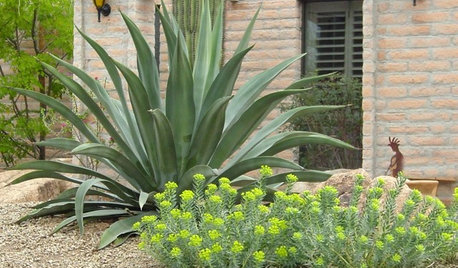
    I'll probably switch from showers to baths and then pump the bath water into the garden. Also looking at greywater systems--the shower and the washing machine are the biggest source of indoor water. The garden is divided into irrigation zones, and some of the zones will get switched to bath water. I'm planning on removing most roses eventually and replacing everything with an aloe/agave/echeveria collection. Might have to do the replacing sooner rather than later, unfortunately. Oh well. It's ok, though. Aloes and agaves have their own spectacular beauty, and a tea rose or two can be included.

    What I would really like to do is figure out how to collect all the run off from the uphill neighbor's garden, which would water my whole garden for free!

  • 17 years ago

    This is really icky, and disgusting, Hoovb, but do you have storm drains separate from the sewers?

    Sump pumps are cheap.
    Somebody needs to figure out how to use the runoff, and a sumppump lowered into a storm drain might just be a solution for some of y'all.
    This would only work for neighborhoods that are all homes (no backyard mechanics dumping antifreeze or oil into drains).

    If an uphill neighbor were overwatering, you could put a french drain type reservoir and then pump from it. (Sumppumps again.) Your washing machine hoses can be deflected easily.

    I can write all of this because we bought an old farm house and replumbed it so that the grey water could go on the roses. Right now, I don't like the way we're using it; it was much better the other configuration which really made for great rose bushes. I'm trying to figure out how to get it to the HPs.
    The option exists in our pipes to divert all the grey into the septic tank, that's for whoever buys this after us.

  • 17 years ago

    Ann, that is a good idea about the sump. I think it must be illegal in the city I live, Our mayor lives around the corner, very nearby and one of my rose friends in the area, has a sump and has gone to great lengths to make a fence of large shrubs so the mayor cannot see him working in the garden, when he needs to dink around with the sump pump or while he was installing it. I'll never tell. I figure we pay enough without the meddling.

  • 17 years ago

    I've had some puter problems and I apologize for not responding quicker.

    I'd like to thank each of you that replied. I have learned so much. And I will be trying some of these techniques.

    Recycling newspapers, not putting down manure. Patricia the pain I know that you have gone through with your water problems in the South.

    Gail, I'm not ready to give up my roses, so there may be some downsizing, but no replacing.

    And what is rice straw?

    And, many of us just don't take showers on daily in these conditions, unless it is very hot.

    Here's to rain, we need it!

  • 17 years ago

    This thread has been very eye opening. I feel so badly for those of you growing roses and getting no blooms, or coming to grips with the fact that you must reduce your beloved collections. I had no idea. Living here I don't irrigate often because of laziness (& cheapness) but we have enough rainfall that I'm still able to grow roses.

    I actually just read an AP story this morning that the Mexico City government is shutting off the water for 3 days each month for the next 3 months because their water reserves have dropped to their lowest level in 16 years. Over 2 million people-from those living in multimillion dollar mansions to cinder block hovels, everyone within the city limits-will have no water. Sobering.

    Dawn

  • 17 years ago

    Here in SoCal, it isn't as bad as Mexico City, but it's bad.

    Per this morning's newspaper, we can look for restricted water use by perhaps July or August.

    Jeri

  • 17 years ago

    Carol, Rice straw is straw from the rice fields. The good thing about it is that one can be fairly sure that it doesn't have weed seed in it. It's also finer than wheat straw. When I use straw I first let it get wet and then rot a bit. Then it doesn't just blow around and lays down easier. I then peel off squares of it and lay it down thick. It conserves water amazingly.

  • 17 years ago

    This article is a how bad it can get.
    Pit toilets, and 450 gallons per day don't get flushed away.
    But the problem is that the infrastucture needs to get so many gallons to the sewage treatment plants to keep them running correctly.

    Schools' water use isn't limited. Lots of hand washing water that could be diverted.

    What about fire fighting?

    Lots of rethinking needed.

    Here is a link that might be useful: 450 gal per day

  • 17 years ago

    I use a sump pump, just put it in the tub with a hose that suns down to a large garbage can. I plug it in and in a manner of moments it is in the can. Then I race outside and lower it carefully into the can, run the hose into the nearest beds--I also dump scrap water from the kitchen sink,running water to get it hot gives you spare quarts and it all goes to the can. Anyway when it is full, I turn on the pump and shoot it over to the closer beds. Right now the rain is blessedly falling but I'm still loading up that can.
    la

  • 17 years ago

    To Hoovb: There are many native plants one can use to create a wonderful garden, but I hope you don't remove too many of your roses because your garden looks wonderful with them. Don't you dare remove your Golden Celebration!

    I myself live in an area of little rainfall, so I kind of feel a bit guilty ordering too many roses as much as I love them, I intend to add a choice few this year.

    Chance

  • 17 years ago

    Great thread and so important as climate changes everywhere.

    Here are a few things that seem to be working for us (so far):

    We had a handyman lengthen the hose that originally went from the washing machine into the utility sink so that when the weather is dry we can run the wash water into a large plastic garbage can on wheels (it fills up 2 x from each wash -- I never realized how much water it takes to do laundry!) Then my husband wheels the garbage can outdoors and we fill up watering cans to water the plants.

    Another trick we learned from a neighbor from the Middle East: put a large plastic bucket next to the kitchen sink and use a pot to ladle water into it when we've finished washing the dishes.

    We also use bathwater to flush. And we wonder who was the genius who came up with the idea that it was more sensible to use drinking water for toilet purposes instead of the traditional compost toilet or the new electric "zapper" toilets that use no water and turn poop into fertilizer.

    Now here's a question: anyone out there pee on the ground near their plants to add nitrogen? I know some hard-core gardeners and farmers who swear by their high-nitrogen "yellow gold." And I read that in some traditional communities it was impolite to have a meal at someone's home without making a "deposit" in the humanure facility!

    Another trick we've learned: plant roses and fruit trees in deep wells, then water by hand filling the well once a week at most. We've found this even more effective than using the PVC "black snakes" that look so ugly in many local gardens here (and are toxic too).

    And I've learned from Jeri and others that in California late fall, winter and early spring are prime rose season and a really silly time to prune! Right now I'm enjoying the winter blooms. In summer the roses "rest" and what blooms there are aren't the best.

    I agree that the old roses seem to take the drought much more easily than the newer roses, although I have to agree with Jeri that if you raise them "rough" and don't prune or overwater, it's amazing what some of the modern roses can survive.

    I just read today that Australia is near collapse from climate change (drought, heat make growing food hard) and that California, the American Southwest and other Mediterranean climate areas are predicted to follow suit. So I guess we'll all be learning a lot more about rainwater harvesting, graywater, swales etc.