Software
Houzz Logo Print
whaas_5a

Cornus Mas berry

16 years ago

Maybe I'm not looking hard enough, but do you need a male and female to get the berries on Cornus Mas?

If so is there anyway to tell them apart?

Comments (13)

  • 16 years ago

    C.mas is monoecious - has both 'male'(staminate) and 'female'(pistillate) flower parts present.
    A discussion thread on them on the NAFEX list over the past few days indicated (several participants made the same comment, from their experiences) that fruit set is much better when two or more varieties are present for cross-pollenation.

  • 16 years ago

    Did anyone happen to comment on the distance between the plants?

    I plan to plant a Variegated and Golden Glory...they may be 50' from eachother.

    I don't plan to plant either if I can count on a good fruit set.

  • 16 years ago

    Them there's perfect flowers, aren't they, Lucky?

    That would be my experience here at the Valley. Nearly 20 years old and wonderful barrel-shaped specimens that lay over with ice loads like giant tulips but straighten right back up again with melting, my Cornus mas 'Golden Glory' have produced about a handful of fruit in all those years despite incredibly floriferous behavior on these 6 plants.

    But the tsunami is rising...

    I planted four or five 'Redstone' cherry dogwoods a few years ago, and these are now reaching decent flowering size. I expect that the cross-pollination opportunity will now be present, and that there'll be bumper crops of fruit after that. The six 'Golden Glory' are planted around my driveway, and the 'Redstone' individuals are scattered in various places on the property (10 acres), none closer than 50' away.

    The flowering time should favor cross-pollination, simply because there isn't much else flowering at that time of year. I hope you have flying insects around that can be bothered to help you out. Closer is always better, but I don't know that a hard-and-fast rule exists.

    I used to manage the landscape at a large Thoroughbred horse farm here in central KY (now rated arboretum status), where six or eight venerable old specimens graced the grounds. There were so many fruit on these plants, that we had to do some cleanup every fall in areas where they intersected with circulation patterns of office staff and visitors. I remember learning the difference between ripe and nearly ripe fruit at that time.

    They are very tasty when they are ready, and birds will wrestle you for them.

  • 16 years ago

    'at's riight, VV. Perfect.
    Guess while I was throwing out the monoecious, staminate, pistillate, etc. terminology, I could have completed the discussion with 'perfect' - but since I'd really not actually looked at the flowers to make sure that both genders were present in each flower, I skimped a bit and hedged on my answer. I try to not act like I know more than I really do. knowhutimean?

    My minimal experience with C.mas, other than reading discussions on the NAFEX list over the years, is based on three specimens planted in a municipal park here. I presume they were just row-run seedlings, no graft union that I've ever ascertained; planted about 15 ft apart; one bears HEAVILY, one bears moderately - and ripens well after the heavy bearer is done, and the third is a shy bearer.

    Someone once likened the fruits to "cranberry-flavored cardboard". But, I like them - both in their firm and bletted condition - and one of my kids likes them, but I can't think of anyone else that I've shared them with who would sample a second one - and in some cases, they've refused to try anything else I've offered, because of their disdain for the C.mas berry I foisted off on them.

  • 16 years ago

    In my Dad's parlance:

    "That's just more for me."

    Maybe you should ply them with Viburnum fruit...

  • 16 years ago

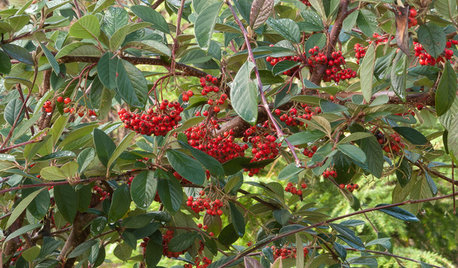
    thanks! I'll keep this one on my shortlist...I saw, what had to have been Cornus Mas in a business, had tons of large olive shaped red fruits...this was late December.

  • 16 years ago

    Whaas -- unless the one you saw was VERY different from the ones I've got, it probably wasn't a Cornus mas, but something else.

    On all of mine, the berries are NOT persistent -- they ripen and then fall off completely over about a 2 week period in mid to late August. By Labor Day, all gone.

    Now, I LOVE the fruit from mine. They are not a fresh-eating fruit, too tart and also a touch astringent, but when cooked taste like a mixture of sour cherry and cranberry, and make wonderful sauces, jams, pie filling, etc. The bushes, I admit, are a bit messy with dropped fruit, since they can be very prolific and produce quantities that no one individual could conceivably use.

  • 16 years ago

    You should take pictures of specimens like that - might be very worth propagating.

    My experience parallels denninmi's. I'm not aware of Cornus mas fruit persisting late in the season after ripening - but I haven't been everywhere (yet). Birds usually do the work on these, or they drop off.

    Cornus mas fruit are usually borne singly. If the plant you saw had clusters, it could have been a nice Viburnum trilobum (or something else entirely).

    Cornus mas also has prominent opposite winter flower buds, which help separate it from most other woody plants. With age, the bark exfoliates handsomely as well.

  • 16 years ago

    I'll check to if the fruit is still there. The sigular berries where much too large to be a Viburnum...I think. Next time I get out there I'll take a pic. If not Cornus Mas, I'm very curious to know what it is now.

  • 16 years ago

    C.mas fruits are ripe here - southern west-central KY - in late July/early August - certainly gone long before any inkling of frost, and it's a battle for me to beat the birds to 'em. Can't imagine them hanging on into Dec.

    I've tried, on several occasions, to germinate some seed, but never had any success - but I'll also freely admit that I didn't do much more than stick 'em in a pot.
    Seems like I recall(mistakenly, perhaps?) that they have some sort of double-dormancy - maybe I didn't wait long enough before pitching the pot(or re-using the potting mix).

  • 16 years ago

    OK you two, that's enough Kentucky speak. Always pushing viburnums...

  • 16 years ago

    Moi? Lucky from Kentucky? I'm the nut/persimmon/mulberry guy.

  • 16 years ago

    And...plantist to the extreme.

    Sworn Enemy to Liquidambar, far and near.