Software
Houzz Logo Print
cateyanne

What tree variety?

19 years ago

Can anyone give advice on selecting a tree for my backyard? I am looking for one as a focal point in a corner that does not grow too large(over 20')but large enough to provide some shade. I would like something that has a pretty spring blossoms and a brilliant fall color. I also love anything with an interesting bark or trunk shape(though this is not a priority). and I would like to make a choice that is tolerant to my area and has no specific bugs or diseases that will habitually attack it. A tall order? can anyone tell me if they have favorites in their own yards or a tree you know of that fits the bill ? There are two areas I can plant it. One would be full sun. The other would be sun with some shade late in the day.

Comments (5)

  • 19 years ago

    cateyanne, I would go with a Japanese Tree Lilac, (Variety Ivory Silk) grows to be about 20-30 feet tall, disease resistant, beautiful fragrant flowers in early summer when most trees are through flowering. Bark looks similar to that of a cherry tree. Hardy in zones 3-7. If you do a google search they show very good pictures of them. Another option would be the prairifire flowering crabapple. This tree has bright red flowers and red purple fruit that are only 3/8". Handsome red-brown bark accents spring and fall foliage. Disease resistant, grows to 20-25' tall, 15' spread. (zones 3-8)

  • 19 years ago

    I'm a big fan of Japanese Tree Lilac, but "brilliant fall color" is not one of its traits. Serviceberry might fit the bill for you. You could look into the ubiquitous Amelanchier x grandiflora 'Autumn Brilliance', or one of the less common cultivars like 'Princess Diana', which is supposedly a bit shorter than Autumn Brilliance. These are elegant little trees that produce cheery flowers in spring (though short lasting in my experience), tasty fruit that birds love, and dependable fall color.

    Is the site somewhat protected with a bit of afternoon shade? If so, Cornus alternifolia is a dandy little tree. Truly a four season gem in my experience. It will be short lived in hot conditions, but if the soil is on the cool/moist side, this can be a focal point in the landscape.

    Bob

  • 19 years ago

    Another possibility might be Heptacodium miconioides (Seven Son Flower), multistemmed to 20 ft, interesting, shaggy bark, late summer bloom of white flowers followed by a long show of red calyxes (these would take the place of fall foliage.)

  • 19 years ago

    How about a Japanese Red Maple? No flowers but come in many varieties with brilliant spring and fall foliage and stay within your 20 foot parameter. They prefer full sun in your area.

  • 19 years ago

    Forest Pansy redbud has reddish/purpley leaves all summer, after it flowers in early spring. Not much fall interest, as the leaves don't change much. I like the branch structure. You might have to trim to keep it to a single trunk, although maybe not. The plain green-leaved redbud is also nice, and has fall color. There are selections for flower color and a variegated-leaf one.

    Chionanthus virginicum (Gancy Graybeard or Fringe tree) is a native tree possibility. Pick carefully, as some are more shrubby in form than others. It flowers in the early summer, leaves turn yellow in the fall.

    Dogwood is another possibility, either the native - if disease resistant cultivars are chosen - flower color can be white or pink/reddish - or the Cornus kousa - white flowers only - which flowers later, usually with its leaves. Both can have red fruits, and both turn a red color in the fall. Pagoda dogwood, C. alternifolia, is another variety, also attractive, with a strongly horizontal branching pattern.

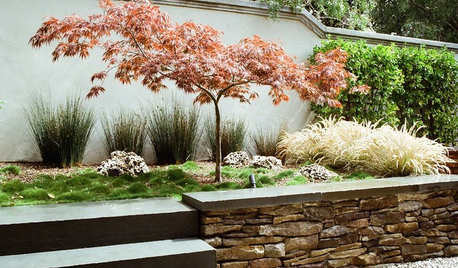
    A Japanese maple is another possibility. Picking the cultivar carefully can give you a small tree with summer interest in variegated or red foliage, and fall foliage as well. As they grow, the branch patterns can become very interesting. No flowers, although the new leaves are frequently reddish.

    While the Ohio Buckeye would probably grow too tall, the variety 'Texas Buckeye' (Aesculus glabra arguta) might be a substitute, if you can find it, and if it will do well in your climate - pale yellow spring flowers and fall color. A. pavia, Red Buckeye, would do if kept trimmed to a tree shape instead of a shrub.

    Another option might be a flowering crabapple, if you choose a disease resistant variety. You would have to pick carefully for one that doesn't drop its fruit, if that would be a problem. Prairiefire has reddish foliage and flowers, and holds its fruits. Check the Morton Arboretum site for disease resistant cultivars.

    Most of the above trees would do well in either site in your yard, full sun (some would need watering a bit more) or part-shade. I would try to find relatively mature specimens growing in your area - is there an arboretum in a reasonable distance, or a public garden? If all else fails, looking at the up-scale nurseries, who would more likely have the expensive, larger trees for sale, might find some of them - I suggest you only look, as smaller trees usually settle in and grow better in the long run, not to mention usually costing a lOT less - unless that is the ONLY source and you are in love. The other option is to use the Google Image function, and look at pictures, which will give you SOME idea of what the trees will look like. Pictures in tree or garden books can also help - try your library; if they don't have a copy of a particular book, interlibrary loan can usually get you one.

Sponsored
Industry Leading General Contractors in Franklin County, Ohio