Software
Houzz Logo Print
dave_in_nova

Mystery Evergreen Oak -- any Ideas which one?

I wonder if any of the oak specialists out there could possibly ID this evergreen oak. I wish I had taken a photo of the actual trees, which are growing on the William and Mary campus, in front of the new Business School building (warm 7B location) in Williamsburg, VA. They are about 15 to 20 feet high and quite wide. They were loaded with acorns which formed in clusters near the branch tips. At first I thought they were Quercus myrsinifolia, but the leaves seem too wide -- probably averaging at least 1.5-2" wide and at least 3-4" long, and they are sort of quilted (at least more relief than mysrinifolia) on their upper surface. They are softly serrated for at least half their length.

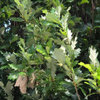
I started some seedlings and here's a pic of one of them. These seedling leaves are very close to what the mature leaves on the large trees looked like (except smaller).

{{gwi:482374}}

Undersurface is your basic green:

{{gwi:482375}}

Here are mature Q. myrsinifolia leaves by comparison (although mysrinifolia leaves show a lot of variability too):

{{gwi:482376}}

Here are the acorns from the mystery oak -- they are on the right side. I threw in some Q. myrsinifolia acorns on the left and you can see that the mystery oak acorns are much more rounded...more rounded even than Q. virginiana.

{{gwi:482377}}

Any ideas? Maybe Q. glauca? or Q. acuta?

Comments (11)

  • 16 years ago

    The first thing I thought of when I saw those dark glossy leaves and read the part about "loaded with acorns" was sawtooth oak. Not an evergreen mind you, and it sounds like you know a thing or two about oaks but I thought I'd just check to see if you've ruled that one out yet or not.

  • 16 years ago

    I'll just add that while they're not evergreen they color and drop leaves really late. They're also a problematic invasive weed in that part of the country.

  • 16 years ago

    This is definitely an evergreen oak. I don't know that much about oaks! LOL! But am very interested in evergreen oaks, since there are only a handful that are hardy in an Eastern zone 7.

  • 16 years ago

    Don't think those acorns on the left are Q. myrsinifolia. Compare here and {{gwi:482373}}.

    If looking for more acorns, collect some of the cups too, they're useful for identification (note the concentric rings on Q. myrsinifolia cups).

    Resin

  • 16 years ago

    Resin,

    Not sure I would trust DK Images. Now, my acorns match your second picture quite closely. Note that the acorns do not fill up the cap completely on the inside. The acorn parts that were covered by the cap are more elongated. And your images do not show the acorn without the caps.

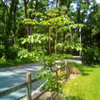
    Here are the presumed Q. myrsinifolia trees. Now that I look at them more closely, the leaves don't look as willowy as I remembered them. Maybe they're actually Q. glauca??

    {{gwi:482378}}

    {{gwi:482379}}

  • 16 years ago

    Quercus glauca caps have concentric rings too.

  • 11 months ago
    last modified: 11 months ago

    I am unable to see pictures now, but Castanopsis cuspidata (Japanese Chinquapin) seems like a likely possibility, given the zone 7 location. While not a true oak, they are more popular on the East Coast because more cold tolerance than Quercus glauca. Though I'm thinking Quercus glauca may be the second most probable possibility.

    Quercus sessilifolia may be another possibility.

  • 11 months ago

    Jacobson's NALT only has C. cuspidata, says it's rare in NA commerce since 1887(!), but only gives a US record in Oakland, California. Contrast with something like Quercus glauca that is mentioned as being planted in Seattle in 1937. The lack of them in the southeast - again, until recently - implies they were not very adoptable, or at least the original stock imported wasn't. Even now, the National Arboretum isn't showing any being grown there.

    The NCSU arboretum has had a couple for a few decades, I'm actually kind of surprised by that.

    https://jcra.ncsu.edu/horticulture/our-plants/results.php?search=castanopsis


    Based on the description and the photos at that link, it was one, it looks closer to C. sclerophylla. But I still think a Mexican oak is more likely.


    I might go visit some family in SE Virginia this fall...was not planning to go by Williamsburg, but might check out this tree if I have time.


  • 11 months ago
    last modified: 11 months ago

    Ooof, there was an easier way to figure this out!!!

    https://maps.app.goo.gl/6DhL9BKCM9FEPTAj8

    Those are 100% the original Q. acutas or Q. glaucas that were on the campus! (sorry, without finding that spiral bound booklet from 1992, I can't remember which) That building used to be where commuter students parked, and I walked past those trees frequently as they recovered from the damage of 1994. Alas, my memories are now vague on exactly how bad it was, I just remember the striking difference between the hardy clones of Q. virginiana elsewhere on campus, that were only slightly damaged by 0F in 1994, and these. I do perhaps recall seeing fresh chain saw cuts of damaged branches - so - it was pretty bad. The Q. myrsinifolia in a hotel parking lot in Colonial Williamsburg was better off, as expected.

    Based on how small they are in the current pic versus Dave's 2010-ish description, I'm wondering if they were so damaged in the polar vortex winters that they were severely cut back - probably for the second time or even 3rd time in their lives - and are recovering from that. Happy evergreen oaks would be much larger, like the Q. myrsinifolia at University of Delaware, which is starting to engulf one of the building bays where it is situated.

    Update, based on comparing w/TASO (treesandshrubsonline!) these are Q. glauca, as socal suggested.


    https://www.treesandshrubsonline.org/articles/quercus/quercus-glauca/

  • 11 months ago

    "they are more popular on the East Coast because more cold tolerance than Quercus glauca."


    what is your source for this?