Software
Houzz Logo Print
sadsaguaro

Saguaro damage

13 years ago
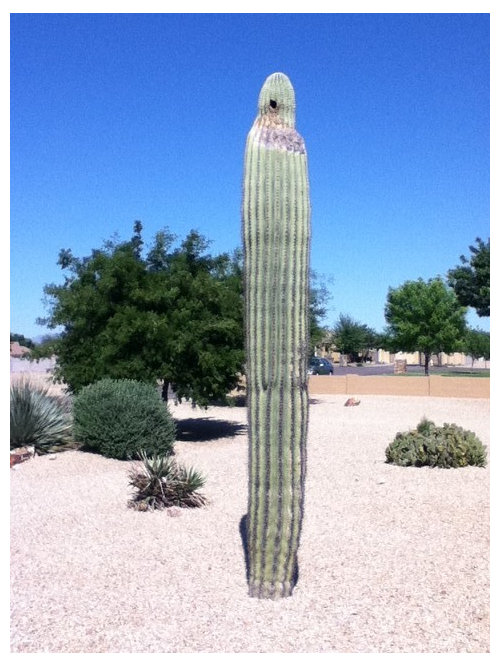
My first post. I had 4 images to download, but it looks like I can only do one.

The hole at the top was made by a woodpecker about a week before Halloween 2012. I placed a box over it until about a day before Halloween to keep the woodpecker from doing further damage, but then began to read that there is some symbiotic relationship between some woodpeckers and cacti, in which the bird actually keeps rot from attacking the plant. The cacti remained unharmed, except for a hole, into mid November, when we had to drive to the East Coast for 6 weeks, for a death in the family. When we returned, it had been freezing, and continued for another week or so, and the cacti was pretty much as pictured. We have no idea if this rot is due to the hole or the freezing, but suspect both. The rot covers about 270 degrees from the West, clockwise to about the North. I've looked at video about how the Desert Botanical Garden in Phoenix removes rot, but it doesn't cover the top of a Saguaro. I'm thinking that if I want to salvage this, it is going to be necessary to cut the entire top off and apply either a bleech or alcohol mixture to keep further rot out, and to allow it to grow scar tissue. But since that scar tissue would be at the top, could it possibly continue to grow in a way that would look acceptable?

Comments (12)

  • 13 years ago

    Hellow and welcome to gardenweb :)

    Cutting off the rot would force it to branch out.

  • 13 years ago

    So strange to get a reply from Albany, NY on a Saguaro question, yet appreciated, Maybe I appeared too informed on this issue. I am not. I'm looking to hear from anyone who can tell me if topping this cacti off is the right thing to do, and how to do it. Should I cut it off flat, or should I shape it roundly? Any and all helpful replys would be appreciated. I really don't want to be the experimenter here.

  • 13 years ago

    If it is indeed rot, I would cut it straight across and NOT use bleach or alcohol on the cut. Straight cinnamon is supposed to work as an anti-fungal, so you could try that, if you're worried. I don't believe this is monsoon season for you, so you're probably safe doing it now. Keep in mind that the top won't grow back into the round shape for years (if ever). I doubt cutting it would cause it to branch, as saguaros don't even begin to develop arms until they are at least 50 years old, but nature is full of surprises......

  • 13 years ago

    i dont exactly know what this cactus would do after it is cut, considering, as said above, saguaros dont branch until they are very old. also said above, anything can happen.
    i wouldnt cut straight across, but at an angle, so water doesnt collect in the center.

  • 13 years ago

    In my opinion, I think if you are going to cut, cut on the bias.

  • 13 years ago

    If it's rotting, the only solution is to cut the top before it affects more of the plant.
    Even though it is a Saguaro I think that when you cut the top it appears a new branch. But you have no other choice if it is rotting.

  • 13 years ago

    The top of the plant contains its apical meristem; this is the place where most of the growth of the plant occurs, unless it is severely damaged. If it's cut off, the rest off the plant won't grow taller, but will technically get wider (natural bark growth) as is normal; the top may seem to be a little more rounded decades from now. Since there's no terminal growth and only normal growth of cactus bark, or "corking", the sugars or "food" produced by the plant has to go somewhere. It will only improve itself until it has enough strength to branch out. At the bases of spines are areoles (buds) that will allow this new growth (even cacti that typically will not cluster will branch out if the growth tip is damaged). *I would not be surprised if your Saguaro would branch out in a few years if you decide to cut the top off.

    I wish you the best, whatever your decision.

    *However, I suppose it might be possible (if it's not been proven already) that areoles of the Saguaro cactus may need to develop to become capable of producing another plant (i.e., only once the plant has reached a sufficient height, further growth will contain areoles that allow branching; or, it's possible the areoles develop gradually, not all at once at a certain height).

  • 13 years ago

    Sad, if you want to post more photos you can just add more posts to the thread. change the "Subject of Posting" so it won't complain about the repeats.

    I'd look for local advice just because this is a plant specific to one small area of Earth, and a local expert could best help you.

    "Bacterial Necrosis (rot) - When the tissues
    of a saguaro's body are injured by physical
    damage, freezing weather, water deficiency, heat
    stress, or sunburn, bacteria can enter,
    causing the tissues to rot. The infection spre
    ads quickly and is the main cause of death of
    saguaros. In cases when rot is detected earl
    y, the plant may be saved by cutting out the
    diseased tissue (it will be discolored and mushy),
    wiping the area with a solution of bleach in
    water (one part bleach to nine
    parts water) and leaving the hole
    to dry and heal in the fresh
    air and sunlight. The most obvious sign of ro
    t is black, smelly ooze emerging from the
    cactus. If the rot is near the surface and in a
    localized area, the plant
    can likely be saved.
    If the rot is coming from deep within the plan
    t's body, or occurs near the tips, the plant's
    chances for survival are slim." -- from the DBG page on Saguaros

    Here is a link that might be useful: DBG page on Saguaro care.

  • 13 years ago

    I wish to thank all who replied. You all have given me food for thought about this situation. Even the controversial postings have elevated my awareness, and have drawn me to the decision to wait and see. Perhaps the best two things that have resulted from posting here are 1) It was necessary to take photos, and thus I now have something to compare to, and further assess any future damage, and 2) It was necessary to wait for information, rather than just going out and acting imprudently. I've waited 4 months thus far, and to tell you the truth, I haven't noticed it getting worse (but it may have). Unless this condition can spread quicky down the spine, while remaining unnoticable from the exterior, my guess is that no immediate action is required, and maybe the cacti's own protective systems may provide the better results, especially now that the dry season is upon us.
    Any follow-ups are welcomed. Thanks again!

  • 13 years ago

    I don't know if this gets to the new list, or not, but too late to worry, It's been over a month since I posted, and since then, the top of the saguaro basically began collapsing towards the 270 degrees of distressed perimeter I described. Being in the midst of several household projects, I simply awaited the enevitable falling of the top, In the meantime, black goo was coming out. This afternoon, I finally went out with ladder and machete, and severed the 90 degrees that was holding the top on. What I found was a cesspool of black goo filled with hundreds of slug-like animals about an inch long, I cut out channels to allow the goo to drain, and the more I cut, the more of these creatures I found, I took the hose up and sprayed them out, but they continued to crawl back up (at least the ones that didn't get inpaled on needles on the way down. I eventually cut about 6-8" below the damage arriving at non-rotting plant, and no further creatures. As I was not prepared for this step, I applied nothing in the way of antibiotics. The top now looks like a short sharpened pencil, approximately 45 degrees, white at the top, and green around. I'll continue to update if anyone is interested.

  • 13 years ago

    Please do update, and best of luck!

  • 13 years ago

    Definitely update and take pictures. One could put cinnamon or sulphur on your fresh cut as fungicide. Did you get all those larvae off? Maybe a spray for killing them to be on the safe side.

Sponsored
Haus Studio
Average rating: 4.8 out of 5 stars28 Reviews
Franklin County's Preferred Custom Cabinetry & Design Studio