Software
Houzz Logo Print
thecactuskid

Custom Mix: Opinions?

13 years ago
Hello, GW!

I'm a somewhat recent victim of the garden bug (but a passionate one, nonetheless), and lately I've picked up on a potentially fatal mistake. My decision to buy and pot my plants (99.9% cacti and succulents) in a standard shelf mix (loaded with peat moss to boot) was a poor one. After scouring for and devouring any and all information on the subject, I think I'm ready to try my hand at creating my own mix.

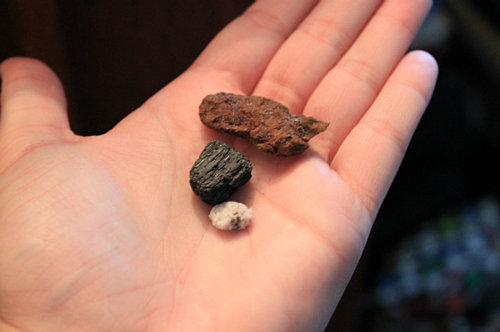
I have one Orchid that survived a mealybug infestation, so I have a couple of extra bags of Better-Gro's 'Special Orchid Mix' sitting around. I only used that mix specifically for aeration at the bottom of the pots, anyway--I use Better Gro's 'Phalaenopsis Mix' for the majority of the pot. It's readily available and I'd rather not let it go to waste. The ingredients are raw fir bark, hardwood charcoal and coarse perlite (pictured below). I know that the mix needs to be finer, especially since most of my plants are juvenile.

If I were to amend this, and add the result to a regular potting soil, do you think that the mix would suffice? My little collection isn't going to perish in mass any time soon, since it hasn't been very long at all since I stuck them in the crap that they're in (a week at most); but I'd like to fix the issue as soon as possible.

This post was edited by thecactuskid on Wed, May 22, 13 at 13:19

Comments (9)

  • 13 years ago

    Personally, unless all of my cactus collection was epiphytic, I'd not use two of those three things, the two being bark of that size and the charcoal. I don't like to use bark anyway (I make up my own gritty mix of #2/#1 poultry grit, Turface and sieved potting soil). It's of course what works for you, but so much of that is experience and environment (the former making the latter understood). There's no reason that I know of to use the pictured materials for a 'conventional' cactus mix, but if you ask 200 C&S Volk, you'll likely get 200+ answers on the subject. Most of the time it's porosity that is a problem. Let's see the other answers you get.

  • 13 years ago

    Hi & Welcome,

    Nor would I use what you're suggesting, to me it's too large a difference in their sizes (tho' I don't use bark in my succulent mixes).

    For the short term, you might just add 40-50% perlite to the mix you're already using & that would buy you time to figure out further what mix you wish to make/use.

  • 13 years ago

    Thank you cactusmcharris, pirate_girl; however, as I said:

    "I know that the mix needs to be finer . . . If I were to amend this . . ."

    I meant that I intend on breaking the bark and charcoal into finer bits. Some of the perlite, even, could do with downsizing. I don't mind working on it, because in the end, I hope, it'll be worth it, and I don't want to end up hardly using those bags at all.

    Do you think that it would be worth a go, or are you standing by what you said above? I'm just curious--I thank you for and am considering all input.

  • 13 years ago

    No, because they're unsuitable, IMO, to begin with - making them smaller doesn't diminish the fact that they're elements I wouldn't use anyway. What are you going to grow in this intended mix?

  • 13 years ago

    Ah, okay. I'm mixing for cacti, succulents, adenium and other container plants that need a medium that drains well, breathes, etc.

  • 13 years ago

    One of the keys to creating a mix that has beneficial physical properties is all the particles being a similar size. That's difficult to do when starting with chunky bits of fir bark. Also, pine bark takes longer to degrade than fir bark, so theoretically it would have a longer useful life.

    Another consideration is how long will the plant remain in the same pot. If you were planting Lithops into a pot where they can conceivably remain for a decade, I wouldn't use anything organic at all, including bark, peat, etc. But a tropical succulent like Adenium needs to be potted up regularly as it grows so there is more flexibility there.

    x

  • 13 years ago

    Oh! Thanks, xerophyte_nyc. I misunderstood what cactusmcharris and pirate_girl were trying to say; that is, I took it wrong, as pure personal preference instead of advice. It's hard to break away from the "organic all the way" mentality, but, given the nature of my collection and what more I've learned, I guess it's time to loosen up and branch out.

    P.S. I hope I didn't come off as rude in any of my messages above; if I did, I'm sorry.

    This post was edited by thecactuskid on Wed, May 22, 13 at 20:35

  • 13 years ago

    Speaking for myself, I did not sense any rudeness in your posts. And even if you were rude, I wouldn't care, it's just a plant forum, LOL!

    Organic stuff is great in the ground where there are worms, microbes and other creatures that process it. In a pot, it's a whole other world - anything "organic" is unpredictable and potentially dangerous for a variety of reasons. Water physics in a pot is also very different than the ground. The Earth has just a tad better drainage than a measly little pot.../sarcasm

    When growing plants in pots, we go out of our way to enable maximum control of the environment, so we have to maximize drainage and aeration and minimize organic breakdown, all while making a feeble attempt at keeping the root zone at a suitable temperature range to keep rootlets alive. Lucky for us succulents can tolerate all this abuse.

    x

  • 13 years ago

    Ha, too true. I felt bad, though, because I tend to be short and frank when I'm trying to problem-solve; so, if anyone did find me rude, know that it wasn't intentional or spiteful.

    Anywho! Thank you again, x. That makes a lot of sense.

Sponsored
Haus Studio
Average rating: 4.8 out of 5 stars28 Reviews
Franklin County's Preferred Custom Cabinetry & Design Studio