Software
Houzz Logo Print
linda_denman_island

Question about agave protection

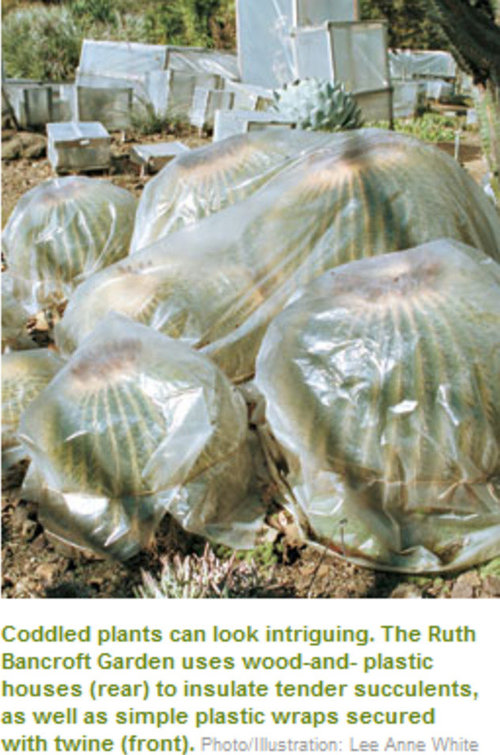
I'm wondering if anyone has seen larger agaves protected with plastic in a way that is similar to what they do with some cacti at the Ruth Bancroft Garden? All they use is some plastic and twine to protect them from the winter rain. Covering a cactus in plastic does not seem at all intuitive to me, but it seems to be effective, so it has me wondering if this would work with other succulents too.

The pic below is from a Fine Gardening article:

http://www.finegardening.com/how-to/articles/shelter-plants-from-winters-worst.aspx

Comments (13)

  • 14 years ago

    looks like a death sentence to me, it also seems the know what they are doing. I wouldnt dare try this tho!

  • 14 years ago

    I know!! It seems crazy, but I also assume they know what they're doing. I would love to be able to protect some of my agaves this way, but am afraid to try!

  • 14 years ago

    I would build a structure or even just use a large tomato cage and not completely cover with plastic so that there is air circulation. Plastic will hold moisture. Perhaps in that situation the soil is very dry. I plan to do something like that to keep the rain off Aloe thraskii this winter. Read in a couple places that it wants a dry winter and rot can start in the crown if it is wet. So a little structure it will get, a wire cylinder with a foam-core board roof.

    Remember the Agaves will be less cold sensitive if they are kept dry. Wet & cold more lethal than dry cold.

  • 14 years ago

    Hoovb, thanks, I really like your idea of a large tomato cage partially covered in plastic - brilliant. I'm going to try that. I use a clear umbrella for one agave, but it's not so great and can get damaged when we get heavy/wet snow or really strong winds. At least the tomato cage/plastic would be easy to put back together if needed... The area I'm thinking of is a fairly large slope with agaves scattered here and there and building a structure is not really an option, at least at this point. I have a few structures in another area and they work well. Sorry the pic below is from out the window, so it's not the best.

    Wouldn't a foam-core board roof keep too much light out?

  • 14 years ago

    You have some nice structures there!

    Foam core will just be for the rainy days, all 4 or 5 of them, scattered over 6 months. Western WA, on the other hand...

  • 14 years ago

    Right, it's the other way around here - about four or five nice sunny days scattered over six months. A bit of an exaggeration, but not much!

  • 14 years ago

    I have heard that planting the Aloe thraski at a slant helps the rosette to drain nicely. In nature they grow at a slant naturally.

    I have seen people put pots over cactus with a rock to hold them down. I will sometimes stuff my pots with leaves. Norma suggested Bubble wrap for the tender cactus.

    If you get 1/2 inch or 3/4(the thinnest most flexible that you can find) thin PVC ( it comes in two wall thicknesses. Jam four 1' rebar (that fit into the PVC pipes into the ground in a square pattern around your agave. Then make two horseshoe shaped curves with your PVC and put it on your rebar. Tie them together where they intersect and cover with plastic. I use the large paper clamps one gets at office supply stores to secure the plastic. If one wants to get fancy. One moves the rebar out as the agave get bigger. I do this for warmth on some of my agave. rot comes from cold and not too much from dampness. I like the frost row covers that come in different weights. Our most severe cold snaps are normally dry as a bone but not always. 3 day ice storms where trees fall down have happened more times than I like to say.

    Linda, it looks like the slanted structures are too far off the ground and wind driven rain coming in on the sides. How about wrapping the side where the wind comes from with plastic. If you wrap a wire cage mack sure the wire ends have something cushioning them because they will rip holes, but you knew that didn't you.

    I had a early near frost but now we are back to the eighties as soon as it warms up. I tossed a few towels on the sensitive stapeliads. I am on a tall hill so my cold air slide off into my neighbors and his heat is radiating off my uplands. their is a 10+ degree difference at this time of year. Weird. Micro climate are a reality here. I can see my cars thermometer swing upwards as I drive around the hill, pull down my street and into my driveway. If I said that I planned it that way, I would be lying.

  • 14 years ago

    I don't think those wrapped golden barrel cactus stay that way for the whole season, as they aren't cold sensitive at the Bancroft as much as they are sensitive to staying too wet. I suspect that they only wrap them during storms, and remove the wrapping inbetween storms. As you can see by the cages beyond, which mostly protect cold and wet sensitive aloes and other things, those are constructed so as not to touch the plants, and do enclose them closer to the ground. For plants that aren't as cold sensitive but do appreciate rain protection, there is a large planting area that is actually covered year round by a shade/rain roof, mostly to protect the Echeverias and Crassulas. Further protection can be added as needed by closing off the sides from the top with plastic if necessary, but isn't left enclosed the whole season either.

    The entire setup amazes me, quite frankly, but then again I am spoiled by living right on the bay, where it doesn't get nearly as cold, and I don't grow many succulents that can't take the winter rains we typically get. Some years things like Senecio mandraliscae or Agave parryi will rot out if they stay too wet, but I've learned to plant these on slopes or raised mounds and amend soil for drainage, and avoid too much shade in winter.

  • 14 years ago

    Just curious would warping them in burlap as I do for some of my roses be something to consider ?

  • 14 years ago

    Burlap is more for cold sensitive plants. I use it on my palms too. But plastic works best for plants that are wet sensitive. It will keep them dry and provide heat inside of the structure. Just be careful that the plastic doesn't touch the plant.

  • 14 years ago

    I have used a combination of both a blanket and plastic on the very bad frosts . If my agave is large, they are on their own. To much hassle.

  • 14 years ago

    I'm thinking of trying plastic this winter on Agave Tequilliana 'Blue Star' which is in a pot, but too big to move under the eaves for the rains.

  • 14 years ago

    Thanks for all of the comments.

    I have been throwing a heavy blanket and then a tarp over most of the succulents (already protected with the rain cover) on the coldest nights in the winter. I don't think about doing this until it looks like the temps will be more than a couple of degrees below freezing. What I am trying to protect in these areas are Zone 9 plants, so they don't require that much extra warmth most of the time. I bought DeWitt N-Sulate fabric for the first time this fall, so it will be interesting to see how effective it is. An umbrella may be perfect for your situation Elvie. There is an Agave filifera hiding underneath this cheap umbrella and this will be the third winter out. It's flawless from the last two winters. If we get below normal temps (but we won't - fingers crossed)I would also cover with some of the N-Sulate. The down side of the umbrella here is that they can break from heavy cement like snow and/or during windstorms, although they may still be useable despite the damage.