Software
Houzz Logo Print
crenda53

Jade Pruning/Dividing Question

12 years ago
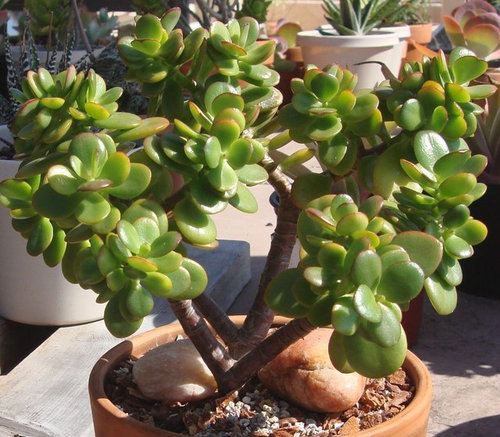
Sorry to ask yet another jade question, but my searches haven't exactly answered my question. Thanks in advance for your tolerance!

I have 12 Crosby's Compacts that came crammed in one pot. I separated them and 2 years later it is time to repot. This is a good time for me to do it - temps in the 80s and not the rainy season. Yes, they need pruned, too, but that will come later.

Almost all of them branch at the soil. There is about a 1-inch stub in the soil that they are branching from and good roots all around. In the picture, there is an immediate branching of the two branches giving me 4 branches at the soil line.

I don't really mind the look, but worry about down the road when everything is heavier. Should these be whacked near the base and rooted for new plants, or should I divide the stem below the soil giving each some roots?

Comments (12)

  • 12 years ago

    I will probably leave some of them alone and see what develops after pruning.

    Here is another example, with a branch in the middle that I may need to remove.

  • 12 years ago

    Hello, I would take them out and take a closer look at the roots and stem out of the pot. Personal preference but I would probably leave the ones alone that share a stem in the second picture. In the first picture, I would take a sterile razor and cut it into two plants. Keep the roots moist with a damp paper towel in a bag, and leave the freshly scarred area exposed to promote healing/drying. After a day I would mist it lightly with water and rub some rooting hormone on it to discourage any rot and promote roots from the area and pot it up in your great looking mix. Good luck!

  • 12 years ago

    I agree that the one in the second pot will probably be left alone. Here is a close up look at the branching on the first picture. I moved the rocks and you can see some roots on the right side near the soil.

    So you think that cutting right through where the 2 main/first branches are will be best? My thinking was also that leaving good roots is a better idea than trying to reroot the branches. I just wasn't sure if the bottom part/stump would be more prone to rot or decay.

    Thanks!

  • 12 years ago

    If the roots look evenly distributed across the trunk, I would split straight through the trunk and roots, with your mix, I don't think rot would be an issue. I have split many jades, and as long as you allow some callousing of the cut on the trunk, and your mix dries out as it certainly will with gritty mix, I wouldn't anticipate any problems at all. With those split trunks, Y shaped, it is nice to take a nice fat rubber band, put it down in the valley of the Y, and stretch it under the pot to securely hold the new cutting in place until new roots establish. Does that make sense? After a month or two you just cut the rubber band to remove it.

  • 12 years ago

    If you're going for the 'mound look', I think you're ok as is. If you're thinking 'specimen', more thought needs to be given to 'trunk' position and the number of trunks - and eventually to branch location and arrangement. Plants with multiple stems look best with 2, 3, 5, or 7 trunks. 4 or 6 trunks in grove or clump style plantings are usually avoided.

    If you have a vision re how you'd like these plants to look several years down the road, I can probably guide you in how to realize your goal.

    Al

  • 12 years ago

    Thank you both for your input! Something I should have told you in the beginning - I am a notorious jade killer. That includes a huge specimen my husband had, although after reading up on this forum I think his was incredibly etiolated. So after learning about soil, sun, water and nutrition from this forum and moving to Florida with a nice year-round growing season, I'm back in the game. And loving it, I might add.

    Al - you have hit on the problem I have. I don't really have a vision of what to do with the plants. With the exception of this plant (which has grown a new branch lower that I need to remove), all of my Crosby's branch at the soil line. They look healthy, and given my history I don't want to upset the apple cart (or jade cart), so I have pretty much been letting them grow the way they want to.

    I will do some more research and I certainly may take you up on the offer to help. I don't fully understand the mound look. I would love to have a specimen plant but all of mine seem to branch low on the growth. This includes my green and tri-color obliquas, the Crosby's and a plain C. ovata that is a baby. I have read how to pinch and promote branching, but not the opposite. Perhaps I am also misunderstanding what a specimen plant is. Like I said, back to more research!

    Thanks again!

  • 12 years ago

    I would simply raise the trunk of that double trunk Jade posted above. If you cut straight down the middle, both trunks will die...so that's not a course of action I'd recommend. The plants look very nice!

    Josh

  • 12 years ago

    I have more experience with killing plants by doing too much to them & they don't recover.

    Jades in particular.

    Given that history, I'm with Josh on this one.

    If it were me, I'd play it safe & root one branch of the Y, then re-orient the trunk of the remaining one.

    Then again, you have lots to play with, even if you lose one or both...with that many plants, I don't think you could go wrong, no matter which route you choose.

    I'd love to see pics & updates as you go, whatever you decide to do =D

  • 12 years ago

    Whatever you decide to do, I agree, those are some great looking Jades! Maybe if you aren't familiar, or have experience with propagating, my suggestion isn't best. I believe I have done it successfully but maybe my memory is foggy, I have been cutting Jades for about 14 years so I could definitely be wrong.

  • 12 years ago

    Crenda. I tend to look at things long term. For instance, the last picture posted would be an easy decision for me. I would chop the entire trunk back to just above the little branch you think you need to remove. The new branch becomes the new leader, and you get a nicely tapered trunk with some attractive movement in it that starts just above the soil line. I would let that branch grow for a year or two and then chop that one back, too. What that does is build a fat trunk that tapers quickly, which makes your plant look much older than it really is, and it imparts interesting movement in the trunk it wouldn't otherwise have. That's a technique bonsai artists use regularly to produce high quality trees.

    Not a jade, but here's an example of a maple that was grown for several years. It was about 6 ft tall when I chopped it back to about 3" and trained a small branch upward as the new leader.
    {{gwi:49581}}

    same tree - mid-summer after it leafed out
    {{gwi:49582}}
    The scar will heal quickly. If you look closely, you can see the callus already rolling over the wound I've trimmed to facilitate wound closure; this, after only about 6 weeks. That isn't necessary with jades or portulacaria. I'll probably do 2 more chops before I start serious bonsai training in about 4 years. I probably have 150 trees that were chopped more than once during their prebonsai training.

    Don't be reluctant to take control over what your plant will look like, and don't be put off by the word bonsai. You can use the techniques bonsai practitioners use to build plants that are much more interesting than those simply left to their own designs. Having that control and understanding how to manipulate plant material (that lends itself to manipulation) adds another layer of satisfaction to the growing experience - much more rewarding than simply watching them grow.

    Here's a portulacaria I've since cut back to correct the heavy branching near the top of the tree.
    {{gwi:3241}}

    For fun, a hardy cactus growing in a pot smaller in diameter than a dime. Use the knap on the terrycloth towel for size perspective. The Turface it's growing in are fines that passed through insect screen.
    {{gwi:50805}}

    Al

  • 12 years ago

    Wow - more to think about than I anticipated!

    Spencer - I have propagated cuttings with success. I have never cut so severely on a plant as to cut it into 2 distinct pieces.

    Josh - you have some lovely jades and I respect your opinion. I, too, was afraid that both would die. If roots are exposed when I raise the plant, will they be OK or might they die back? Is the really bad for the plant, since it has more roots beneath that wouldn't be exposed?

    Hookilau - good to hear from a fellow jade killer! :-) I like your idea as well. I DO have several plants to play with, but of course I don't even like losing a leaf!

    Al - you are correct. The word bonsai does give me pause! Perhaps that is something I need to research further. My mother had bonsai plants, but I never paid attention to how she kept them. That portulacaria looks amazing!

    Nothing says I have to do something tomorrow, so I will consider all ideas and research those with which I have no experience. In the long run, I just want healthy plants that are pleasing to the eye. Or at least my eye.

    That again folks! I'll keep you informed on what I do!

  • 12 years ago

    FWIW, I've been helping growers in my community and on garden sites like GW to learn how to apply some of the easier bonsai techniques to help them keep their plants at their best. When growers seem reluctant to adopt a practice that hints of bonsai, I usually frame bonsai it in the contexts it's just another form of container gardening. Jumping off a diving board is diving, but there are 'difficulty factors' associated with dives like a triple somersault with 2-1/2 twists. Bonsai is like container gardening with a difficulty factor. The best of THAT is, no one enters diving with the ability to perform intricate dives, but they can still 'dive' off the board. Same with you. Trust me - if you chop that plant back above the little branch and wait for it to grow a while, you won't kill the plant, and you'll have the potential for a very unique plant ..... even if it's only the shape of the trunk that's unique.

    Some of the simplest of bonsai practices (like the soils used and regular root maintenance) are techniques that allow bonsai artists the ability to keep their plants healthy and beautiful for generations. Whereas, most houseplants are left to their own fate, dying usually of root congestion due to lack of care, or an accumulation of salts in the soil because the grower chose a soil that didn't allow the plant to be watered appropriately w/o the probability of root rot entering the picture, so forcing the grower to water in sips, never flushing the soil of the accumulating salts.

    Your plant - your decision. I'm just offering encouragement in the hope it will help you make the first step toward your being in control of what form your plants take instead of the plant being in charge.

    BTW - you can correct the growth habit that causes the plant to grow in a trifurcated pattern. When you start a cutting, snip off the branches on the cutting flush to the trunk. Plant your cutting at a slight angle. When the cutting strikes, prune ALL active buds off the plant except for 1 bud that faces the direction you want it to grow. If you do that, you won't have a problem to correct later. Don't be afraid to prune your plants or remove buds in places that, after the bud turns to a branch, will spoil the vision you have for the plant. Even if YOU don't know what looks awkward, your eye does. Branches or trunk arrangements that draw your attention and leave you visually confused are your eye's way of telling you something is off.

    Al