Software
Houzz Logo Print
fairfield8619

Keteleeria

13 years ago
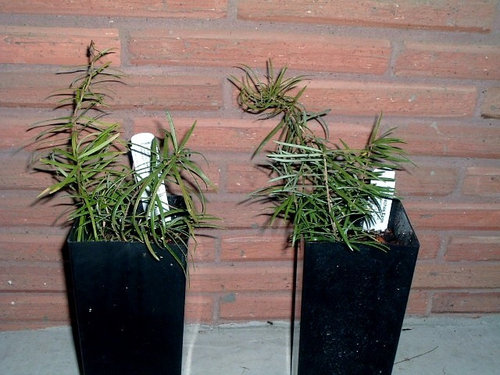
Just out of the box. These will have to be potted up I think until they can go it alone. Vaguely looks like the Cathaya to me at first glance. Glad to have them.

Comments (13)

  • 13 years ago

    Nice addition to the rare and unusual collection. Where did you get them? Are they davidiana or evelyniana?

  • 13 years ago

    They are davidiana and came from Far Reaches Farm.

  • 13 years ago

    They look quite a bit different from my davidiana - I know there is a lot of variability in this species.

  • 13 years ago

    This would be the first that I've seen in person, I really don't know what they should look like.

  • 13 years ago

    I received my plant too... they have very long needles.. The source is suppose to be the Dayaoshan...

    osprey

  • 13 years ago

    "The source is suppose to be the Dayaoshan"

    Looked that up; it's a long way south, in Guangxi prov.:
    Latitude: 23ð 30' N
    Longitude: 110ð E

    So might not be a very hardy source.

    Resin

  • 13 years ago

    Looks to be fairly mountainous so it would probably be ok for me. It has not been very cold here for many years. Low here this winter was 29F, at the old house the upright elephant ears have not died back for at least two years and now have "trunks" on them about 2ft tall and about 6in in dia. That tells you how warm it's been.

  • 13 years ago

    Only time will tell.... seems to be one of the southernmost stands of K. davidiana... I need it to be hardy to -10F!!!

  • 13 years ago

    I got one of these from them as well... I ought to be able to give it a good hardiness test.

  • 13 years ago

    The highest elevation in the entire Guangxi province is only 7000 ft.; to the west the city of Kunming at 6200 ft. (and surrounded by higher mountains) has a 30 year low of 18F/-8C. The area those trees were supposedly collected shows up in Google Earth as having at most an elevation of 2000 ft. - unless they trekked through wilderness many, many miles north of there. Seems unlikely. It's probably in the "Longtan National Forest Park". Since Hong Kong isn't far away and its all time record low is 32F/0C, it's safe to assume this area's record lows are only in the mid 20s. And zn 10 normally. But, very few non-tropical plants seem to be less than 1 zone hardier than their native range, and are usually more so. It would seem they should at least be zn 8b hardy. The present day location where Metasequoia was discovered is certainly no colder than zn 8, but the plants have proven hardy to zn 5.
    So probably OK for Fairfield, not for me or Osprey.

    BTW wherever they came from, kudos for Far Reaches Plant Farm for at least having them. They carry many super rarities and seem to be filling the niche left by the late lamented Heronswood, which once listed this plant.

    This post was edited by davidrt28 on Sun, Apr 28, 13 at 16:07

  • 13 years ago

    Well, there was one at the UW Arboretum for at least several years, that seemed not to have any problems with cold winters, anyway; until it was chopped by vandals. Although that may have been K. evelyniana, I can't remember.

  • last year
    last modified: last year

    Here's another snippet from an article from Taiwan some of you may be interested in:

    ... the Taiwan cow-tail fir (Keteleeria davidiana var. formosana), was taken off the list of the Cultural Heritage Preservation Act in 2009 thanks to the restoration work of the Forestry and Nature Conservation Agency. The success story represents a famous case in the conservation of endemic flora.

    The Chinese name for the genus - youshan ("oil fir") - is apt: Chung tells us that when a colleague drilled into the wood, "there was an eruption of oil-like sap." Tall and straight, and with close-grained wood, the Taiwan cow-tail fir was used by the Japanese to make railway sleepers, and by residents of what is now New Taipei's Pinglin District to make furniture. As one of the few conifers that thrive at low elevations, it has also been a horticultural favorite.

    In addition to celebrated specimens in the Taipei Botanical Garden and at Pinglin Elementary School, there’s an old Taiwan cow-tail fir off Taipei’s Jinshan South Road with a history stretching back to 1931, when the island was under Japanese rule. Also in the capital, two Taiwan cow-tail firs flank the front entrance to the Presidential Office Building on Chong­qing South Road, as if standing sentinel there. They have engrossed many passersby with their luxuriant foliage and attractive cones ...

    Even though Taiwan cow-tail firs produce reasonable numbers of seeds, their germination rates are low, which affects their chances of survival in the wild. With a view to helping them survive, researchers have used tissue culture technology to induce immature seeds to germinate. Other methods, such as establishing pollen banks and field gene banks, also help ensure the perpetuation of this precious ancient species.

    The Four Legendary Trees of Taiwan, Cindy Li, Taiwan Panorama, November 2024

0
Sponsored
NME Builders LLC
Average rating: 5 out of 5 stars2 Reviews
Remodeling Company in New Albany, Ohio