Software
Houzz Logo Print
breasley_gw

Cukes for Pickles

18 years ago

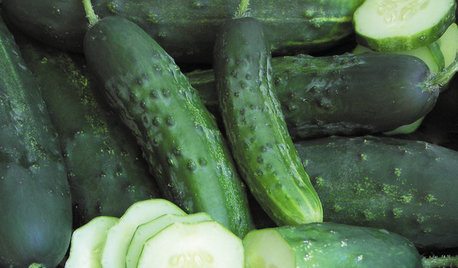
I have some County Fair seeds to grow this year. I understand if you grow only this variety they are nearly seedless. Is that a good thing for pickles or should I grow other varieties also? I notice that some people recommend growing several varieties. What is the benefit of growing more than one variety?

Comments (14)

  • 18 years ago

    Cukes don't grow extremely well in my soil. The sandy stuff works best. And you never know what kind of climate you're going to have -- extra warm, lots of rain, etc. If you mix your varieties, you kinda cut your losses if you've chosen one that doesn't do well in your garden. County Fair is supposed to be disease free. National Pickling is also good. Everyone has a favorite, I'm sure. Several varieties will also give you a wider time frame for picking.

  • 18 years ago

    I don't know the variety but last year was a great one for me and the many pickles I canned. I did Hot dills, reg. dills, Sweet dills, B&B and Sweet chunk. A vendor at our Farmers Market kept me supplied. I never asked for the name but the pickles were fresh and had very small seeds. I could barely see the seeds. I hope he has the same pickles this year.

  • 18 years ago

    I haven't grown County Fair, but it is billed as a pickler and has the characteristic appearance of a pickler in the pictures. IMO, seedlessness would be an advantage in pickling. The pickles would be more firm all the way through, with no tendency toward hollowness.

    Because of its disease resistance, it would probably be a good risk if you were to grow only one variety. I don't plant slicers because I like the picklers for fresh use as well as for pickling.

    Jim

  • 18 years ago

    Seedless types do need a pollinator. You may get some seedless, or very soft small seeds (common with picklers), but the amount the plants yield may be quite low. For instance, I plan to grow seedless watermelon (in the same family as cukes), and the very necessary need for a pollinator to help them form melons. The seed company said a seedless could have a couple of true seeds per seedless melons, but no melons if there is not a seeded variety nearby to pollinate from. They said to grow twice the amount of pollinators to the amount of seedless ones. The seedless watermelon seeds cost me about $20 for a pack of 15 seeds. There is also a benefit to grwoing a couple of types in that you will get a much larger amount of cukes from each plant. If you do plant a seedless cuke of the type mentioned, you would only need maybe one or two pollinators nearby. Disease can be easily controlled by Serenade antifungal sprays, and the cukcumber beetles can be trapped on yellow sticky traps with sex lures attached. Last years cukes were very healthy plants and yielded all the way to the middle of September. I've grown County Fair type for several years and always plant a few othee types along with them. Currrently I have some kind of 'vine' with tendrels growing under an evergreen bush. Must have been dropped by a bird. I let it grow and its now a fot long. Well before anything else is even planted. I am leaving it there in my lawn, just to see what it turns into. Might be a big pumpkin? I also agree that slicers are not good candidates for making pickles. I don't even buy regular cukes for salads.

  • 18 years ago

    I grew an heirloom white skinned cuke last year and sold it at my Farmers' Market for slicers (sold out every day) and I also used it to make pickles. Wonderful flavor, not bitter, thin skinned (no peeling needed), I'd say pretty close to burpless, and so pretty dill pickled. They are quite a bit smaller and wider than National Pickling, which I also grow every year for pickling. They are a lot easier to find when harvesting too! I saved the seed but I didn't know that they cross-pollinate so those seeds are probably worthless. I have two seeds left from the original bunch so I am hoping they germinate! I also did not write down which of my gardening buddies gave me the seed! Woe is me.

    Nancy the nancedar

  • 18 years ago

    Most al picklers are thin skinned and I never peel them. If I were to use reruglar cukes, they get either totally peeled or stripe peeled. Now I am waiting to see if anyone wants to mention English cukes. They are very tender and are not good for picking.
    Try these:
    http://www.johnnyseeds.com/catalog/product.aspx?scommand=search&search=white%2bcucumber&item=2940

    Here is a link that might be useful: White cukes

  • 18 years ago

    Most seedless cucumbers do not need a pollinator. Some all-female varieties will set fruit without pollination. They will then be seedless. If pollinated, they will have seeds, but the cukes will still be good. Examples include the gherkin Cool Breeze and the Middle Eastern type Diva. A few zucchini varieties, such as Greyzini, will also set fruit without pollination, and those fruits will be seedless. After the insects and male blossoms come out, fruits will have seeds.

    Some (expensive) greenhouse varieties of cucumbers set nice, mild seedless fruit without pollinatin but are inferior when pollinated. Therefore, these varieties are not grown in the garden.

    Other all female varieties of cucumber need a pollinator to set fruit, but the fruit will have seeds. Examples include Orient Express and (I think) Sweeter Yet. Commercial growers like all-female varieties because of their productiveness. They are typically sold with a pollinator variety included in the packet. If not, responsible seed houses will note that they should be planted alonside another cucumber variety.

    The seedless watermelon analogy doesn't exactly fit, because breeders have not, to my knowledge, developed an all-female watermelon which will set fruit without pollination. Seedless watermelon varieties have an unusual number of chromosomes and cannot set fruit by themselves. They must be pollinated by a "normal" watermelon variety.

  • 18 years ago

    Even for that, the seedless watermelons do have seeds, but not big black ones as normal. Instead they are small soft white seeds, that are hardly noticeable. The seedless watermeon seeds I have here actually came from seedless melons, as once in a while a melon will produce a very few bigger black seeds. Cukes that are described as seedless, are similar in that they have very small soft seeds in the core. Pickling cukes in most cases have thinner crisper skins, and very small soft seeds. Most packets I buy for pickling cukes mention growing two types just to increase productivity. Not to compare, Blueberry bushes also do better production wise, if there are a couple of types growing in the same area. Corn, on the other hand, do not like to see a mix of SE and SH or SH2 types in the same area, as they are all ruined by the pollen of the other types planted nearby.

    I grew a small, short very light green cuke, along side other regular types. Its shape was like a short Italian sausage, with no bumps, and no smaller blossom end. The plants produced only about 6 of these all summer, and was a poor choice. Luckily, there were plenty of traditioanl picklers nearby.

    On a side note, get your dill seeds growing. I planted several dill types in March, and all are an inch tall now.

  • 18 years ago

    ksrogers,
    Your description of small, soft seeds or seedcoats in seedless watermelons and cucumbers is accurate. The "structure" is there for seeds, but the seedcoats do not fill in with viable seeds.

    When you notice a fertile seed in a "seedless" watermelon, you have a chance for a fun experiment in growing it out. If you ever see a seedless cucumber described as "triploid", it needs to be grown with a pollinator just like seedless watermelons, whether the "mother" plant has male blossoms or not. I haven't ever seen one described this way, but that doesn't mean they don't exist.

    Gardeners need to be aware which all female (cucumber) varieties need a pollinator, especially if only a few plants will be planted out - you could get zero fruit with no pollinator. On the other hand, if one wants only seedless cucumbers, it is necessary to grow only all-female varieties which will set fruit without pollination.

  • 18 years ago

    Yes, my seedless watermelon is the triploid type. Seeds are quite expensive and have only about a 90% germination. I started 10 seeds of the triploid, along with 20 seeds of diploids of two types. Only got a total of 25 plants. The seed varieties will encircle the seedless ones.
    Odd, I am now seeing few big round first leaves emerging from seeds that were probably dropped by the wild birds. One is out in front of my house under an evergreen shrub. It has tendrils on it and the leaves look like cuke leaves. It had a good start and is almost a foot long. It may be a pumpkin, but I wasn't the one who planted it. Same out back, next to some blueberry bushes, where I see two more of the big primary leaves and some cuke looking leaves with tendrils. Can't be sunflowers, or I could be wrong. My wild bird seed mix has many seed types. I'm letting them grow, and just had to spray neem on the one out front to kill whatever is chewing on a few of the leaves.

  • 18 years ago

    I've had some pretty decent volunteers from the cucurbit family and some really awful ones - particularly the F2 generation from hybrid melons. One can get some weird volunteer squashes, too. In our mild-winter climate, we get a lot of volunteers, and it's tempting to grow them all out. Takes a little discipline (at least for me) to dig up the ones which I know it will be impractical to grow.

  • 18 years ago

    How about this 'volunteer'. It showed up in a packect of Harris seeds for growing Buttercup squash. Its a foot long, ad has an inside like a deep orange pumpkin. Not only that, I collected its seeds and the plants it grew were identical in shape, until the woodchuck chewed them all to death.

    {{gwi:881056}}

  • 18 years ago

    First a rogue squash, then a rogue woodchuck. Always a few surprises in gardening.

  • 18 years ago

    I still have a big bag of these seeds, and I must plant a few this year, just to keep the seed supply viable. The squash was grown 4 years ago, and is bewteen the obvious buttercup types, all from the same seed packet. I am quite sure they will grow into the same kind of shape as the original, but at least that monster from hell woodchuck is gone to woodchuck heaven (or is it hell?).