Software
Houzz Logo Print
james_m_clark

An idea for wintering herbs

17 years ago
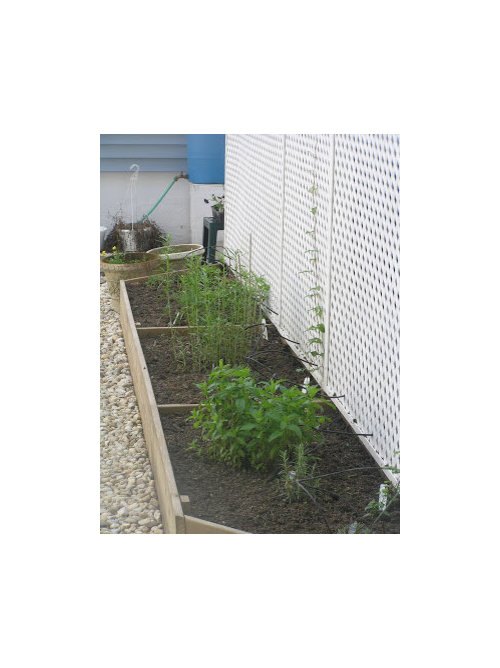
I had been growing herbs in containers, but last year I built this raised bed 9 inches high, 27 inches deep and about 18 feet long:

From Trellis Project

(I mix in a few flowers for color, and grow clematis to climb on the lattice that rests on the back edge of the raised bed.)

I found that not all of my herbs survived the winter in this bed. so I thought of making a structure that I could put on top each winter that would convert it into a cold frame. The raised bed is already divided into three 6-foot sections, so I would make the cold-frame topper in three corresponding sections to make it easier to add and remove, and use clear plastic instead of glass to reduce the weight.

The back of the cold-frame topper would provide ventilation via the lattice, but this might be too much ventilation, so I am thinking of hanging a curtain of black porous plastic as the back wall of the cold frame. I have left over some black porous plastic made for a weed-stopper under a crushed rock path that I could use. The black plastic would absorb heat from the sun and help to heat the cold frame.

But the soil level of most cold frames is at or slightly below ground level, and mine is 8 inches above ground level. I am afraid some cold may enter (or heat escape) through the side walls. Perhaps I could set aside some of the bags of leaves I collect every fall to lay alongside the raised bed all around for insulation, then dispose of the leaf-bags each spring. The leaf-bags are heavy paper that can withstand rain for a week or two, but for a whole winter I probably would need to put them into plastic trash bags. These plastic bags are generally black, so that would be another heat-absorber.

What do you think of this plan? Would the ventilation be too much or too little, or would it need to be adjustable? Is the leaf-bag idea over-doing it, and too much trouble for what its worth? Anybody have experience with a raised cold frame? I am in zone 6b in northern New Jersey.

Jim

Comments (8)

  • 17 years ago

    I suppose I should list the herbs that I am growing, because maybe for some herbs, they may not survive winter no matter what I do. (I am fairly new with growing herbs, so I am still learning.)

    1. basil - 3 kinds
    2. parsley
    3. Dill - dwarf fernleaf
    4. Sage - white
    5. Tarragon
    6. Thyme, English
    7. Oregano - 'Kent beauty'
    8. Peppermint
    9. Rosemary - 'blue spire'

    1. Lavendar = 'coconut ice'

    Only the tarragon and peppermint survived last winter.

    Jim

  • 17 years ago

    1. basil - 3 kinds Annual. Won't survive winter temperatures plus it is an annual which means 1 growing season life cycle.

    2. parsley biennial. Two-year life-cycle ending with a blooming and fruiting phase. If it bolts (blooms) in its first year, it will not come back the second year.

    3. Dill - dwarf fernleaf Annual. 1 growing season. No coming back either. Although it spreads its seeds quite vigorously.

    4. Sage - white - White Sage Salvia apiana is hardy to zone 8. Sorry, not hardy in NJ. Try regular sage, salvia officinalis. Comes back every year for me - I'm in Western NY State.

    5. Tarragon - French tarragon is a hardy perennial in your zone.

    6. Thyme, English - Common Thyme is a hardy perennial in your zone but needs lean, well-drained soil.

    7. Oregano - 'Kent beauty' - Should be a hardy perennial in your zone.

    8. Peppermint - A hardy and vigorous perennial in your zone.

    9. Rosemary - 'blue spire' - The variety "arp" is one of the more hardy rosemaries and I have not ever been able to over-winter it. I know other gardeners in my area that have. I didn't check the hardiness for "blue spire" but I would try a variety like "arp" noted for hardiness.

    1. Lavendar - 'coconut ice' - Plant files say this variety is one of the english types and is hardy to zone 6a. I've had the best luck with "munstead," another english variety. Lavender, like thyme, needs lean, well-drained soil to survive.

    FataMorgana

  • 17 years ago

    Thanks, FataMorgana, for your analysis. In summary, three of my herbs (1,2,3) will need to be restarted every year, and four (5,6,7,8) are definitely hardy. Sage will be hardy if I switch to the regular kind. Two (9,10) are marginal. Lavendar might do better if I switched to the "munstead" variety. Rosemary may be the only herb that would benefit from the cold frame idea.

    The herbs that failed last winter may have failed because they had been transplanted from pots, and may not have had a chance to rebuild their root systems before winter. Perhaps I should see if the Thyme and Oregano survive next winter before trying the cold frame idea.

    Judging from another thread on this forum about mint, maybe I should have left my Peppermint in its pot, or plant it pot and all in the raised bed, to prevent spreading. Earlier this year, I pulled up and gave away half of it.

    As for the Dill, I suppose I can 'preserve' it by seed. If I let it drop its seed in the bed, I feel I will not have enough control over where it grows. But I am not sure how best to harvest the seed, and when to plant it.

    You said that Lavender and Thyme need lean, well-drained soil to survive. Does 'lean' mean not much compost? My herb bed is well-drained because I mixed a lot of sand with the soil, and the raised bed helps drainage. I automatically water the bed with a timed drip system. Do the Lavender and Thyme prefer less water? If so, I can move the drip stakes further away from them.

  • 17 years ago

    Check back within this forum for ways to keep dill weed under vacuum in canning jars. allowing it to go to seed will make it sprout everywhere in your garden. Mine is coming in cracks of my walk, and around areas where it could never grow if I planted it there. Mine is mammoth and is over 5 foot tall and all is start to form the seeds.
    {{gwi:904919}}

  • 17 years ago

    Wow ! ksrogers,

    Your dills and basils are really mammoth.And still growing!
    My dills are getting tired and old. What do you expect with daily highs of over mid 90s for nearly 2 months? Georgia is hot. New England has generally very nice summers. I have lived in Connecticut(SW) for many years. I have heard that you have had a very wet and cold season so far. Last week wee had couple of TStorms that dumped about 5 inches of rain. That was nice! I don't need to water my gardens for another week.

  • 17 years ago

    KS, your greenhouse looks very much like the one in Bertha Reppert's herb garden in Mechanicsburg.

    Thank you for sharing your lovely photo.

  • 17 years ago

    If you are somewhere that frost line penetrates to a depth of , say, 18 inches it would be very difficult , if not impossible to winter certain plants and herbs.
    But if the winter is not that harsh, you can winter them by a simple method: pile up lots of dry leaves on your plants, (about 2 feet high, semi compacted) cover with black plastic sheet, nailing it around so the wind won't blow it away. Also make sure that water will not get under it. This way, the ground heat loss will be minimal and will be replenished.Usually, ground temperature is higher than 50F(way bellow)maybe more. The dry leaves, with lots of air trapped between them, will act like an insulatoer.
    Also, black plastic can absorb sun heat.
    If you get a lot of snow, to cover it, it will act like as insulator too; i.e. better than bear ground under harsh cold.

  • 17 years ago

    Someone can correct me if I'm wrong, but I suspect that being buried under leaves and black plastic will not loved by sage, rosemary, thyme, or lavender. I suspect that they would rot under such conditions.

    If you pick the right plants for your zone, they can do very nicely with minimal special handling.

    Here's a picture from the first winter with some baby sage (s. officinalis). They are now very robust going into their 3rd year. No mulching and they are in an open bed with zero protection. My lavender and thyme have similar conditions.

    FataMorgana