Software
Houzz Logo Print
mary_palmer4077

Snow load on Betula utilis jacquemontii !

19 years ago

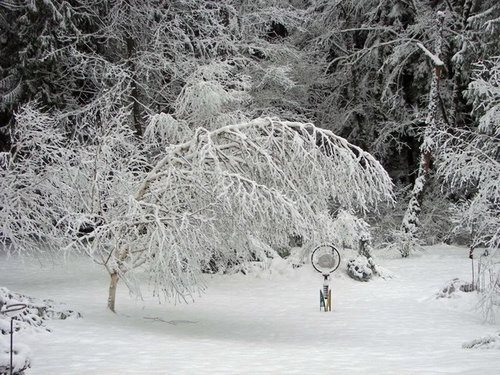
Is there any hope of this tree returning to its upright form? I have searched the Internet for information on this and came up with nothing. I was hoping someone on this forum might have had some personal experience with this problem. I have five of these in a clearing in the woods on our seven acres. It's heartbreaking to think of removing them as their white bark is a real treat against the towering dark conifers in the winter!!! (getting rid of the conifers is not an option at this point as they are in zoned forestland) This one is the photo below is the worst of them. Does anyone know why some might do this and others don't. The trees have been planted here since about 1996. None of the trees are in soggy soil as I know they don't like that. Was it a genetic defect or? Is there a different tree with "light" colored bark that might be more suitable in this woodland opening? Any help or suggestions are most welcome!!!

Comments (15)

  • 19 years ago

    If they don't crack they may straighten. I have found with other trees maximum recovery can take many months. We had a huge number of 8 to 10 year old Douglas firs which remained bent way worse than this for many months after the ice and snow. I had given up on them thinking they would have to be removed as they had lost their timber potential.......I think it was the middle to the end of the next summer before they recovered and I have seen similar recovery from other trees. jwww

  • 19 years ago

    Birches are also prone to ice buildups, as are alders. Fast-growing, sun-loving trees for open positions.

  • 19 years ago

    Thanks Judywww. It sounds like there might be hope so I'll put the chain saw down for now! I just worry that it will start sending up watershoot-like growth next spring/summer then look really odd.

  • 19 years ago

    It looks like it is planted too close to the conifers in the background giving it a little bit of a lean to begin with. I have the same thing happening with a Larch, Katsura, and a Styrax. The lean isn't apparent until they begin to get some height. One of the most suseptible trees that is sensitive as to where the light is coming from is Cryptomeria japonica, 'Elegans'. It has to be way out in the open to avoid leaning.
    You can prune the branches on the downward leaning side to help straighten the birch out, but it will only work for a short while.

  • 19 years ago

    This one doesn't seem to close pruning cuts very readily, either, plus when you reduce the volume of trees grown for bark effect you get less of that effect.

  • 19 years ago

    Now I'm confused. Were the trees leaning before the snow/ice load? jwww

  • 19 years ago

    Yes, Judy. It doesn't take much, and once the snow or ice builds up, over it goes.
    A lot of books suggest planting birches with an evergreen background, but it's a recipe for disaster in the future if the light isn't coming in equal from all sides with regards to Birches.

  • 19 years ago

    So, the overall picute is that they are already weak because of being too close to the big firs with limited light which makes them even more vulnerable to the ice/snow. But they are not cracked. Beginning to sound more and more like what happened with my young firs. The area had been selectively logged after the big blow down in the mid 90s so they were surrounded by mature firs and big leaf maples. Some of them were up 15' to 18' tall and appeared permanently bent at about a 45 degree angle to the ground. They were so bent from so low on their bases that I actually hacked through underbrush to check to see if roots had been tipped out of the ground. The biggest difference is that they may be more tolerant of the limited light and competition from their big brothers. good luck....jwww

  • 19 years ago

    You have to have the evergreen backdrop far enough back to give the birches enough light. This is not that hard, it just needs to be close enough and big enough to be seen behind the birches and set them off. The birches are not small trees, there is a certain minimum space needed to use them anyway. The stark white clone common here may be a little on the slow and compact side as far as it goes, probably encouraging people to stick them into all kinds of places where they eventually will be crowded. Many are planted in close groupings that seem not likely to work out in the long run, such as at 700 Stewart St. in Seattle, where there is a large, conspicuous grid planting sure to become a thicket.

  • 19 years ago

    Hummmmm, now I am thinking I should just put them out of their misery! It sounds like this situation will only get worse over time and more snow. The birches that still look decent are the multiple trunk specimens and I suspect it is a matter of time before they suffer the same ending. I planted all of them far apart so as not to crowd them and they are anywhere from thirty to fifty feet from the forest. Obviously not far enough! As Ron mentioned, many people frequently group these trees close together. I have also observed this and was starting to think it was so they might support each other in times of stress..... Has anyone ever pollarded birches. I am tempted to try it before I have them totally removed. Hope Cass Turnbull isn't reading this......

  • 19 years ago

    30 to 50 feet from the firs would seem sufficient. They aren't on the north side or completely surrounded are they? jwww

  • 19 years ago

    In not much is broken, there's hope.

    Even if it doesn't straiten all the way up, you could put a tie in the upper third, and lead it to another tree trunk of something. It would only need to be braced straight for several months - then the string or rope could be removed.

  • 19 years ago

    Unfortunately they are on the north and west side of the evergreens and this time of year they get very little sun. Since the snow and ice have melted, the tree is starting to correct itself a bit. I won't do anything rash right away!
    Thanks for everyone's thoughts on the mater.

  • 19 years ago

    I'm glad you are going to give them a chance. I think the most correcton will occur after the sap rises in the spring. jwww

  • 19 years ago

    Interesting follow up on this subject. Don Marshall (horticulture teacher at Lake Washington Voc Tech) approached me at the NW F&G show . He had helped me with some pruning in my garden a while back. I told him about the damage from the snow to the tree in the photo. I doubt if he remembered the exact tree, but he said if the birch had Sap Sucker damage, it would not recover to an upright position!!! When I got home and looked at the tree, sure enough, the tree in the photo with the snow and ice damage had the worst Sap Sucker damage!!! Interesting. The other birches with Sap Sucker damage had also suffered more from the snow and ice than those without the Sap Suckers presence. Paper Birshes are one of their favorites! Bummer!!!!!!

    Here is a link that might be useful: http://www.na.fs.fed.us/spfo/pubs/misc/sapsucker/ne-136_cover.htm

Sponsored
Landscape Management Group
Average rating: 4.9 out of 5 stars33 Reviews
High Quality Landscaping Services in Columbus