Software
Houzz Logo Print
homernoy

Got a great deal on Gingers

20 years ago

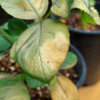
I think things are changing around the Bremerton area. I go to little nurseries that used to sell roses, Azaleas,and perenials at most are comming up with some really great stuff. I just bought a 15 gallon Hedychium 'tara' for $29! Here are the pictures. I have five 'tara' Hedychium, but the very. These are by far the most beautiful, and the cheapest!! I guess I am just happy sorry for all the pics on this forum, but I am a picture fanatic. Not for me posting the, I just love to see others post pics, so I do the same hoping one or two of you out there get some enjoyment.

-Brian

{{gwi:1086969}}
{{gwi:1086971}}
{{gwi:1086973}}

Comments (7)

  • 20 years ago
    last modified: 11 years ago

    That one is a Hedychium densiflorum cultivar.

    "A considerably finer form was collected from Eastern Nepal by A.D. Schilling in 1966 and named 'Tara' in 1982. It has fine large spikes of light orange. This has proved hardy in Surrey."

    --G. Thomas, PERENNIAL GARDEN PLANTS

  • 20 years ago
    last modified: 11 years ago

    Hi Ron.

    I purposely don't use the species name when referring to this plant, for I have seen some fierce debates on the subjuct, getting into technical details, and even claims of DNA identification on one U.K. forum a few years back. Here is some recent information on the plant, that includes a link to the well known information you posted above.

    -Brian

    "Hedychium coccineum 'Tara' AGM

    This is a superb, strong growing plant for the garden with leafy shoots to 2 m, lovely glaucous foliage and spikes of spectacular orange to orange-red flowers 30 cm or more in height.

    In 1993 'Tara' was awarded an AGM by the RHS and given the hardiness rating H3. This indicates that the RHS suggest that the plant is "hardy outside in some regions or particular situations or which, while usually grown outside in summer, needs frost free protection in winter e.g. dahlias". We think that 'Tara' is much hardier than this implies and it does not need to be lifted each winter like a dahlia. Indeed, lifting 'Tara' every winter like a dahlia would almost certainly prevent it from ever flowering. 'Tara' is one of the hardiest and most reliable of the Hedychium for the open garden and remains green and leafy until it is frosted. 'Tara' does benefit from mulching in severe winter weather where frost is likely to penetrate the soil significantly but this is hardly necessary in most situations.

    There is some debate as to whether 'Tara' should i) be classified as a form of Hedychium coccineum as it was originally by Brian Mathew or ii) classified as Hedychium gardnerianum, as has been suggested by Tom Wood or iii) treated as a hybrid. We can so far see no convincing reasons for treating it as H. gardnerianum so we have kept it here under H. coccineum pending formal publication of any nomenclature change. Whether in the garden or under glass we find that each inflorescence bract of 'Tara' produces 4 to 6 flowers in succession. This is similar to H. coccineum but different from H. gardnerianum which produces only 2 flowers per bract and at the same time. Although some people report otherwise, 'Tara' seems to have very little scent in our experience, even in the evening. Again this is similar to H. coccineum but different from H. gardnerianum which is heavily fragrant. On the other hand, 'Tara' seems very similar H. x raffillii and H. x kewense which are reputedly synthetic hybrids between H. coccineum and H. gardnerianum; perhaps 'Tara' is a naturally occurring hybrid between H. gardnerianum and H. coccineum.


    'Tara' originated as a 'blind' collection of seed by Tony Schilling in Nepal. When the seed germinated at Wakehurst Place the plants proved remarkably uniform and the group of seedlings (a grex) was eventually named 'Tara' in honour of Schilling's daughter. The word "tara" is Nepalese for "star". Since 'Tara' originated as a grex and not a clone there is the possibility for some variation in the plants in cultivation; this may have been increased by nurserymen raising Tara from seed. We have one clone of 'Tara' that produces abundant pollen whereas another produces none. Variability in the cultivar may also explain occasional reports of 'Tara' being noticeably scented."

  • 20 years ago
    last modified: 11 years ago

    Above excerpt looks familiar. They don't even mention H. densiflorum. Plant certainly doesn't look like it. Being different species would explain it being "considerably finer." Such mis-placement of cultivars is not unseen elsewhere. For another example (it's actually an American ash, thus the "superior foliage characteristics")...

  • 20 years ago
    last modified: 11 years ago

    Saw one at Molbak's recently and bought it. "Rare" plants become garden center fare whenever a wholesale grower picks up on them and makes them available to general retailers. It also depends on garden centers having buyers that are willing and able to order alternative selections, such people vary in their knowledge and enthusiasms and this is reflected in which particular items they order--same as in other retailing.

  • 20 years ago
    last modified: 11 years ago

    Rosso nursery in Georgetown had some spectacular tall ones flowering in pots right in front of the office yesterday.

  • 20 years ago
    last modified: 11 years ago

    Mine is two years old and grows just fine - but hasn't flowered yet. Any ideas?

  • 20 years ago
    last modified: 11 years ago

    If it's big and doesn't bloom try a warmer location, like a south-facing wall.

Sponsored
Urban Upkeep LLC
Average rating: 5 out of 5 stars6 Reviews
Columbus High Quality Painting Expert