Software
Houzz Logo Print
mary_palmer4077

What are these!!!!

17 years ago
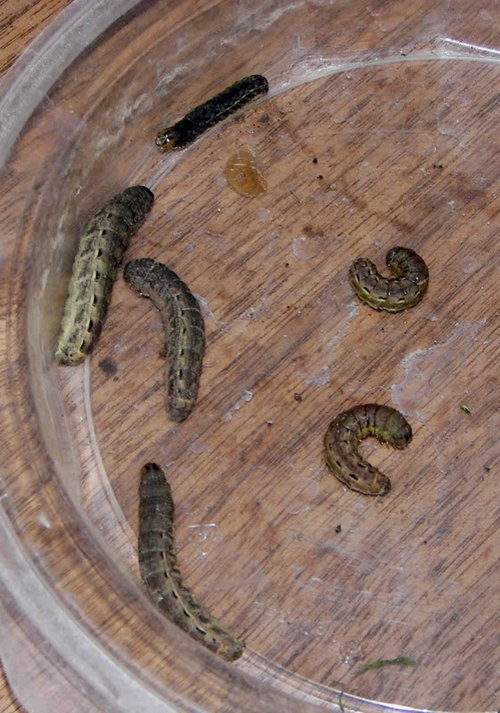
While out raking leaves I keep finding these things in the lawn/green stuff. I have been calling them cut worms but I am not certain. I find them on my garden plants in the summer too. (little eating machines they are!!!) I found seven in a relativly small space maybe 5' x 8'. I can only assume there are LOTS more throughout the garden. I kill as many as I can find but it seems to be a losing battle with so many in the lawn. Do they have a moth stage? I seem to find these wormy caterpillars things all year long and in different sizes. Is there some sort of control that is environmentally friendly (besides birds)?

Comments (12)

  • 17 years ago

    Look like cutworms to me.

  • 17 years ago

    Yes, looks like cutworms to me too. Dont' know what they're doing in the lawn though. They are the larval stage of a moth.

    You can use a spray called Bt, short for Bacillus thuringiensis or something like that. It's a bacterium that is specific for lepidopteran larvae, ie caterpillars of butterflies and moths. But it doesn't distinguish between cutworms, and caterpillars of desirable butterflies.

    The caterpillars have to be fairly young still, and actively feeding, for it to work. Larger caterpillars and those about to hibernate for winter won't be affected.

    In other words, wait til spring.

  • 17 years ago

    Thanks reg and bboy. I was afraid that's what they were. I will continue to pop all I can find until Spring! I have seen very few desirable butterflies so I am not too worried about sacrificing a few to be rid of these cutworms!

  • 17 years ago

    Cutworms are moth larvae.

  • 17 years ago

    Mary, "popping" is a very effective if somewhat disgusting control :-) Light cultivation now during fall/winter clean up will expose a good number of them and doing a similar activity in spring will do the same. If you have a lot of birds (and in your heavily and diversely planted garden I imagine you do), they will locate and dispatch a high percentage as well.

    Also in early spring if you mix bran with Dipel (or similar Bt product) and sprinkle it on the soil around vulnerable plantings, this will take care of most of those that have avoided predators and made it through winter. The advantage of this technique is that it only targets soil dwelling larvae like the cutworms and avoids any more desirable butterfly larvae.

  • 17 years ago

    Even though they curl into a c-shape when disturbed just as do cutworms, these fellows don't go by that name. But that's a small technical detail when you know they have the same diet as cutworms -- fresh greenery.

    Their common name is greater yellow underwing, the technical name Noctua pronuba. The adult is a moth.

    These moths arrived on the west coast about 5 years ago. The larval stage -- that is the caterpillar -- is the stage that survives the winter. As a result, they're ready to chomp on a wide variety of greens come early spring.

    Around here, I find one or several now and then through the winter. But come February, they all seem to reactivate.

    As was said, dealing them on a one-to-one basis works. As does Bt but that only when the caterpillars are eating.

    If you lived near me,, I'd ask you collect them. I preserve them for use in a hands-on practice of investigating insect parts when I teach Entomology to Master Gardeners.

  • 17 years ago

    Wow, Thanks everyone! Great info! I was out raking again and found lots more and also what I think are cabbage loopers! They are bright green and a bit easier to pop (disgusting yes but very satisfing and organic!) I wish I could send them too you jean, the ones I gathered for the photograph are still alive in the container. If you want some I could help you out. Sometimes I make a bet with myself on how many I can find in a given place. (I know, I need a life LOL) Do you want big ones or little ones. It's nice to have a positive ID at last! I can't believe the things gardeners have to put up with! When I got back from my vacation beavers had removed three Japanese maples from my garden so these little wormy guys are small potatoes compared to beavers!

  • 17 years ago

    Speaking of pest control, did you know that elk season started on the 20th? Why doesn't Ciscoe mention these important things.

  • 17 years ago

    Stay low to the ground.

  • 17 years ago

    I also have these in large numbers. I could hand pick 25-50 every night if I wanted to, and my garden is not very big. They are mostly devouring Calenula, spinach and some Thymes but can be found all over the lawn at night. I also had them at my previous home, also in Edmonds but further up the hill. Up there they dined on Crocosmia. Interestingly they seem to be most numerous in late summer, fall and early winter. I really have not noticed any damage in spring-summer. I have noticed starlings picking them out of the lawn and weeds during the day. Thanks for the ID jean001.

  • 17 years ago

    The common name "Greater Yellow Underwing" is relatively rare, "Large Yellow Underwing" predominates. And like most common names, it confuses this moth with the even larger, showier, catocala underwing moths.

    Thanks, Jean, for IDing this; I had the correct scientific name in my notes just from matching my specimen to moth image plates and didn't know the history. Perhaps these larvae are causing the large holes in my rhubarb, the caterpillars must hide during the day, I haven't seen one during a rhubarb harvest.

    Here is a specimen from 2002; my notes state that it showed up in my Portland garden in 2001.

    {{gwi:1094580}}

  • 17 years ago

    Yes that is the moth I frequently see in summer. Yes, they can really do a number on any Rheum as well as Hostas and Plantain and many other attractive leaves that slugs don't usually touch! I remember thinking this moth was rather pretty, NO MORE!

Sponsored
Haus Studio
Average rating: 4.8 out of 5 stars28 Reviews
Franklin County's Preferred Custom Cabinetry & Design Studio