Software
Houzz Logo Print
chrisrobt

Grevillea

17 years ago

On a recent Ciscoe Morris show I heard someone talking about this plant/bush; one variety blooms in winter and is a good food source for hummingbirds. The info I've found on the Web suggests this plant is not winter hardy here. Does anyone know which variety blooms in winter and if it can be grown here (I'm on Mercer Island)

Christine

Comments (10)

  • 17 years ago

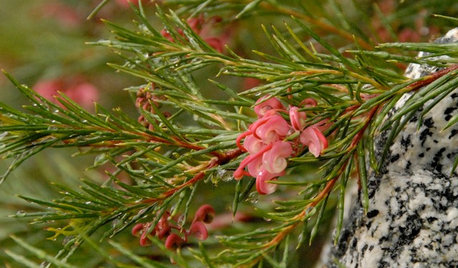
    Grevillea victoriae is likely the species referred to. It is arguably the hardiest for this area and I know of several NW GW members that grow this plant (Ian, chime in please!) and have for a number of years. I just recently (September) acquired one, still in a container. I moved it indoors into a protected location well before our recent bout of cold weather but it is looking definitely peaked at the moment :-) I am fearful but hope for the best.

    Mercer Island, because it is surrounded by the temperature moderating effect of water, should offer a pretty suitable environment - Colvos Creek Nursery on Vashon (similar situation) has been growing and offering this plant for years. I'd still look for a somewhat protected location with reflected heat, especially if full winter blooming is desired.

    FWIW, there are other winter flowering plants that will attract hummers and perhaps be easier - certainly hardier - than Grevillea to grow. My Mahonia 'Charity' is in full bloom right now and visited often by hummers. Soon, witch hazels and winter blooming honeysuckles will add to the offerings.

    Here is a link that might be useful: Grevilleas for the PNW

  • 17 years ago

    I've grown about 55 Grevilleas with mixed results. Some of them are hardy here under certain conditions. In general, they tend to be far less hardy under fertile and well irrigated conditions - and far hardier in poor soil with no water once established. I've suspected this for a long time, and as I hear reports about how people's plants have done in this last freeze, and observed damage to my own plants, I am now fully convinced this makes the whole difference between success and failure.

    For hummers you can't go wrong with either G. victoriae (one of its many forms) or G. 'Poorinda Constance'. I have had both in my garden in Olympia for more than 10 years. They bloom every year for months at a time including through the winter. In their first winter they lived through 12 degrees with little damage. Snow can crush them but they always seem to bounce back and assume their former shape.

  • 17 years ago

    I think it would be interesting to try to grow one of the grevillea; where (other than Vashon Island) could I find one and when is the best time to purchase and plant one (not now, I'm sure)? It sounds like they need to be abused a bit after they are established, but how long does it take before you can consider them established? It sounds like it is best to start in a pot so they can be brought in with severe temperature drops like before Christmas.

    Christine

  • 17 years ago

    You could probably plant one in the spring and water it only a few times its first year, and none thereafter. I planted my first G. victoriae in the middle of summer and I think I only watered it once or twice. I wouldn't keep it in a pot for too long... for the most part they're easier to maintain in the ground.

    Unfortunately I don't know who is selling them now. Most nurseries are rather low on selection at this time of the year, but call around.

  • 17 years ago

    I saw some 1 gallon G. victoriae at Swanson's just a day ago if anyone is looking for it.

  • 17 years ago

    Browned on Camano, OK in Edmonds. The Camano site seems to lie in a cold air drainage. The Edmonds location is about 1/4 mile from Puget Sound. All plants have a particular minimum temperature and will be damaged if a site drops below that. Influences like the extra moisture and fertility mentioned above will have an effect if they prevent a plant from maturing fully in fall and reaching its full level of hardiness before serious cold comes. But you cannot make a plant more hardy than it is genetically capable of becoming. If a specimen is of a type hardy to only 10 or 15 degrees F. at best it will eventually be lost or damaged in this climate except in the most favored sites close to salt water.

  • 17 years ago

    Very mixed results here with our low of 13F. Things like Grevillea 'Poorinda Royal Mantle', which failed to survive 20F in the ground for me, survived outdoors in their pots. Most G. victoriae forms were fine in pots except perhaps 'Marshall's Seedling' and the much more tender var. leptoneura. No damage on potted plants of G. juniperina 'Lava Cascade' (same plant as 'low red') either.

    I accidentally left a flat of South African Proteaceae outside as well. Many of them died but Leucadendron galpinii looks flawless and Protea magnifica and Leucadendron rubrum look like they will survive at this point.

    Proteaceae are quite unpredictable and much remains to be learned about their habits in cultivation, especially in marginal climates.

  • 17 years ago

    Are you knocking these out of the pots and looking at the roots before deciding they survived? Tops of shrubs are much hardier than roots. I have seen tops of dead camellias not show it until spring flowering time, at which point the parts suddenly go brown and drop off.

  • 17 years ago

    I just checked them... roots look great. Snow cover wasn't very deep at the time, but still probably helped some.

    Even if roots were dead.... still wouldn't explain why 'Poorinda Royal Mantle' failed in Olympia but went through much colder temperatures in a pot. I'd say that probably has more to do with it not liking clay soil and tons of winter rain.

  • 17 years ago

    There's also that phenomenon I don't know very much about where fungi or bacteria on/in the leaves promote freezing. This may be part of the problem with moist locations. Today I drove by a collapsed cordyline in a shaded position that made me wonder if it had that kind of a problem. The site is quite near salt water, although not right at the beach. About a block away.