Software
Houzz Logo Print
kbmas0n

Yet Another Insulation Question. What would YOU use?

18 years ago

We are building our forever home, so we will be there approximately 40-50 years. It is is approximately 2,000 sq ft main living space and will be have an unfinished basement until we can afford to finish it.

We have been builing with the assumption that we will be using BioBase500, a soy foam insulation. We have 2x6 exterior walls and would get the 5.5 inches of foam in all exterior walls and the wall between the master bedroom and garage and the wall between garage and laundry room. We are also going to spray the rim joists. That would run us just over $5,000. To do the walkout basement wall woudld be an additional $1,000.

We are willing to invest this amount of money to make sure that we are saving energy as best we can, but I want to make sure we are doing the right things.

For the attic, we were going to blow in insulation, and put fiberglass batting in the vaulted parts.

I need your help. I want to make sure we are being smart about this and investing our money in the correct places. Thank you for reading all of this!!

Keri

Comments (24)

  • 18 years ago

    Your vaulted ceiling areas are probably the most crucial part of needing decent insulation, so why not foam there.

    Leaving the windows, controlling air infiltration, thermal bridging alone, The rafter cavaties, wall stud cavaties, floor joisting bays are in that order of importance for insulated spaces. If your ceilings have dormers or skylights , that would be addressed similar to decent windows and doors on the walls, but as far as cavaties go, the ceiling is the most important so you might consider foaming the lid as well.

  • 18 years ago

    Interesting. I hadn't thought about foaming the ceilings. We have vaulted ceilings in the great room and also in the master bedroom. I'll look into getting those sprayed as well. So the roof is MORE important than the wall cavities? Wow.

  • 18 years ago

    5 1/2" of foam in the walls? For $5,000?
    Thats a pretty good price. Are you sure they
    are pricing 5 1/2" of of foam?

    And the roofline is a good idea also.

    But what would I do?
    conventional insulation in walls with air tight drywall approach. My foam would be to exterior of wall in the form of polysyrene sheathing.
    No recessed lights that were not Insulation Contact AirTight (prolly no recessed lights cause I just don't like them)
    Windows with .35 or lower solar heat gain coefficient.
    Unvented attic with radiant barrier & conventional insulation.
    That is if I couldn't afford SIPS.

    Good luck with your build.

  • 18 years ago

    What's missing is, where are you?

    You don't build the same home in Anchorage as in Key West. Check the Building Science Corp. recommendations by zone. See Link

    Here is a link that might be useful: Designs That Work

  • 18 years ago

    I'm in Illinois. Sorry! I meant to include that in my original post.

    Energy rater - I'm sure! I have the quote in front of me. I think it's 1.26$ a foot or something to that effect. It's a closed-cell soy spray foam.

    Also, we have the outside complete already, siding is up. And the roof is on. I'm sure it's much too late to do a lot of what you have suggested. What do you consider conventional insulation?

  • 18 years ago

    fiberglass, rockwool or cellulose.
    btw..thats a great price soy based sprays here are much higher.

  • 18 years ago

    I've read (on this board) about doing an inch of foam and then the rest cellulose. Would the be yet another alternative?

    I guess I was just convinced early on that the spray foam was THE way to go, as long as we were willing to invest that much money in it. And then it seems from reading this forum that less people are doing it than I thought. Is it because of budget constraints? Or truly because there is a *better* alternative?

    (and because you see like you have done your research)...
    I know that the closed-cell has a better R factor, but I've read too that you want an open-cell foam so you can detect water leaks when they occur?

    I have someone coming tomorrow to bid on Icynene, which I believe is an open-cell. Will that be cheaper, but less efficient?

  • 18 years ago

    2000 ft^2: assume a 40x50 building with 9' wall height on the main floor, and that you are insulating all exterior walls (no garage since we do not know the layout). This would total 1620 ft^2 of wall and @$1.26 per ft^2 it would cost $6K for 3" of foam.

    I am in the process of finishing an addition, and sprayed 3" of foam in exterior walls, and 2.5" in the attic followed by blown in fiberglass. I had four dormers that are open to the floor, and I had foam in all dormer walls and 6" in the ceilings. The addition is around 900 ft^2 and I paid .85 cents per ft^2. Total was around $5500.

  • 18 years ago

    jmhjgh - it is definitely 5.5 inches of foam. And the bid is for just over $5K. He came last night to re-figure the bid to include the walkout wall. He said that it would be an additional $1K for that wall downstairs. And that the rest of the bid was the same.

    What kind of foam did you use? Was it the soy? Or Icynene?

  • 18 years ago

    I used closed cell polyurethane. Many companies make the product, but I used the Henry wall foam called Permax 2045.

    Here is a link that might be useful: Henry Spray Foam

  • 18 years ago

    Thanks for the link. I also just read up on the BioBase and it is an open cell, which doesn't have as good of an R-factor as the closed cell. Which is probably why it was so much cheaper than yours.

  • 18 years ago

    Even if you're not finishing your basement until later, it would be economical to insulate it to the floor--or at least four feet below grade--during the initial construction phase.

    My preference there is cc spray or xps on the foundation wall, followed by fg or cellulose to the interior. The catch though is that they both have to be covered to meet Code. As will the oc that you are planning for the rims. (After using oc on the rims once and watching it shrink away leaving voids that had to be filled with handheld spray cans, I switched to cc.)

  • 18 years ago

    it's too late to spray the exterior walls. The exterior is done. What is xps? FG is fiberglass?

  • 18 years ago

    The spray foam is for the interior. An alternative, which will often be more economical, is to use extruded polystyrene foam board (XPS) or expanded polystyrene board (EPS). You attach it to the wall with adhesive or mechanically, usually with concrete screws. Then frame the walls, put fiber glass (fg) or cellulose between the studs, followed by a fire protective board, typically drywall.

    Look at the Basements forum, where this method is often a focus of discussion.

    Here is a link that might be useful: Basement Insulation Systems

  • 18 years ago

    We too are building our 20 year house...I am 45...in Nashville,Tn. We have 4650 heated/cooled space with 6500 ft under roof in porches and garages (my screen porch of 500 ft2)
    I have received quotes that range from 27000 to 23000. The sealtech500 is higher than the biobased for us. Both bids include the 10ml crawlspace liner and the block walls sprayed with closed cell. All attic spaces sprayed (the main reason for doing foam is conditioning the attic space) and all exterior walls. I have cellulose in my lake home and love it, but I feel that with energy costs heading nowhere but up, I will have a 3-4 year payback vs cellulose. We are also 65 degree people year round...ie...we use a lot of ac and open windows in the winter.

  • 18 years ago

    Insulation is only one part of the design of the entire exterior building envelope. An exterior wall should be designed in conjunction with the total system.

    Discussing one part of a complex interdependent system as if it were independent of the rest is the approach that, in my opinion, causes so many of the common mistakes found in home construction.

    So, tell us the entire envelope design including the roof, HVAC system, moisture/air control, windows, site orientation, exposure, shade, etc. If it is too late to design the wall then you will probably choose the insulation based on how much you can pay now vs later.

  • 18 years ago

    Okay, please bear with me. We jumped into the building process, and yes, have already made "many of the common mistakes found in home construction." Your help is greatly appreciated, but you just need to keep in mind that the exterior is up and was unfortunately not taken into account as part of the building envelope. Truly, I had never heard of the building envelope concept until just yesterday. So I have to attempt to do what I can with what I have.

    Roof - Um, it's just a roof. We covered it with tarpaper and put shingles on it. It is vented.

    HVAC - geothermal

    Moisture/Air Control - not sure what you mean.

    Windows - low-e something or another

    Site Orientation - The front of our house faces South.

    Exposure/Shade - We are surrounded by trees with the north-facing front facing a pond.

    Does that help at all? I really appreciate you taking the time to work with me.

  • 18 years ago

    Here are a couple of clues:

    All attic spaces sprayed (the main reason for doing foam is conditioning the attic space) and all exterior walls.

    =Unvented attic.

    sealtech 500

    = Steel-frame construction.

  • 18 years ago

    worthy - what are you talking about?

  • 18 years ago

    kbmas0n, worthy, all- I live in Chicago and would also appreciate some advice. brick house, gutted now. Can I just open cell foam the attic and use fiberglass on the exterior walls? What is the best route? Could really use any help offered. Thanks!

  • 18 years ago

    worthy - what are you talking about?

    Got me! Lack of "edit" feature here to blame.

    Wherever you're building, a good start is checking out what Building America and Building Science recommend for homes in the specified zones.

    Re: gutted Chicago home. Economics determines a lot of your choice in insulating materials. But the limitations of the house itself are important. For instance, in my cold climate, 2x4 walls require a high R value per inch insulation--which pretty much limits me to sprayed cc foam-- in order to meet the Code minimum for new construction. But if I were "flipping" the home, would I spend the extra bucks that aren't required for a reno?

    Dry blown cellulose in the attic is more economic than sprayed foam. But you have to be prepared to carefully seal all the air leaks in the attic to get the same effectiveness.

  • 18 years ago

    We just used a product called Demilac Sealation 800. We did the building envelope and had to install a Fresh Air system. Important if you go this route for this as well as making sure the windows are efficient. This foam makes an air lock in the house. VERY important to include roof.
    You mentioned the garage and dividing wall. IS there anything on top of the garage? Might want to consider spraying the garage roof if so.

  • 18 years ago

    Wow, your spray foam is a lot cheaper than SW Louisiana! Our bid for a 2900 sq ft home from Icynene was $14,000-$15,000, closed cell would be more I was told.
    We still have not decided what to use. (Slab was just poured today).

  • 18 years ago

    Just checking back in with the thread. I thought for sure it would have dropped off by now.

    We ended up going with Sealection. The BioBase was a little lower, but the Sealection people really seemed to know what they were doing compared to the BioBased. They had been in business longer, too.

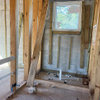
    We foamed 6" in the exterior walls and put blown-in cellulose in the attic. I LOVE the foam! It was SO cool to see them spray it in. It looks like spray paint and then WHOOMP, it expands. I'm quite easily entertained :)

    Here's a picture from the walkout basement wall: