Software
Houzz Logo Print
hazmatt_gw

contract questions

17 years ago

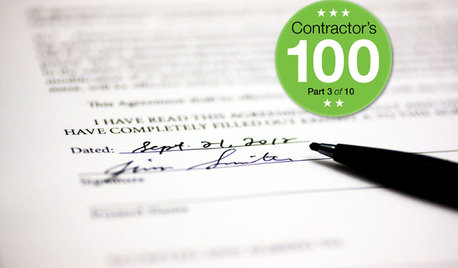
I'm new to this forum, just beginning to get ready to build a new house for the first time and utterly ignorant. Before we can get started, we have a couple of contract issues that need to be resolved and I wondered if anyone here had any good ideas about them or (in my dreams) actual sample phrasing we could propose. We did take the GC's contract to our lawyers, but before we go back to them I thought I'd ask here. The two questions:

1. Rather than have the GC give us notarized lien waivers from each and every sub (our lawyer's language, which the GC said was unduly onerous to lots of smaller-scale subs who *never* do that kind of paperwork), the GC wants to have everything go through a Mechanic's Lien Agent working on behalf of our lender. The GC's proposed language requires that only subs who have registered with the MLA must submit lien waivers to the MLA. Does this seem like a reasonable replacement? What about subs who have not registered with the MLA? Does the bank usually require all subs, or all whose work will come in at over $x,000, to register? Should we insist on getting copies of some written form of release from all subs?

2. He had an "Indemnification" clause which stated that he's not liable for anything, no matter what, even if the house is not inhabitable. We obviously thought that was not okay. Our lawyer replaced that clause with one that says WE are not liable for anything, no matter what. The GC thinks THAT is not okay. Do any of you have any language to this effect in your contract that covers both parties equally? What if we just took it out altogether?

I have no idea if what I'm asking here breaches either an ethical or an actual law (copyright? intellectual property?) -- if so, apologies to all, I promise it's in full innocence. And I'm not trying to avoid paying the lawyers what they're due: I'm trying to find a common ground with the GC without endless loops of legal advice and without being stupid by opening us up to future problems.

thanks in advance to all

Comments (12)

  • 17 years ago
    last modified: 11 years ago

    Hi,

    We built a house from the ground up. It is good that you have a lawyer look over the contract. In the end I beileve that reputation and peoples experience is just as important as the contract. Also do you get on with your GC. You can contract all the want, but so many things can go wrong, and so many items can be mis-communicated. What you really need is good communication and a good working relationship. By the time you start falling back on the contract things have already gone awary. The contract is the emergency fall back position.

    One good source of contract wording is the AIA, the American Institue of Architects. They sell contracts which are "standard." Note these contracts are IMO drafted to the advantage of the Architect. You can buy a copy and then use that as a template as to appropriate language. (see Link).
    There are a number of contracts available so pick the right one. You probablly want the A-Series.

    Good luck with your build.

    Warmest regards, Mike.

    Here is a link that might be useful: AIA contract link

  • 17 years ago
    last modified: 11 years ago

    AIA contract forms are written for projects that are required by law to have an architect design the building therefore the Architect is always named and his/her role defined as carefully as for the Owner and Contractor. To use an AIA contract for a single-family home where there is no architect involved in the construction phase, it is possible to simply strike all references to the architect or substitute another kind of Owner's Representative.

    Most AIA A series forms are very long, home builders are not familiar with them, and the conditions are not all necessary. Look for the small project forms like A105 for a Fixed Price contract with the General Conditions included with the agreement. For $8 an owner can't get better contract information.

    I don't know what is onerous about lien waivers other than the requirement to have them notarized. If a sub can submit a written bill he can also submit a lien waiver form since it contains essentially the same information. If he has a bank account he can get forms notarized for free.

    Usually any sub that doesn't register with the Lien Agent within 30 days is out of luck if he wants to file a lien. You should use one if you are in Virginia. If you use one be sure the title insurer is notified.

    Indemnification clauses in a construction contract protect one party from the mistakes of the other. I have never seen one that protected the Contractor since the Owner has little opportunity to cause damage to people or property on the site but I suppose it might be needed in some cases.

    The AIA uses language like this:
    To the fullest extent permitted by law, the Contractor shall indemnify and hold harmless the Owner, Architect, Architects consultants, and agents and employees of any of them from and against claims, damages, loses and expenses, including but not limited to attorneys fees, arising out of or resulting from performance of the Work, provided that such claim, damage, loss or expense is attributable to bodily injury, sickness, disease or death, or to injury to or destruction of tangible property (other than the Work itself) including loss of use resulting therefrom, but only to the extent caused in whole or in part by negligent acts or omissions of the Contractor, a Subcontractor, anyone directly or indirectly employed by them or anyone for whose acts they may be liable, regardless of whether or not such claim, damage, loss or expense is caused in part by a party to negate, abridge, or reduce other rights or obligations of indemnity which would otherwise exist as a party or person described in this paragraph.

  • 17 years ago
    last modified: 11 years ago

    Rely on your lawyer's advice. This may be a red flag with this builder and you may just need to find another builder. Some builders only want to work with people who are not represented by a lawyer so that they can have a contract that is to their advantage only. A house is a huge investment and you need to protect that investment with a good, fair contract.

  • 17 years ago
    last modified: 11 years ago

    Thanks so much to all of you -- I now know that the AIA language is pretty much exactly what our lawyer put in the contract instead of the GC's clause, so it's AIA language that's making the GC uncomfortable. I'm meeting with him this week to try to hammer this out. To your point, Mike, I completely agree: what matters is the working relationship -- and in fact, we have had some (small) issues with communication, so it might be that this is not the right builder for us after all. But we love the houses he's built, and we can't say that about a lot of builders in this area, plus we couldn't use the house plans we've now worked on for some time if we switch to someone new... It's amazing how stressful this process is!

    Anyway, thanks again to all for your input.

  • 17 years ago
    last modified: 11 years ago

    I have provided a link below to the simplest contract I can find. It is used by the state of Maine for projects below $50,000 in cost. It is not unreasonable.

    Check out the Indemnification clause.

    Your contractor is either using inappropriate contract language without understanding what it means or he is intentionally trying to put you at risk for his potential errors on the job.

    Ask him where he got the contract he is proposing.

  • 17 years ago
    last modified: 11 years ago

    That is BS regarding the lien waivers. I made EVERY sub sign one. None of the subs had a problem with it. I even had the computer geek sign one for the ethernet wiring ($125 job).

    Like macv stated, I have never seen the owner indemnify the GC. I work with commercial contractors and contracts every day, but this is no different in some respect.

  • 17 years ago
    last modified: 11 years ago

    Thanks so much, macv -- tremendously helpful just to see another contract in its entirety. And thanks zimzim for the reality check on the subs' lien waivers -- it really didn't seem like such a difficult thing to get, in essence, a receipt from each sub, Lien Agent or no Lien Agent.

    Now I have a new question. Background: the GC bought the rights to an original set of plans from a local architect who designed the house that the GC has now built three times (with some changes each time). We have now put in some more changes (e.g., adding a back staircase, turning a bedroom into a huge master dressing room/closet, adding a mudroom/pantry area, etc.). In an early discussion with the architect and GC, we were assured that if the GC went bankrupt during the process, the architects would "work something out" so that we could continue to use the plans when we had to switch to another builder. Should I have additional, specific language in the contract to the effect that if the contract is terminated for ANY reason, that we may still use the plans and continue our build? Without such a clause, would we have to change the plans somehow, or pay the architects directly?

  • 17 years ago
    last modified: 11 years ago

    I'm not a lawyer but I believe that if you have a contract with the builder who has bought the right to build from the architect's plans and the builder goes bankrupt, you still have all the rights granted under the original contract even if another builder completes the project without any additional protection. Once the architect has sold the rights to a design he can't take it back. Of course, the right to use the design would be limited to one house.

    But only a lawyer can say for sure.

    With whom does the architect have a contract for this project? In other words, what is the architect's role on the project? Does the builder and the architect have a contractural or business relationship? Is the architect really an architect?

    If the architect sold the rights to a design to the builder and you contracted for that project to be completed by builder, the architect shouldn't have any grounds to prevent you from completing the project whatever the circumstances. The "work something out" comment doesn't seems proper to me and sounds like he wants to send you a bill for doing nothing. I should think a court would not be sympathetic to any future claim by the architect.

  • 17 years ago
    last modified: 11 years ago

    Bevangel, ... wow. Terrifically helpful and timely explanation of the intellectual property/licensing issues at play here. I'll contact the architect and get this squared away. Can't thank you enough for making it so clear.

  • 17 years ago
    last modified: 11 years ago

    So, the architect can get paid twice for the same documents for the same house? People who take advantage of the misfortunes of others tend to have a poor reputation so you should talk to prior clients.

  • 17 years ago
    last modified: 11 years ago

    If the contractor is providing design services for the project, a Design-Build contract form should be used and issues such as ownership and use of documents would be included. Usually such a contract would require a separate agreement in order for the owner to use the documents to finish the project by others UNLESS the contractor is in default. However, since it is unclear what the arrangement is between the builder and the architect, a separate agreement should be made relating to use, liability and compensation for the owner's use of the drawings.

    Design services provided by a builder can cause many problems on a project because the architect has no obligation to the owner regarding performance not only in regard to the quality of the documents but for construction phase assistance. The issue of use of the documents in case of builder bankruptcy is just the tip of the iceberg.