Software
Houzz Logo Print
momto3kiddos

Question for david_cary re: insulation

14 years ago

Hi david_cary - I think you are in the central NC area based on some of your previous posts. My husband and I are in the design phase, but we know very little about insulation options and energy efficiency. Could you recommend any resources that can be of help to us? I have looked at buildingscience.com and it is difficult for me to find a place to start as I need a foundation in the subject first.

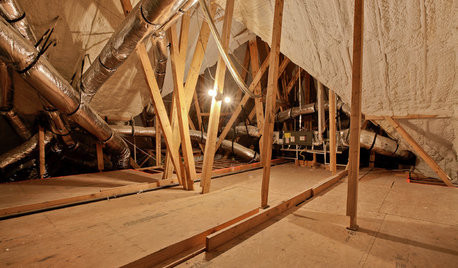
We are builing a 5000 sq ft one-story home outside of Raleigh, NC. We will have a walk-up attic and it is early enough to decide about duct work - it can go anywhere. It seems to make sense to me to insulate the ceiling and perhaps condition the crawlspace, but rafter foam seems like a little much. Our roof pitch is fairly high, so there is a lot of unused attic space up there. How should I go about educating myself on the options and the payback period? This is our forever house so we do want it to be as efficient as possible. What about other options like geothermal, passive solar, etc?

Thanks in advance!

Comments (15)

  • 14 years ago

    Southern Energy is who did our energy audit and energy star certification. I can't say that I recommend them without reservation but I have no huge complaints either. They charged about $900 for energy star certification which is worth 5% lifetime discount from progress energy and PSNC. That gives a decent payback. Energy star is ridiculously easy to meet so it doesn't cost much to do meet their requirements.

    You first have to decide if you are just interested in efficiency for money reasons or environmental reasons. Then your payback goals - ie 10 years, 20 years etc.

    For a ranch, I'd just put the ductwork in a sealed crawlspace. Skip foaming the rafters. Minimize your E/W windows and maximize South windows if you can. Work on air infiltration as one of your fastest paybacks. Energy star has some requirements that are helpful here. Low-E windows are obviously wise along with fairly good SHGC windows.

    Do you have NG? If not, Seer 15 Heat pumps at least.

    After those basics - it gets more complicated. An audit will help. I will tell you that our audit had estimated utility costs of $3400 a year and in reality, it is more like $1800. But it does give you an idea of what you need to save money.

    With our incentives, if you don't have NG, solar hot water is a no brainer. Attic to r-40 is an obvious upgrade. Upping the walls above code eventually pays back but it maybe well over 10 years (depending on NG availability, your tolerance of heat pumps, solar gain, your desired temps). You are probably $2000 or so for foam sheathing with a $200 a year savings (If I had to take a guess) so you need to decide on what you are wanting to do. I'd suspect going to 2x6 walls would cost a little less and save a little less.

  • PRO
    14 years ago

    The problem with going to 2x6 over 2x4 walls is sure, you get a few more performance r values, but it still does nothing for thermal bridging. Exterior foam sheathing is about the only way to do that. It also does not need to be XPS or polyiso like most use. It could also be cheap EPS to gain similar results. Slightly less r/in, but still serves the purpose. Use strapping to mount the siding too and you have a good drainage plane and a house that can dry nicely in either direction since EPS is pretty vapor permeable. I would also highly recommend Huber ZIP sheathing on at least your walls and possibly your roof. The ZIP sheathing is a very good and easy way to get an instant tight house just by the nature of the install. It will most likely be an upgrade, but it is much more effective as an infiltration barrier then standard osb sheathing and crappy building wraps that flap in the wind.
    A good wall structure would be 1/2 or 5/8 gyp, 2x6 studs (possibly spaced 24" oc for more insulation...this is NOT a 'cheaper' (as in quality) way to build as many contractors think and claim), blown cellulose insulation, ZIP sheathing, 1-1.5" EPS (or XPS) foam sheathing, 3/4" strapping, siding.

    We do not know what gas and electric prices will be in 5, 10, 15 years, but we do know they will go up. If you build super efficient and tight as possible now, that will only decrease your payback periods of your smart upgrades as prices rise.

    When talking about energy upgrades, the biggest concern to everyone is PAYOFF. Insulation and caulk is not fun. You don't see it, you don't touch it. But it has a massive effect on the comfort of the inside of your home, with controlling air infiltration, helping with humidity levels, etc. (I am assuming at this point with the following comments) Your granite counter tops and $30k kitchen cabinets will never see a payback, ever, yet people do not hesitate to throw those into their home. Yet in some of these threads people with 3,4,5k sqft homes debate over spending the extra $2000 on additional air sealing, more insulation, whatever. Something that does affect your comfort and does have a payback. How does this make any sense?!
    Put the money in the shell and performance. These things can not easily and cheaply be changed later, but counter tops and fixtures can be. Just some things to think about....
    //rant over :)

  • 14 years ago

    I always like to give an argument for argument sake. Obviously infiltration is important. But... my 5000 sqft house in this climate has about $100 worth of infiltration costs per year. This is based on an energy audit and includes just foam around the windows and ES blocking requirements (although I did foam or caulk penetrations in the ceiling). The actual number was roughly 50% of ES standard. Zip sheathing on the walls would have cost about $2500 so guessing that would reduce infiltration by 50%, it comes to a 50 year payback.

    Is $2500 high? Perhaps. It is possible that the framers gave a high labor estimate because they didn't want to do it. But since it is fairly rare in our mild climate, that maybe an issue for the OP. But - you also have to think that 50% is pretty optimistic. Change the numbers to $1500 and 30% and you come to the same conclusion.

    So even infiltration fixes do not necessarily payback given a mild climate and access to NG. Your suggested wall structure in this climate would obviously be overkill. Just going one step beyond r-13 batts is probably 10-15 year payoff but anything after that is getting to 50 years.

    Broken record off.

  • PRO
    14 years ago

    So basically you are saying, because NG prices are CURRENTLY low, by all means, do not strive to go above and beyond in anticipation of the future but rather burn as much as this currently cheap resource as possible?
    Granite costs 2,3,8x more then a laminate counter top and laminate can last for years and years and years. That extra $5k+ spent there will never have a payback, but at least that $2500 ZIP upgrade does. (Then again, I never recommend granite, I tend to lean towards the recycled product such as glass and quartz. I just say granite cause everyone and their dog wants it right now)
    Triple pane windows with u values around .17 even in my zone 6 have a 50 year payoff. However they also offer comforts double pane windows do not.
    Sometimes its not always about payback, but that is up to the owner to decide.
    Overkill is what I tend to do on the shell, but then again, it just come down to the owners priorities. Most want a nice looking (inside and out) with current popular finishes and features. I tend to not care as much about high end featuers. But my points are, the costs involved in making it better are not as significant to what people are shelling out for finishes on the interior that give you no added comfort or efficient upgrades.
    This is probably regional obviously, but ZIP around here is a minimal upcharge compared to sheathing and Tyvek. It then becomes cheaper if you add in caulking and sealing requirements you have to do to make that type of a system half way air tight. Even then it will not perform as well as ZIP.
    Simple sheathing and tyvek probably will not hit new energy star infiltration ratings (which are still jokingly low standards) after a blower door test.

  • 14 years ago

    Hey, no sweat. Just a different opinion.

    The US has a ridiculous amount of NG. The price will be low far beyond oil at $250 a barrel. Remember that I know what you drive and the cost to run that far exceeds my houses energy cost. All without zip walls or foam sheathing.

  • PRO
    14 years ago

    and opinions are good. THe OP can take from it what they will to figure out what fits their situation, goals and budget the best.
    Comparing auto to homes is apples to oranges. But I also spend about $60/month in gas if you must know. But trust me, if I knew how to make cars more efficient I would certainly design them that way!

  • 14 years ago

    I agree with both 'rants'. didn't really think it was
    ranting, just information. I too get frustrated with
    expensive moldings, flooring and countertops (that can be
    upgraded later) and the cheaping out on the things that
    don't 'show'. I've seen homeowners lose their show place homes simply because they couldn't afford to pay the $800
    a month utility bill. its sad.

    OP...check RESNET for an energy rater in your area.
    can't remember the website but google resnet/energy rating.
    not only will a certified rater give you options for your upgrades, but will also inspect and test your home and ductwork. its always a good thing to have another pair of eyes looking over your build.
    resnet uses energy rater/energy auditor interchangably
    other companies have an unclear distinction.
    energy audits don't always cover duct testing.
    shop for someone you are comfortable with and that has
    a few years of experience.
    lots of companies are getting into the biz with book learning only..you need someone who knows what they are looking at, and can offer suggestions that are do-able.

    best of luck.

  • 14 years ago

    Thanks everyone for your feedback! It gives me a great place to start with my learning. Does a brick exterior affect the recommended insulation for the walls? We are planning all brick, but I don't know how that affects tyvek, zip, wall depth, etc.

    We do want to do the "best" things we can in this home - both structurally, energy-wise, and finishings. One high priority is ease of maintenance - especially in the long run. We will have to look at the big picture to determine where our priorities will be within our budget. Our main priority for energy efficiency is for its payback; however, we are building in the country because we love the outdoors, so we do want to do the responsible thing as well. As far as payback period - I think we will have to look at each individual decision to decide. Given that this is our forever home, 10-25 years seems reasonable, but 50 is hard to imagine. We will be quite old by then. :)

    David - when you say you have $1800 utility costs - is that your total bill (electric and gas) combined? That would be fabulous. We are in a 6 year old home of average construction (it was a spec home) with 2300 sq ft - only the lower 1700 is usually heated and cooled - and we have about $1600 annual. I would never imagine that our utility costs would not rise dramatically in the new larger home.

    On a similar note, do any of you have/recommend a reclaimed water system?

    Thanks again for all of your input!!!

  • 14 years ago

    So Brick does a few things but they are minor in the grand scheme of things. Mostly the thermal mass helps as they heat up during the day and stay warm after the sun goes down so help to minimize wall heat loss (same with gain in summer). The R-value is about 1 but the thermal mass effect is a bit larger. I actually notice my loss more on the back wall which is not brick.

    I think there is probably an infiltration benefit with a brick wall but I can't say that for sure. Just looking at it , even with the weep holes, it looks to be a pretty effective air barrier compared to siding.

    You should easily be able to beat your spec house if you try. The only thing that $1800 doesn't include is the gas connection fee. I only used about $120 in gas last year but there is another $120 a year in connection costs. I try to justify that this fee is not really energy cost...

    In the country - orient your windows right. 1 inch foam (my biggest regret) on the walls and basic infiltration work (foaming windows and doors etc). I'm guessing no NG, so at least Seer 15 heat pumps. Get a geo quote but they are hard to justify generally. Use shade trees on those E/W walls (and south walls too as long as they are deciduous and not oaks or something that keeps leaves too long).

    Water? What is the motivation here? You should have a well? That is nature's best water reclaiming system. I priced a rain catchment and it was absurd. A well would have been cheaper and I am on city water. Code makes graywater difficult (although I don't know exactly which jurisdiction you are in). But generally NC is not Arizona so the benefits are minimal and jurisdictions have no need to be flexible.

    Shade/orient windows well/foam sheath/seer 15 - and you should have no problem getting below $1000 a year in HVAC costs.

    Lezarc - you must not drive much! Average car, average driving = $2000 a year - all carbon, mostly foreign (my house, mostly US uranium). Sure apples and oranges but perspective. You may not design cars but you decide what to buy....just tweaking you.

  • 14 years ago

    There are other factors besides just annual cost. As was mentioned, some people like to try to minimize their impact on the planet by using less resources. But another big factor is comfort. A well-insulated and sealed house should have very even, consistent temperatures throughout. Having grown up in drafty old New England houses with little or no insulation, I'm amazed what a well-built home feels like. My contractor has an ICF home, and it's uncanny how even the temperatures are. ICF is (or can be) airtight, very well insulated, and has a lot of thermal mass. Unfortunately, it's too expensive to pay off in a mild climate like NC.

  • PRO
    14 years ago

    Flg-
    thermal mass (pertaining to a heat storage/releasing device) in ICF is negligible at best. ICF efficiency is greatly effected by your climate. In the southern areas, or areas where the diurnal temp is above and below the interior temp, will perform much better then heat dominated areas. The "mass" acts more as a heat buffer than anything. In a heating dominated climate (such as mine, but not the OP) ICF walls will perform basically as good as the r value of the EPS foam (r16+ depending on forms) However it is true you can get a very tight (sub 1.0 @ 50pac infiltration) with proper installation, which does have a great impact on the interior air quality. But ICF are expensive, but they also come with other benefits such as storm protection, fire protection, etc. They typically will stay pretty tight for the life of the home however since they are concrete, unlike wood structures that twist, settle, crack, etc. I have done a couple ICF projects here, but in most cases, they do not price out for the client. (both have been tornado designed safe room applications with 10"+ thick concrete cores).

    Brick has some air buffering abilities, but should not be viewed as an air barrier by any means due to the design of the system. Brick is meant to allow some air into the wall cavity to allow proper drying of the assembly. We still spec air barriers on the brick substrate (being block or wood framed) on all of our projects.

    DC- my main vehicle gets around 30-35 mpg av, but then again, I only live 4 miles away from my office currently ;)
    My job decided what I drive.

  • 14 years ago

    We're going ICF on our basement, since the cost wasn't that much greater than poured concrete. The cost to do the main floor was far too expensive compared to 2X6, and that's a technology I can do myself. I'm going to do what was suggested here- external foam over ZIP sheathing with conventional insulation in between the studs. I'm considering LP Techshield for the roof, which has a breathable radiant barrier facing the inside. Any thoughts on that stuff?

    For anyone considering ZIP sheathing- make sure your contractor knows how to install it. I saw a house being built with it in SC, but they didn't tape the seams, but put a vapor barrier over it instead. The whole idea of ZIP is to tape the seams for a good seal, and skip the added expense and labor of Tyvek altogether.

  • 14 years ago

    I wish the builder of my 1920s house had not been looking at "payback". When I eventually build my personal home I want to leave my heirs or future generation something thats comfortable and easy to heat and cool.

    Interior finishes come and go but the building envelope sticks around for a very long time...

  • 14 years ago

    Payback is rational thought. Doing extra for the environment is rational thought too. Overdoing it is wasteful. That is my point. Putting 2 inches of foam on the outside of a zip wall with 2x6 framing in central NC is a waste of resources and money.

    One thing you do is drive up the cost of foam for the people who really need it. Ditto all the other materials.

    Capitalism is a system for allocating resources and payback is part of that. The fact is that the vast majority of houses don't even consider future costs and build to minimum code. So being rational about payback is a step above.

  • 14 years ago

    I have looked at buildingscience.com and it is difficult for me to find a place to start as I need a foundation in the subject first.

    It is the place to start--and more often than not--end when it comes to building science in North America.

    Consider the specs in a high-performance green home in your climate.

    As other posters have noted, consultants/energy raters etc. can help you with the decisions. As can your architect/designer.

    *************
    even with the weep holes, it looks to be a pretty effective air barrier compared to siding.

    Neither brick nor siding are air barriers. Nor are they designed to be.

    Here is a link that might be useful: Understanding Air Barriers