Software
Houzz Logo Print
meg711_gw

what does side venting really mean?

19 years ago

I've browsed through pages and pages of specs and, my mind is mush trying to figure out the solution to my problem. If I'm reading it correctly, it looks like side-venting means that there's a hole in the side of the dryer to meet up with the dryer vent that goes outside--as opposed to having the hole only in the back bottom part of the dryer.

Is this right? And, if that's so, why didn't the salesman yesterday mention that some machines have this option?

Thanks!

Comments (15)

  • 19 years ago

    You are correct. Most dryers come with the option of venting out the back, on one side or the other (sometimes both sides), and a few brands even offer downward venting through the underside. On some brands an optional conversion kit needs to be purchased, on other brands, it's simply a matter of opening and closing the appropriate vent ports.

    It's not surprising that a salesperson wouldn't mention this. Most buyers, if they have a special requirement, would ask about this. Since most installations are set up for rear venting, if a buyer doesn't bring up the question, a salesperson might not mention it.

  • 19 years ago

    Hi again Jamesk,

    First, thanks for answering my questions! Although I didn't ask specifically about side-venting options (didn't know the term then) I had explained to the saleman my problem about the location of the venting hose (whatever the part that leads to the outside is called).

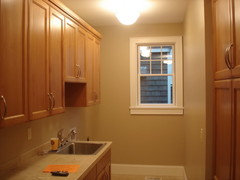
    If you look at the photo below, my venting hose is in the corner, but really more on the side wall (the window wall). It comes out a little, so it's angled, and is facing the wall opposite the sink. I'm not sure why they did it this way but I think it's going to make venting a problem. (Sorry but I recently lost my digital camera.)

    Not to be dense, but when you say that it can be vented out the back on one side or the other, are these holes on the back panel of the dryer or are they on the side panels of the dryer?

    Thanks again!

  • 19 years ago

    Sorry, I wasn't clear. Usually, dryers vent out the back. Typically, the dryer exhaust port is down low in the back, usually in the middle. It can, however, be located on the back toward either side.

    The side vent option allows you to vent out the side of the dryer, usually down low toward the rear of the cabinet. Some brands will allow a side vent to be either on the left or the right, other brands only allow it on one side, usually on the right.

    If I understand your vent set up, the vent pipe exits the laundry room to the outside on the wall that has the window. The pipe extending through the wall has an "L" on it so that turns 90 degrees and the vent opening faces toward you as you stand facing the washer and dryer.

    That being the case, it sounds as though you have two choices. You can either vent through the back of the dryer and connect to the vent pipe as it stands (you might have to turn the "L" so that it faces up instead of out, then connect to it with a length of flexible aluminum pipe shaped like an inverted "U"), or you could remove the "L" and vent out the right side of the dryer.

    Most likely, your choice will be determined by how much room you have to the rear or the right side of the dryer. One choice or the other is bound to allow you to push the dryer closer to the back wall. You'll probably want to go with that choice.

    I'd recommend that you measure the washer and dryer space, measure the distance of your vent pipe from the floor and the right rear corner of your space, then take a photo of the space showing the vent line set-up. You can then print the photo on your computer printer (it doesn't need to be in colour), and take the the photo and measurements with you as you're shopping for laundry appliances. If you show the photo to the appliance salesperson (a picture is worth a thousand words!) and give him or her the measurements you've taken, you shouldn't have any trouble getting a dryer that will meet your needs and the space.

    I have a hunch that a dryer venting to the right side will be your best bet, but to some extent it depends on how wide the washer and dryer space is, and the width of the machines that you choose.

    Hope this helps.

    James

  • 19 years ago

    Hi dmlove! (Fancy meeting you here!) If I measured correctly, I have 55 1/2 inches between the sink and the window wall, but now I can't remember if that took into account the floor molding or not. I have a bad feeling that the two 27" machines will be a tight fit--especially if you have to leave some allowance for a side vent configuration. And now I realize that the window trim will be in the way of a regular-sized stacking unit so stacking is probably out.

    Jamesk, you've been very clear and a great help. I know this sounds weird, but the vent coming out of the wall doesn't have an L or an elbow on it. I'm pretty sure it's just sticking out of the wall at an angle, but not parallel or perpendicular to the window wall. I'll be emailing the builder tomorrow to see why he did it that way. But I appreciate your comments and advice. I was going to bring photos with me to the appliance store and I will definitely take better measurements.

    As for the Euro models, we're a family of four so I'm not sure those will work. Although we're in an apartment right now using a GE Spacemaker and it seems to be fine for us. I can't believe that I'm having this kind of problem. Actually I can; I've had many slap-your-forehead moments with the builder.

    Thanks again!

  • 4 years ago

    Hey i was just looking for a dryer . i asked the guy if i need to get a side vented machine because the vent to outside is on the side of the dryer . he said it was ok ok to get a dryer that has the vent in the back and just get the long vent kit . im getting a small dryer for a closet in a condo.. was he wrong shiuld i go with a side vent dryer.

  • 4 years ago

    HU-124482187,

    Perhaps you didn't notice, this discussion thread last had activity 14 years ago.

    Dryers are normally configured at the factory to exhaust from the rear. Those that can exhaust from the side (left, right, or both) are reconfigured to do so at installation and may require a conversion kit from the manufacturer. Some can also exhaust at the bottom, which is conducive for mobile home installations through the floor. Confirm that the model you select can be converted to exhaust the direction you wish. A compact model may not have the capability. Gas dryers usually have the burner on the machine base at the right side and it can't be moved so gas models that can reconfigure usually can exhaust out the left side but not the right.

  • 4 years ago

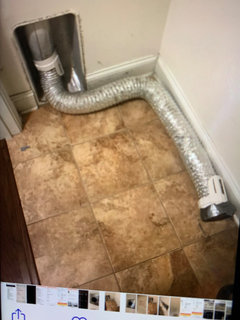
    the vent is on the side and i have a vent kit that will go around the back wasnt sure if that was a good idea. i wasnt tring to change the venting to the side . the machice that i want does not offer that . Can i bend it i the corner like that . as far as it being a long vent dryer i checked and it is . thank you for answering the guy at the store was not very helpful


  • 4 years ago

    That should be workable ... but the aim of course is to keep the ducting length as straight and short as possible. The end of the duct that connects to the rear of the dryer will also turn 90° to connect to it. The installation instructions for your selected dryer should state what is the maximum allowed ducting length and number of bends, which includes the length inside the wall to the outside. Using 4" solid-flue ducting with 90° elbows for the turns instead of the flexible ducting with embedded spring coils would reduce the airflow friction added by the coils.

    Regards to the length, will the dryer be placed at the corner beside the vent wall, or further over where the ducting is laid to end?


  • 4 years ago

    Thank for responding. from the side wall to the dryer about 8 inches of space and from the back side 6 inches so at the corner not the end of the duct. i told him i needed about 6 ft of duct and he ordeed me one that goes 4 ft to 8 ft. i was telling him i thiught that was too long he said it would be fine . the dryer wont get a lot of use about 1 time a week and i am serious about cleaning the lint thing. and at the condo they make you do a cleaning i thinkmaybe one a year or 2 a year . and i think the vent goes straight ip from the wall no turns

  • 4 years ago
    last modified: 4 years ago

    Semi rigid maybe aluminum vent and an elbow for the end

  • 4 years ago

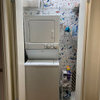
    The LG laundry center has venting available in the rear, the left, and the right. My closet space is tight. After placing the LG there, the closet will have the space of 3 3/8" in rear and 6" on the sides of both right and left available for the dryer duct. If I move the LG towards the left side, I will have 2" space on the left, and 4" space on the right side where I can possible fit the standard 4" dryer duct. Am I right?

    Do I need any elbow joint?

    Can I simply install the regular 4" duct on the right, without the LG side vent kit?

    If I need space between the dryer duct and the LG dryer, can I use a reduced vent size for 3' or 2' duct with the proper connector to the 4" dryer vent?


    Also, can I place the washing machine pan underneath the LG laundry center to protect the floor and to facilitate the moving of the appliance?


    Or shall I put a heavy duty felt sliders underneath the LG laundry center or under the washing machine pan for the needs to move the appliance in the future?


    Lastly, shall I install the dryer duct lint trap to facilitate duct cleaning in the future?


  • 4 years ago

    May I ask what model of LG laundry center you have? I’m having a heck of a time finding the side vent capability on their units.

  • 4 years ago

    What I mean is whether that is an option.

  • 4 years ago

    Beth,

    Exhaust choices should be stated in the installation instructions, which usually can be found at the manufacturer's website in the details of each model, either as a separate document or as part of the user guide. A given set of installation instructions may apply to multiple models but it's always best to check each model of consideration separately. You may get some assistance here if you cite the model numbers of your interest.