Software
Houzz Logo Print
harrimann

Sources for open shelving?

15 years ago

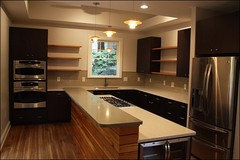
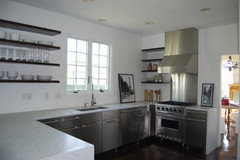
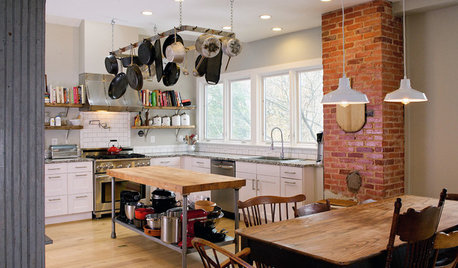
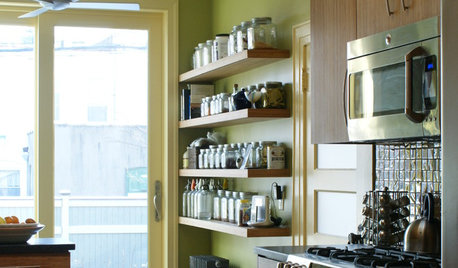
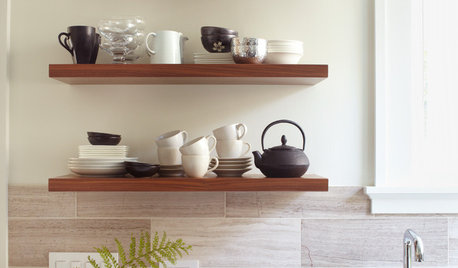
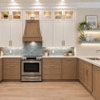
I'd like to add a few open shelves to my kitchen, but am unsure where to buy them. I'd like something like the shelves in this photo:

I guess this is "floating shelf" or ledge style. There are no shelves made by my cabinet line, so that's out. I tried my local unfinished furniture store and came up empty. I'm not sure what my next move should be. I can find pre-made cheapo ledges at Target or Home Depot, but the color is off. I was hoping to find a higher quality shelf that I can stain myself if necessary, or that comes in colors other than white, black and espresso.

Comments (17)

  • 15 years ago
    last modified: 11 years ago

    ok, I already typed this once, but it didn't show up, so you never know, it might end up being a duplicate. so if it is.....sorry about that:

    Try Ikea!

  • 15 years ago
    last modified: 11 years ago

    I looked at their site. I see black, white and red. Do they have more of a selection in the store?

  • 15 years ago
    last modified: 11 years ago

    Good luck! I've been looking for years.

    Ikea's are nice but come in a limited palette and VERY limited (and odd) sizes. They also don't have a very big load rating. I wouldn't want to put stacks of dishes on them.

    I researched various methods of building these. All are fairly complicated. All methods that are strong enough for stacks of crockery involve locating the wall studs and usually opening the walls to install some sort of welded rod/bracket that then slips into the shelf.

    I basically came to the conclusion that if you want them to be strong, it's a pretty pricey custom job :(

    If you don't care that much about strength, there's a site that has various finishes and styles of floating shelving linked below. They have real wood, MDF, painted, etc.

    Here is a link that might be useful: ennospace floating shelves

  • 15 years ago
    last modified: 11 years ago

    I've been looking for something like the ones you posted also. I've looked at Google images and not really come up with anything like a nice floating wooden shelf that I could stain and finish myself. I'm pretty resigned to the fact that I might have to have them custom made (unless DH thinks he can do them-and I don't think he wants to). The guy who installed our cabinets didn't really understand what I was talking about, so I let that go. So-long winded unhelpful reply to say I'd like to know where one could find these too.

  • 15 years ago
    last modified: 11 years ago

    Thanks for the input. This lets me know that I'm not a huge failure at Googling. I thought this would end up being one of those "dumb" questions and I'd find that this type of shelf is easy to locate. Actually, I'm sorry that isn't the case. Oh well.

    I'll check out the ennospace site.

  • 15 years ago
    last modified: 11 years ago

    Maybe not what you're looking for, but Rakks has a variety of shelf support systems.

    I too like the ones on the pictures, but I think you have to prepare for those before drywall IF you want it to handle a heavy load. For a lighter load, the bolts (one side into the stud, one side into the shelf) are available at Lowes.

  • 15 years ago
    last modified: 11 years ago

    Another IKEA option is to get the Ekby Bjarnum brackets and go to your lumber yard and get wood milled to fit them (not super expensive). The bracket hides the cut edge so you can just get lumber with smooth sides. That lets you use whatever type of wood you like, and then you can hang it with the brackets. You do have to mount it to a stud if you want it to hold any sort of weight, though.

  • PRO
    15 years ago
    last modified: 11 years ago

    West Elm has the Paxton Shelves come 2', 3', 4' long. If you mount them on studs they can hold up to 45 lbs. I also think that some of the IKEA shelves might work for you. I think they have them in butcher block if that's what you're looking for.

    Here is a link that might be useful: Paxton Wall Shelf

  • 15 years ago
    last modified: 11 years ago

    I to have been looking for shelving heavy enough for dishes, pots and such. No luck googling! However this may be a really dumb idea (DH) thinks so . . .but found some pre made stair treads at Lowes with not a bad profile. Google stair treads on line you will find lots of options and they are heavy. Not sure if this will work for mcmjilly, but may work for those who want brackets. Now to find heavy brackets and how to hang on drywall over block wall, without removing drywall?
    If anyone knows why this is a bad idea please let me know the downside!

    Red

  • 15 years ago
    last modified: 11 years ago

    maid o cliff, excellent idea. The wood treads can be stained or painted. NOT a dumb idea!

  • 15 years ago
    last modified: 11 years ago

    Thanks for all the ideas! Now, I'll start investigating.

    I have the IKEA ekby brackets elsewhere in my house, so that's something I can do (but the finish tarnishes).

    This will be between two windows, so there are plenty of studs to work with.

  • 15 years ago
    last modified: 11 years ago

    Whoops i meant I too as in also, so much for proofreading LOL!
    Thanks for telling me it's not a dumb idea, if someone else can think of a downside please let me know.

    Thanks
    Red

  • 15 years ago
    last modified: 11 years ago

    We are cutting down Ikea countertops to make our floating shelves. We are going to hide larger lag bolts into the drywall that the shelves will slide onto. They'll be HEAVY so we need the lag bolts to bear the weight. We don't have them done yet since my hubby is currently on tour but when we get them moving along I'll post thoughts and photos on our process.

    Ne

  • 15 years ago
    last modified: 11 years ago

    doggonegardener-

    Please DO post pics and details when you make your shelves! That is the basic idea I had for my shelves, but DH thought it would be too difficult to execute. He thinks it will be too hard to get the lag bolts perfectly square to the wall to side into the holes drilled in the shelves. Since he's a boatbuilder and would be building them, I deferred to his concerns. But to me, in theory, it seems like the ideal, inexpensive, DIY-friendly solution. (I wasn't even going to mess with the drywall: just use 2-sided lag bolts and drill them into the studs, then slide on the shelves.)

  • 15 years ago
    last modified: 11 years ago

    I had let this slide for months, but this thread has me thinking about it again. Here's something I found on a "contractor talk" forum:
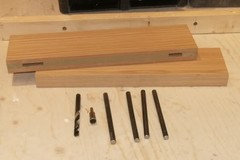
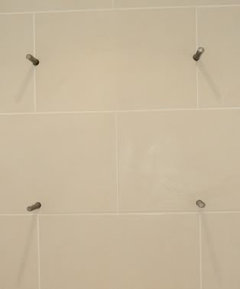
    "try using solid timber for the shelf with metal dowels drilled and resined 3/4 of the way into the shelf and as deep as you can go into the studs "

    and

    "I have installed a few of these in the past that were pre-made. They used large 8" L-brackets that were 2-4" wide installed behind the drywall, then a hollow slit in the shelf allowed it to slip over the bracket."

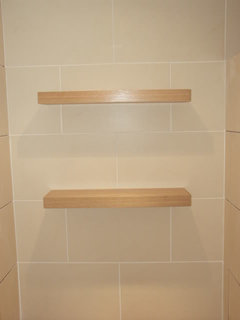
    here are some photos from the thread:

    This is Ikea's LACK bracket. DH suggested we buy some LACK shelves and make our own shelves. Maybe...
    {{gwi:1798736}}

    and here's a pictorial explanation of what I thought would work (looks like it CAN work!)


    More from the same thread:
    He says, "I've used the same method as above. Drilled 3 holes in the shelf and then into solid corresponding studs. Dry fit with threaded rod, then used poly glue to attach."

    more advice, "All thread works very well. 3/4" all thread works real well. Drill a 3/4" hole in the center of the stud and pound the rod in like a nail. the treads bind up with the fibers and hold incredibly well.
    Then just adjust the rod to be nice and square to the wall. Drill a 7/8" hole in the solid stock shelf that you previously scribed to the wall. Pump a couple of squeezes of construction adhesive in the holes and a thin bead along the back edge. And press it on to the wall. Brace it level.
    Keep a scrap block and a piece of all thread on hand to practice how much adhesive to squirt in the holes. Too much and you have screwed the pooch big time. Not enough, and well, that sucks too. "
    "Level line at the top of the shelf. Take a hammer and nail and poke around after your stud finder gives you the approximate edges of stud. You can easily and accurately locate the edges of the studs with a nail. Drill the hole in the middle. Then mark the edge of the shelf after the all thread is in place. "
    "Personally, I'd counterbore the drywall and put a solid packer between the shelf and each bolted stud as well. "

    I linked that thread below.
    Now here's another one, woodworkers this time:
    Question
    We are in the process of installing floating shelves in a kitchen. They are 60 inches wide, 12 inches deep, and 1.5 inches thick in solid oak, so they are pretty heavy. They need to be able to support plates and glasses, so assume a fair amount of weight. The surface is drywall and the wall is finished, not open.

    Our tentative plan is to use 12-inch x 5/8 inch steel threaded rod to support the shelves by screwing the rods about 3 inches into the studs, and then sliding the shelves (with holes drilled in them to correspond to the rods) onto the rods. We also planned to use Liquid Nails inside the holes in the shelves.

    There are 3 studs behind the shelves that we can use to anchor the rods. Has anyone done a similar installation?

    I am most concerned about being able to drill perfectly straight into the studs, and also perfectly straight through the shelves (to a depth of 9 to 10 inches). We have a drill guide and a 10 inch Forstner drill bit that is 7/8 in diameter to make the holes in the shelves. What kind of drill bit would you recommend for drilling the studs?

    Finally, I am aware that there are blind shelf supports available at Lee Valley and Hafele, but unfortunately they are not long enough for this application (only 5 inches long, not enough to support a 12 inch deep shelf that has to take a fair amount of weight).

    Forum Responses
    (Cabinet and Millwork Installation Forum)
    From contributor M:
    I wouldn't wish drilling a 9" deep hole 7/8" bore into a 1 1/2" thick edge on anyone. I usually get around this situation by cutting a slot in the drywall over each stud and screwing on a massive steel angle bracket. The bracket leg sticking out into the room slides into a slot in the edge of the shelf which is miraculously formed by laying the shelf up with a hollow space in the center. (1 1/2" thickness = 2 x 5/8" faces with 1/4" thick spacers)

    From contributor K:
    I have a couple methods of doing this, but I need to know the maximum weight. Does either the left or right touch a wall?

    From contributor Y:
    Does the shelf have to be solid oak? You could build a torsion box with oak veneer and lag screw it to the wall. The torsion box is extremely strong but lightweight and you can make them in whatever dimensions you need. You can probably still find Ian Kirby's articles on them in Fine Woodworking archives.

    From contributor W:
    You don't have to drill perfectly straight into the studs. I use lag bolts, pre-drill as straight as you can, drive the lags as far in as you want, cut off the heads, then use a piece of pipe to bend them perfectly level and square to the wall. If you have a horizontal boring machine you could start the holes in the shelves with that then finish them by hand. Although I would opt for the torsion box method mentioned above.

    From the original questioner:
    Thanks. Unfortunately, the torsion box method is not an option; the shelves were custom-milled and have already been delivered. I *wish* we had gone the torsion box route, but it was not my choice and it is too late now.

    To answer other questions: there are no walls on either side of the shelves. The only way to attach them is along the wall running directly behind them.

    Regarding the angle brackets suggestion: are these special brackets, or something you can get off the rack? We had considered having brackets made by welding steel rod onto railing, but nixed the idea due to costs and time constraints.

    From contributor K:
    Is the back open at all or is it banded/solid all around?

    From the original questioner:
    The shelves are completely solid (we had planned on drilling 9 inches deep into them to make tunnels for the rods to slip into). The wall is closed also, but obviously we could open up parts to expose the studs if need be.

    I did find someone who offered to drill the holes in the shelves in their shop with a big drill press, if we get really stuck. But apart from the issue of drilling the shelves, does it seem that the rod approach (i.e., using allthread to support the shelves) would work? We can only go 2 or 3 inches into the studs with the allthread, and would have about 9 inches of rod supporting the shelves. Do these ratios make sense (I am concerned about shearing load)?

    The shelves themselves weigh around 60 pounds, and they need to be able to hold plates and glasses safely. Ideally I would like to have them be able to bear 150 lbs total; I know someone who has similar shelves in a kitchen rated to 150 and they work very well.

    From contributor R:
    I would think you could get all of 3" into the stud with your allthread. Test your idea in the shop. Take an existing stud... mark the idea of drilling a hole into it to the cost of education... or fasten one someway to your wall. Drill your hole and insert the allthread, gluing as desired, and let cure. Then hang a bag or so of rock salt on it and see what happens. Or do two rods and have your 150# employee do a chin up. Does it hold?

    From the original questioner:
    You know, that is a really good idea. I was thinking along the same lines in terms of weight - if it could handle someone standing on it, I think we would be good to go.

    From contributor C:
    I would use a spurred ship auger to drill the hole through the shelf. It will stay true going through once you get the setup on the drill press. You may need to grind off the threads on the self feeding tip to take the load off the drill press and/or bring the speed all the way down.

    From contributor T:
    I recently tried to pull this off, only with thicker salvaged timbers. Started out by cutting a stopped channel in back edge of shelves, and made a ledger strip to fit in that channel. I epoxied and bolted threaded rods into the ledger, drilled corresponding holes into shelves. I drilled the holes on drill press, as deep as possible, then finished by hand. The plan was to screw and glue ledger separately to wall, then slide shelves on. The wall was plaster on lath over block, so it was real uneven - all told, a nightmare waiting to happen. Finally talked the owner into simple angle iron brackets painted to match wall. Much more secure, and I haven't thought about it since (as I would have if I went the way you're trying to go). Still had to scribe back edges of shelves - a little easier because of the channel. You might want to do this (relieve back edge of shelves) to reduce the scribing chore. I guess your plan can work, with a lot of trial and error for each shelf. You'll want to somehow support the shelves in level position for a couple days while the construction adhesive sets up.

    From the original questioner:
    The salvaged timbers must have looked really nice.

    The owner is very particular, so visible brackets are a no go. It really would take away from the look of this particular kitchen, which is ultramodern and sleek. We are going to give it a try with the rods on Monday. Thanks so much for all the tips.

    From contributor J:
    Use a long lag bolt, then cut the head off after installing.

    From contributor V:
    I mounted a fir timber mantle, which weighed 120lbs on its own, by drilling holes into the studs as you are planning, and used pieces of black pipe instead of the all thread. The all thread really should be under tension in any sort of structural situation.

    From contributor L:
    Why exactly do you need to go so deep into the shelves? Drill a 3" deep hole in both the shelf and the stud, and set the rods in epoxy, with spacers running up from the floor. End of story?

    From the original questioner:
    The idea of going deeper into the shelf was to provide support for the front part of the shelves (they are 12 3/4 inches deep). I have an engineer friend who insisted that an 8 inch deep shelf needs 5 inch deep supports, and a 12 inch shelf needs something more than that. And I know of one person who successfully did the same installation using allthread and he drilled 9 inches into the shelves. Three inches may very well have sufficed, for all I know, though.

    In any event, as it turns out, we were only able to go about 8 inches into the shelf with the particular drill bit we had today. That is, into the one shelf that is now drilled with its 3 holes. All the rods are up on the wall; no problems there, and they appear to be able to support plenty of weight. But none of the three drills we had were particularly enthusiastic about their encounter with the oak, so we made a quick phone call to a friend and are using his drill press tomorrow to finish. Hopefully, that will go more smoothly. I also think we should have used a different drill bit, but that is another story.

    If I could have done it differently, I think I would have opted for the torsion box method or the method of sandwiching the brackets, which probably would have worked really well here.

    From the original questioner:
    Thanks everyone for all of your advice. It was very helpful. The allthread worked fine, as it turns out. We ended up drilling the shelves without a drill press (just an auger bit and a corded drill) and that worked out also.

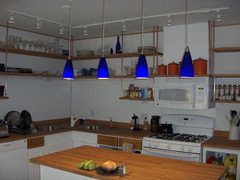
    ...and.... another option. These folks used Ikea BB countertop and supported the ends with threaded rod to the ceiling which is covered with copper tubing.
    Materials: NUMERAR countertop, 3/8″ threaded rod with assorted hdwre, 1/2 copper tubing lacquered, 1�1 wood stapping cut to length Description: NUMERAR counter top was ripped in half lengthwise to make above counter kitchen shelving. Threaded rod supporting the outer edge is concealed by copper pipe which has been lacquered to prevent oxidation.


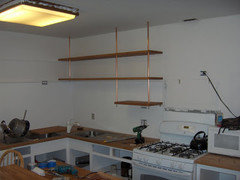
    and here's another way to do it:

    Ok. I'm still not sure what the best method is!

    Here is a link that might be useful: Contractors talking about floating shelves

  • 15 years ago
    last modified: 11 years ago

    Thanks, staceyneil. This is great!