Software
Houzz Logo Print
criticalmass048

Overloaded kitchen, or not?

17 years ago

(still doing kitchen remodel)

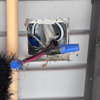
Ok, so I have the walls ripped out and the wiring all exposed. Currently, we have a portable dishwasher, some minor appliances (toaster, chopper) and a microwave plugged in to the same circuit. I can also see where 10 years ago, our handyman installed a GFCI and tapped in to the same circuit for an outlet feeding a garbage disposal.

We want to move to an under-cabinet microwave/exhaust, and an in-cabinet dishwasher, so I need to move the outlets around. My problem is that, as you might imagine, in doing research, I see any appliance rated at 1,000 watts or higher should be on its own circuit. If this is to be true, my current setup which has been fine for years should actually be broken down in to three circuits, since the "average" ratings are 1,200W for a DW and 1,400W for a microwave. I'm now lost, and unable to move any further until I get more advice from you good folk! Thanks once again!

dw12,m14

Comments (11)

  • 17 years ago

    If an appliance is fixed in place, such as your OTR micro or DW, then they almost always need a dedicated circuit.
    Typically folks will share a 20A circuit between a DW and disposal. An OTR micro typically needs it's own 20A circuit.

    NONE of these items are allowed to share a circuit with counter or general use kitchen receptacles.

  • 17 years ago

    So then I DO need one for the microwave, one for the DW/GD, and one currently there for the small appliances, correct?

  • 17 years ago

    If you are renovating the kitchen and wiring it to code then you need at least TWO 20A circuits for the general use/counter receptacles.

  • 17 years ago

    Well I hate to break it to you guys, but you should see how this place is wired!

    This is a duplex (we own). There are two kitchen lights, a bathroom light fixture, a bedroom light fixture (and outlet), refrigerator, garbage disposal, microwave, and appliances that I mentioned in addition to whatever else I didn't mention ALL on the same circuit! When I turn that breaker off, everything goes black. I have a worklight plugged into a separate circuit so that I can see.

    I'll run the new lines, but I'm thoroughly confused as to how the builders got away with this 40-50 years ago without the place burning down, or even how we've managed to live here without popping breakers left and right!

  • 17 years ago

    Well, burning the place down isn't the concern nor the reason for the code - that's what the breakers are there to prevent. Assuming all your connections are tight and solid, overloaded circuits just result in someone having to go reset a breaker or replace a fuse.

    As far as how you haven't been tripping breakers - lights aren't big loads unless you've got a crapload of them. The refrigerator runs periodically but not continuously, garbage disposal and "minor appliances" (toaster, chopper, etc.) don't run very often, and the dishwasher pretty much just spins around and pumps water most of the time - of course you mentioned it's portable so it's engineered in expectation that someone's going to plug it into a circuit that powers something else...

    In short, breakers have a time delay built in - the delay is longer for smaller overloads - and it's unlikely that you've had a large enough overload for a long enough period of time to trip yours.


    I'm living in a house right now where one circuit powers the entire upstairs except one room, most of the kitchen, and various lights scattered about the place. We never trip breakers except when Kc tries something dumb like welding with a chopped extension cord (looong story) or shoving a ball of steel wool in a lamp socket - ahh the nightmare joy of living with a pyromaniac.


    Anyway, this is one of those times when I say "go with the code just because it's code". I've seen so many situations like you describe and they seem to go on working forever, but you've got the walls open anyway, so do it right.

  • 17 years ago

    A large portion of the work we do is fire restorations, being in that line of work I can tell you countless stories of electrical fires in homes. In many of these situations I hear the line "I just don't understand why we had a fire when it worked fine for the last 20 years".

    The answer is relatively simple - things that are not installed properly will eventually fail. Could be 2 minutes, 2 years, or 2 decades but it will happen. The only question is how bad will the failure be?

    One must also consider that power requirements 40 years ago were much less than they are today. Many people do not realize how much juice all of todays electronic gadgets draw, especially when all of the smaller ones are added together.

    Wiring an entire house on 2 circuits may have worked in the past, but in todays age of numerous small kitchen appliances, computers, big screen TV's and ink jet printers the demand on older wiring methods can and will push it to the limits.

    This is why you truly need to update the wiring to todays standards, no matter how much you may feel they are not needed or are an overkill.

  • 17 years ago

    You require.
    1 20 amp for GD and DW
    1 20 amp for microwave.
    2 20 amp for counter receptacles.
    1 15 or 20 amp for the other stuff already on the circuit.

  • 17 years ago

    OP states: This is a duplex (we own)

    Is it legal in your area to do the electrical work if this unit (or the other unit) is going to be rented out?
    Most areas require a licensed electrician to do such work.
    You may do electrical work on your own residence, but not in a duplex/multiplex/apartment that will be rented out or a portion of it rented out.
    Better check with the AHJ/building department before they make you tear it all back out and start over using an electricain!

  • 17 years ago

    (thank you all for your great input, and no, we have no intention of renting out; if anything, our daughter may move into the top floor)

    On the one circuit, I plan to have the line going into the outlet for the DW, then into a switch, and then into the the outlet for the GD. On the other, I plan to have the line going directly to an outlet which will power the microwave.

    QUESTION #1: Don't the outlets for the microwave and DW need to be GFCI, in addition to the one we already have for the third circuit?

    QUESTION #2: I thought I heard that code says that ALL kitchen/bathroom fixtures need to be on separate circuits? If that's the case, do I need to re-wire what's already here?

  • 17 years ago

    The reason I ask Question #1 is that if a GFCI has to be on the first outlet in the circuit, then that means the GFCI would be under the counter, behind the DW, which means if it ever tripped we'd have to pull the DW out to reset it. Would I be better off going with a GFCI breaker in this case, or is there something else I'm missing here?

  • 17 years ago

    1. Not required for either.
    2. Kitchen counter receptacle are not allowed to have anything else on them.

    Bathroom has different requirements.
    There are two ways to do a bathroom. 20 amp circuits are required for both.
    method 1. The 20 amp circuit serves only one bathroom. It can serve anything within the bathroom including counter circuit. Lights, fan etc can be on the circuit but are not required to be.

    method 2. The 20 amp circuit serves ONLY receptacles. It can serve receptacles in more than one bathroom.