Software
Houzz Logo Print
criticalmass048

Over-crowded box

17 years ago

Ok, so the wife decides that instead of having the one single light above the kitchen sink, she wants three canister lights about 3' apart (kitchen is only 10' wide at that point).

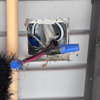
Upon removing the fixture that's there, I find FOUR sets of wires in that box -- the hot set, the pair going to the switch, and two more sets that apparently power the living room and dining room lights as well.

It's an older place, and I've noticed a lot of stuff like this, so I've been adding circuits left and right. I don't think the way they wired this place would ever be acceptable by today's standards.

I'm stuck, because I don't want to put yet another set of wires in the canister light box (going from the 1st light to the 2nd light), but on the other hand if I run a new circuit for the kitchen lights, I will still need to join the other three sets of wires already there, AND make the junction accessible, which would put it in a very awkward place, especially since the canister light will be occupying the same hole as the original box.

I'm looking for some ideas, and I know from past experience that this is the group to give it to me! Thanks!

Comments (6)

  • 17 years ago

    (I'm guessing that by "cannister lights" you mean that you're planning on installing recessed lights.)

    Somewhere on the junction box of the recessed light you're installing should be stamped the maximum number of conductors the box will accommodate.

    If not, you will need to find the volume of the junction box and do a box fill calculation (see the link below).

    In any case, if you end up being over on what can fit in one box, would it be possible to physically relocate the living room and dining room cables to the second light? Then you could just run a short length of 14/3 (or 12/3) to carry both the hot and the switched from the first light on through to the second one. Just a thought.

    >if I run a new circuit for the kitchen lights, I will still need to join the other three sets of wires already there, AND make the junction accessible, which would put it in a very awkward place, especially since the canister light will be occupying the same hole as the original box.

    I'm confused by this. Are you saying that you would be installing a junction box, and then running wire from there to the lights? If so, why would you not just use the box built in to the recessed light(s)?

    Here is a link that might be useful: Box-fill calculations

  • 17 years ago

    The box not only isn't big enough, but since it's about 8" away from the canister, I don't think all the wires would reach.

    What I meant to say was, if there are too many wires to safely fit inside the box, running a new circuit still wouldn't help either, because I would still need to put all the existing wires in some kind of junction box as well.

    If I use your idea, instead of having 4 two-conductor cables, I'll have 3, plus a three-conductor, so I'll have the same amount of "hot" wires, and one less neutral. I don't know that it would make much of a difference when it comes to box size.

    Maybe my only other option is to replace the included box with a bigger junction box, if all the wires will reach?

  • 17 years ago

    Sorry, I misunderstood you to mean that you were replacing the existing light/box with one of your canister lights at the same location. Anyway, you're right--if the LR/DR cables were moved to the second light, you'd end up with three two-conductor and a three-conductor in its box, since you'd still have to run a two-conductor from it for the third light (duh).

    >Maybe my only other option is to replace the included box with a bigger junction box, if all the wires will reach?

    The problem with replacing the box on your canister light is that it would void the device's UL/CSA rating. If there was a fire and the light was found to be at fault, there goes your insurance.

    It's sounding like you're going to have to leave the junction box where the old light is/was and put a plate over it for access. If that's the case, is there anything stopping you from replacing it with a larger one??

  • 17 years ago

    " If there was a fire and the light was found to be at fault, there goes your insurance."

    Not true at all...

    Homowners are covered in this instance unless it can be proven that it was done to intentionally cause a loss to a covered property.

  • 17 years ago

    I know that homeowner's insurance generally covers for wiring mistakes, but to intentionally modify a UL/CSA listed device? I always thought that was grounds for an automatic denial of claim. So, then, the whole point of having a device listed is nothing more than liability CYA for the manufacturer?

  • 17 years ago

    gblentz,

    You were correct, in that the location of the existing light fixture will be the "middle" of the three canister lights. I'm not sure where exactly I confused you, but thank you, because you let me on the right track.

    I think that instead of putting the switch at the end of the circuit, I will instead run a new line into the switch first, then run 12/3 cable from there (one hot, one switched) into the first canister light. There, I will connect the living room light to the "hot" wire, and pass the "switched" wire to the second canister.

    I will then use another piece of 12/3 to go from the second canister to the third (one will be the same "switched" circuit, while the other will carry the existing/old "hot" wire.

    In the third canister, I will connect the light to the "switched" line, while I will connect the "hot" wire to the line that goes to the dining room.

    As for the canister box, it specifies "Maximum 6 #12 connectors".