Software
Houzz Logo Print
gedman

Help with choosing a portable generator - please !!!

18 years ago

I want to buy a portable generator, mostly for piece of mind - but also to keep my family somewhat comfortable and my sump pump running in the event of an extended outage. I searched & read lots of posts on this forum, and "Googled" plenty of sites, and I am still in need of advice.

Basic facts: I have a 2,300 sq ft home. I want backup power to run basic necessities:

* gas furnace (forced air w/ electric blower)

* refrigerator

* two sump pumps (one light duty and one heavier duty, but neither one runs much even during major rain)

* 10-12 19w compact fluorescent bulbs

* possibly run the clothes washing machine occasionally

* a few smaller items like a radio, cellphone charger, etc.

I plan to have a generator panel added by an electrician to supply power to my 200amp house panel. I'll shut off the breakers for all non-essential house circuits when using the generator.

Question #1: What wattage should I get?

Online wattage calculators seem to indicate around 7,500W. It is highly unlikely that my 2 sump pumps and refrigerator compressor all startup at the same time creating high peak demand. Of course, I'd rather have too much than too little power available.

Question #2: What brand?

I don't mind paying more $ for a quality product. I want a generator that will last, is easy to maintain, and local repair shops will not have a problem getting parts/fixing/servicing as needed. It sounds like OHV engine is a must.

Question #3: What features?

I like the idea of an engine that throttles based on load (or at least idles when there is minimal load) to conserve fuel and noise. I have no idea if I need DC power or an inverter. A wheel kit would be necessary. I'm not sure how I'd keep a battery charged to make use of electric start. Fuel gauge, low oil shutoff/alert seem obvious.

Question #4: It is feasible to use a 20-25' cord to connect the generator to the panel?

Thanks a MILLION to anyone who can help me with this decision.

Gedman

Comments (6)

  • 18 years ago
    last modified: 11 years ago

    That's quite a mix of questions you've asked and a lot of them, I'm afraid, can be answered with: "That depends."

    When you Google the sites about sizing generators, most of them encourage you to add up the wattage of everything you want to run and then use that as your minimum capacity. Except in a narrow band of cases, that's nonsense, of course. You've noted that not everything is on at the same time and it's unlikely that every motor--sump pumps, refrigerator, furnace fan, etc.--will start up at the same instant.

    Accounting for "diversity"--the probability of different mixes of things being used simultaneously--is a basic when planning capacity. Otherwise, if most people added up the size of every light bulb and electrical device in their house, they'd run out and double or triple their service.

    The biggest single draw you've listed is the washing machine, which you've designated as "optional", or subject to discretionary management (e.g., maybe don't run it when the sump pumps are working hard and everything else is on).

    They highest demands would occur when a motor starts up (sometimes requiring 3 or 4 times the rated wattage of the motor), but that is usually covered by the surge capacity of the generator, unless a large motor is being powered. Here, you're probably talking about motors in the range of 1/3 or possibly 1/2 h.p. A 6KW genset ought to be able to handle it.

    If you want a seat-of-the-pants guestimate, you would probably do just fine with a 5-6KW generator (that's continuous capacity--surge would be a bit higher). I could be convinced that more power is needed if those are exceptionally large sump pumps and are pumping frequently.

    What concerns me more is the method for connecting the generator to the house power system. The right way to do this (and I'm sure your electrician will confirm this) is to use a transfer switch to isolate utility and generator power.

    This issue of how you connect the generator to the transfer switch is something you should discuss with the electrician. A 20-25' cord is feasible, yes, if it is a very heavy duty 240V generator cord, made for purpose.

    I'll skip the question about brand because I don't think it's a proper in a forum of this type to indulge in product endorsements. (That's only my take and others may disagree.)

    From the specs you've given, I can't see any reason you'd need DC power or an inverter. (The generator already has an inverter built in.)

    Any good quality generator has a governor that responds to load and consumes less fuel when there is less demand for electricity. A generator under full load will make more noise and use a great deal more fuel under full load.

    As far as keeping the generator battery charged, there are a couple of approaches. If you are dilligent in starting up and testing your system regularly (some recommend montly), that should keep the battery charged. Another approach, if circumstances permit, is attach the battery to a small, inexpensive solar panel (say, 3 watts) with alligator clips. This isn't enough to charge the battery when if it runs down, but is enough to provide a "float charge" and, at that capacity, it shouldn't require a charge controller. It's about a $30-40 solution.

  • 18 years ago
    last modified: 11 years ago

    Excellent advise!

    You might also consider a generator that uses propane for fuel. You could have a tank installed where you're going to place the generator. You won't have to keep going out to fuel the generator nor be storing a bunch of gasoline for it. But if you live in a very cold climate, I would avoid propane. It doesn't like the extreme cold temps.

  • 18 years ago
    last modified: 11 years ago

    keep in mind tha tyou can run the fridge for a couple hours a couple times a day and it will stay cool enough. so it is not a continuous load. back in '94 during the ice storm here we ran the fridge twice a day for 1 hour or so, then unplugged it and ran other devices.

    when you buy a gen set, you get what you pay for. i am VERY leary of those 8kw gennies that sell for 5-600. we paid 3k for a 5kw, and it IS 5kw if not more. i have seen it run an entire RF shack at a tower site before, no small load at all.

    the governor will adjust the throttle for load. i personally don't like the ones that cut all the back to idle under light loads, i have seen sudden loads cause a voltage sag. we have another 2500w genny that does this. with a very small load it is idling, but when you put a big load on it, it dips then surges up. NOT GOOD for electronics.

    speaking of electronics, you WILL want to either put a UPS on your entertainment system, or unplug it when on generator. i have yet to see any TV newer than the late 80's that really liked a portable generator.

    we use a 50' gen cord at the shop to power the NOC. simply throw the disconnect, plug up the cord to teh genny after it has stabilized, and throw the other switch to feed in power.

    lastly, RUN that generator once a month. i don't care if you use gas, diesel, propane or natural gas, it is an internal combustion engine and the parts need to move freely. if you don't run it to allow everything to get oiled up good, you WILL have problems in a year when you need it. plus with gas gen sets the gas will go stale on you. i run the 3 at the shop(gasoline units) on the last business day of every month. i run the one at my house that weekend. all you have to do is crank it up and let it run for 15-20 minutes. on our Honda gennies we let them run about 10 minutes then cut off the gas. the fuel in the bowl will keep it running another 5-10 minutes before it dies. this serves 2 purposes, it we get a good exercise of the genny AND we end up draining the carb so it doe snot gum up. if you get electric start, this will also maintain the charge on your battery.

    i HIGHLY recommend electric start too. nothing worse than standing outside in freezing cold rain and pulling on a rope for 20 minutes!

  • 18 years ago
    last modified: 11 years ago

    If you are going to this much effort, have you given serious thought of a permanently installed standby genset with auto start and an auto transfer switch?

    Its very nice when the lights go out to know they will be back on in 30 seconds. And that the genset will shutdown when the utility power comes back.

  • 18 years ago
    last modified: 11 years ago

    for portable generators that are reliable and serviceable its hard to beat Honda in my opinion.

  • 18 years ago
    last modified: 11 years ago

    Hi,

    One day I will do a website on my experience on puting in my genset but here goes.

    I think the easiest way to decide is to group the pricing for solutions into three broad categories:

    1) gasoline powered, portable, Up to 7.5 kw, $US 1000-3,500 all in
    2) Propane powered, fixed install, lawn mower engine based, Up to 15kw. $US 5000-10000. Auto start. 3,600 rpm
    3) Car truck engine based, 1,800 rpm, liquid cooled. Auto start. 20 kw and up. Propane based. $US 12,000 and up.

    I think you are looking for a moderately priced solution which will bring you into option 1 or 2.

    Option 1: Gasoline powered portable generators have the advantage they are an economical solution. The key decision reason I think is your familly. Do you have a person who is able bodied? You will need to move this heavy piece of machinery outside, set it up, possibly in bad weather. Also refil it with gasoline every 5 hours or so. Do you have somewhere that you can store 20 gallons of petrol? 20 galons may give you about 24 hours of run time. More thatn 20 gallons is usually prohibited by fire codes.

    I would store the genset in you garage and prepare an outside spot to run the generator. This needs to be sheltered (rain and electricity together are bad), and away from the house windows / doors / vents Carbon Monoxide poisoning and fire risks. To hook up you can use a 240 V two phase NEMA connector to a special connection point on the ouside of your house. The wires then feed to a transfer switch which will supply your pump, well, fridge etc.

    When I was looking at it I think the Honda EB7000i AB is the best unit in the market. It has inverter electronics that allows it to run at the most efficient speed. Non Inverter generators run at 3,600 rpm to give you 60Hz freq. This units is expensive though at about $US 3,000 I think.

    Option 2:

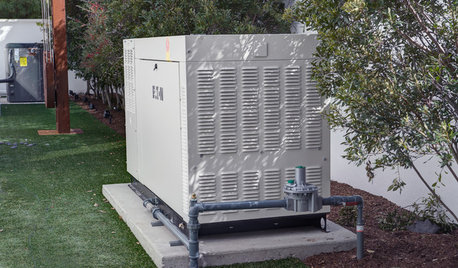
    This is a more expensive option. Go for this option if you do not have an able person around. The generator is installed permanently and everything can be made to be automatic. Propane can be stored indefinately, no need to wheel about generator sets. The genertors come with weather proof housing. When the power goes out, wait 20 seconds then everything comes online automatically.

    In my situation, I ended up going fot a Cummins Onan 20 kw unit from Costco. All in cost was about $US 20,000. This was a 4 months install process.

    Overall it was not too bad an experience.

    Best, Mike.