

Heaven Can Wait Blackberry?
Gurney's is selling a blackberry, called "Heaven Can Wait" but I'm curious if it's simply relabeled like many of their other berries? They list the cultivar as "A-1960" and some quick googling revealed it's part of the Arkansas breeding program but I can't find if it ever received an actual name or if they simply sold the rights to Gurney's. Anyone try this blackberry? It's said to be productive in zone 10.
Here is a link that might be useful: Gurney's Blackberry
Comments (40)
 11 years ago
I planted one about a year ago,but the growth has been kind of slow.There may be some fruit in 2015 and I'll report if that happens. Brady
This post was edited by Bradybb on Tue, Dec 30, 14 at 11:16
Jay Part Shade (Zone 10B, S21, Los Angeles)
Original Author11 years agoThanks Brady, I assume you ordered from Gurney's? Did it arrive in a 4" pot or a 1 gal?
Related Professionals
Belleville Landscape Architects & Landscape Designers · Bowling Green Landscape Architects & Landscape Designers · Lake Charles Landscape Architects & Landscape Designers · Aiken Landscape Architects & Landscape Designers · Portsmouth Landscape Architects & Landscape Designers · Emporia Landscape Contractors · Annapolis Landscape Contractors · Miami Landscape Contractors · New Bedford Landscape Contractors · Denver Landscape Contractors · Cornwall Landscape Contractors · Baltimore Home Additions · West Plains Home Additions · Rochester Home Additions · Jamestown Home Additions 11 years ago
Jay-Part-Shade,
You may want to check to see how many chill hours you get at your planting site. You may have to get a very low chill variety blackberry. Kiowa and Tupy are the lowest chill varieties that I know. 200 or less chill hours needed for these.
Jay Part Shade (Zone 10B, S21, Los Angeles)
Original Author11 years agoHey JT,
Thanks for the info. Just checked it out, my area gets roughly 350-550 (though last year we only got 230).
My hope with the "Heaven Can Wait" was to find its common name so I could check out chill hours. Not many blackberries are pitched for zone 10. That said, I just looked at the listing and Gurney's says they can't ship to CA.
I have two Prime-Ark Freedoms (one in an aquaponics system) but not sure how many chill hours those need. Also just got a Baba Raspberry and thornless boysen. Kiowa and Tupy are on my list for future acquisitions. Annoyingly, Driscoll's is phasing out their Tupy fields and replacing them with their own varieties that are said to be low chill and better tasting. Of course, they're not releasing those varieties for others to purchase.
- 11 years ago
Jay-Part-Shade,
I stopped by a Home Depot in Woodland Hills last year and they had both blackberries and raspberries for sale. I don't recall the varieties but they may have some with lower chill requirements. I also purchased a Marion Blackberry in San Diego (another Home Depot) a couple of years ago and I believe it has a chill requirement in the 300-500 hour range.
I have purchased mail order from groworganic.com and they are based in CA. They only ship in Jan and Feb I think.
Jay Part Shade (Zone 10B, S21, Los Angeles)
Original Author11 years agoGood to know, I need to make a trip to HD and see what they got. I'm thinking the hybrids are a good bet -- boysen, marion, tay, olallie.
I can't seem to find any reliable info on Prime Ark Freedom chill hours. Anyone know? I read initial trials rate it roughly with the lower chill hour AK varieties. I guess I'll find out in a couple of months if my floricanes fruit.
- 11 years ago
Jay-Part-Shade,
I learned something new.
I did a little research on Prime Ark series of blackberries. According to a HortScience abstract written by John Clark and Chad Finn, primocane fruiting blackberries do not have a chill requirement for the primocane crop, only the floricane crop. The floricane crop for the Prime Ark series is between 300-500 chill hours, depending on the variety of primocane fruiting blackberry. Prime Ark 45 and Freedom have a 500 chill hour requirement according to Agristarts website.
One additional note...the primocane crops tend to not produce as well when they flower during really hot weather (>85F). That might one additional factor to consider.
Jay Part Shade (Zone 10B, S21, Los Angeles)
Original Author11 years agoThanks for digging that up! I guess it makes sense the primocanes don't need chill -- there's no way for them to get any chill hours if they're popping up in spring.
Good point about the high temps. One reason I'm excited about the primes is I read the berry size is said to be very large in CA trials. If I get enough chill hours, I think our climate is temperate enough to get the large, productive floricane crop.
- 11 years ago
My Prime Ark 45's usually have good floricane crops with large (10-13g) berries. The primocane crops tend to be not as good in productivity and berry size. Despite that, it is nice to have fresh blackberries until frost (usually mid-to-late October). At frost, I usually have about half my primocane crop still unripe, so you may have blackberries well into December and that's pretty cool.
- 11 years ago
A bit late here, but maybe a bit of knowledge exchange. I have a large number of berries in containers in my garden. Many blackberries including Heaven Can Wait, Apache, Natchez and Ouachita (2 plants 'cause the bees and I love them). BB raspberry crosses: Logan, Boysen, Olallie (the only thorny), Young, 6 varieties of Blueberry, 4 varieties Raspberry (including the yellow, Anne). Fall Gold on it's way. A cherry pair, Anna apple, Mid Pride peach, Spicy Zee nectaplum (amazing, beautiful plant with WOW factor fruit= dark red and green leaves), Cold Kissed apricot (apricots are difficult in warm climates) and more that I can't recall at this moment. All are growing like weeds and producing an amazing amount of fruit already. I've already harvested nearly 4 lbs of early blueberries. Did I mention 7 varieties of strawberries (most in hydro)? LOTS of tomatoes (hydro, too). 25 to 40 Lbs heading to ripeness as I write. 6-packs only about 6 weeks ago. They are taller than me, I'm 6'4" Lots of other veggies and artichoke, rhubarb, etc, etc,. LOTS of herbs and spices. All this in a 16' X 25' , tiny urban plot. The final kicker is that I am in a coastal Cali Zone 11 ! My chill hours this last year (I'm VERY near the station) was only 45 hours of sub 45F. ! Not one of the above are Zone 11 plants, and only a very few to Zone 10 (if any). Don't believe what you read. Good cultural practices trump all for the home gardener. BTW, I'm all Organic, except most of the fertilizers. LOVE my vermiculture. My favorite insecticide is the yellow jackets on the other side of the house. Amazingly smart and docile characters. As long as you don't go after their nests or swat at them, they are only interested in ridding your garden of nasties. If I need to weed or inspect, they obligingly move to the next plant. I'd put pics up, but I don't think I can here. If I have enough requests, I'll throw some pics on one of my web sites.
Jay Part Shade (Zone 10B, S21, Los Angeles)
Original Author11 years agolast modified: 11 years agoHey Phil, yes, would love to see pics of your setup, sounds pretty amazing.
- 11 years agolast modified: 11 years ago
Phil, don't let your yellow jackets, meet mine. No other bees or wasps bother me. I don't pay attention to them at all, but yellow jackets have a chip on their shoulder. Eating my fruit, stinging me etc. Death to all yellow jackets here. I cut them in half when eating my raspberries. They are focused on the fruits and it is easy to decapitate them.
- 11 years ago
Well, I don't care for the way this site crunched and cropped my photos. Many details are now omitted. Plus they are so small, the details that are here aren't worth eyestrain for. No more pics here from moi.
Jay Part Shade (Zone 10B, S21, Los Angeles)
Original Author11 years agoGreat pics and writeup, Phil! Fyi, you can click the pics to make them larger. They say Natchez needs 300-500, but clearly you're not getting that. I maybe got 150 chill hours this year but everything is fruiting. My Prime Ark Freedoms are producing huge berries from floricanes, which is really exciting. I have one against my stucco house that holds tons of heat, so it probably got very few hours. Why even list chill hours if they're practically nonexistent?? Maybe there's other factors in play.
Anyway, thanks for the writeup, really interesting to see your success in z11!
- 11 years agolast modified: 11 years ago
Hi Jay,The idea of chill hours is supposed to be for max production. Sometimes a bit overblown. Sure, there are some plants I have issue with. Apricots are a disaster in my hands. Massive growth, with minimal to no production in most years. I grew Katy for 11 years. Not one piece of fruit on a supposed very low chill variety. It was amazing wood in the smoker. Rich and sweet. I have a 2 year old 'Cold Kist' that is yet to fruit. My 'gardening friend' in the same Z11 is thinning fruit on her 2 year old tree of another variety. This Winter, I will be grafting. Mostly, I can get Zone 7 max producers to give a nice crop for other factors than chill.
Thanks for the tip to re-enlarge. Sheesh, and I'm the retarded 'Computer Guru'. Broader pics to follow so you may see what micro gardening is truly like.
- 11 years ago
I don't have to worry about chill in zone 5, I can grow low chill too, it depends on what it is. Many of us here have large collections of fruit. I have about 12 different blackberry cultivars, 20 raspberry, 7 blueberry, I grow about 15 tomato plants, and 15 peppers plants every year from seed. Currants, gooseberries, honeyberries, strawberries galore, melons, watermelons. Beans, onions, garlic. Many users here are like me or have even more. I don't have many fruit trees about 26 total. Some users like Scott has grown 1200 different cultivars in the last 12 years. This place is loaded with impressive growers.
Jay Part Shade (Zone 10B, S21, Los Angeles)
Original Author11 years agoIt almost feels like there needs to be a new zone system, almost all berries don't list zone 10, as if they'll die off when they're grown here. But pretty much every berry grows well. Everything grows well, the only thing we can't grow are high chill varieties, but it's impossible to tell what is truly high chill and what will actually produce fruit.
- 11 years ago
Impressive, Drew. It seems likely that your locale may account for the differences in our yellow jacket attitude. I would be 'stinging mad' if I had to face your Winters. With my lousy 45 hours of chill, I'm jealous of what you can grow. Of course, I'd need a lot more room to go with it.
Jay, yup... Most high chill varieties will grow here, but have limited to no production. In theory, the more chill required, the proportionate lower the fruit production. I do find the a good humic rich compost will help a lot. I use worm tea and compost extensively. It helps production a lot.
Jay Part Shade (Zone 10B, S21, Los Angeles)
Original Author11 years agoDo you guys ever use potassium silicate? Aka Dyna-Gro Pro-Tekt? I've used it before on my tomatoes and whatnot and the results are really fantastic. I'm planning on using it on the brambles this year to see about reducing pests and increasing cane strength etc, but I haven't found any good studies on it.
- 11 years ago
Jay, I would be very cautious using potassium silicate on cane berries. It strongly alkalizes the soil. We know cane berries don't like that. If you're worried about cane strength, you might try some calcium nitrate. In fact, I use both calcium nitrate and alternatively calcium sulphate (finely ground gypsum) in my hydro solutions. It would work fine as a top dressing. The sulphate form does not like to dissolve. The chloride form is also available, but not prefered by me.
My 'pests' have large, flapping wings. I'll send pics soon so you can see my monstrosity of a solution so I can finally eat more blueberries than the local birds.
- 11 years ago
Potassium silicate provides silicon a
trace mineral that does strengthen structure. I grow most of my tomatoes
in pots (9 out of 15) and I use diatomaceous earth as a soil amendment
to retain water or air. It's full of silicon, so I don't use that
product. I also recycle potting soils into my beds so the DE ends up
there. it lasts decades if not centuries.
My blackberries are
starting to leaf out at last, but now we have a weeks of cold temps
coming (the winter here, just will not end-worst in my lifetime). Lows
are 32F. But they should be fine. It's my new flower seedlings I'm
concerned about, and my herbs. I'm going to have to cover them.
Last
year my blackberries had a lot of winter damage. this year I protected
them and it looks like I will get an excellent crop. Raspberries don't
care about winter. I had a great crop last year, and another I'm sure
this year.
I have 2 raspberry patches here is one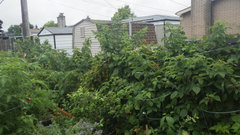 raspberries · More Info
Here is Polka, a great tasting cultivar!
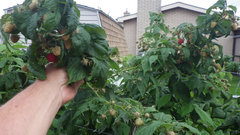 raspberries · More Info
I try to grow every color in the rainbow
 raspberries · More Info
- 11 years ago
Great looking berries. The 'Anne' really stands out. It's big and luscious. Mine is setting the Spring crop now. I think it's my fav for flavor. Any others that you're particularly fond of?
BTW, diatomite is composed of a completely aqueous insoluble form of silica. An amorphous form of silicon dioxide. The same composition as plate glass. It is quite effective as a soil oxygenator, but I'd bet little to no amount ever gets to plant cell walls. Diatoms, even broken ones are far to large. Cellular support would require an aqueous soluble form of silicate such as potassium or sodium silicate. Again, I would caution due to the raising of the pH of the soil caused by either of these. Tomatoes and such really wouldn't care. These are the only soluble silicates available to plant growers. Cane and blue berries would likely be damaged or even killed by the pH raise.
As a side note, I killed a portion of my Gojis a few years ago when I mistakenly sulphured them along with the canes and blues. Gojis sound like a perfect target for a silicate as they tend to be a bit floppy and adore higher pH soil. I will give it a try.
Jay Part Shade (Zone 10B, S21, Los Angeles)
Original Author11 years agoGood to know about the SI treatments. Brambles are higher PH than, say, blueberries, right? I was thinking of adjusting the PH of the SI so it's not as shocking to the plants. Also, I use powdered and chunky DE but I'm not seeing the same effects as potassium SI which really works well.
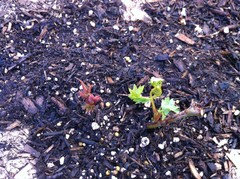
Anyway, got an issue: my bareroots came in from Indiana Berry 10 days ago or so. They're starting to sprout, but some have purple growth. The one shown is Prime Ark Freedom. They're in 15 gal root pouches with Kellogg patio plus and no fertilizer for now. Any ideas why it's purple??
- 11 years ago
Jay... I keep both the canes and blues in the same range. About 5.8 to 6.2. Sometimes, I even let them go a tad more acid, down to about 5.5. We both know it's tough with our alkaline soil and water. The high carbonates in our Colorado River soup doesn't help.
As I wrote above, DE is not a source of plant absorbed silica or silicates. In practical use, only sodium or potassium silicate works. On the other hand, DE is one of my prefered insecticides. Sow , pill and springtails are all susceptible to the sharp little diatoms. I'm using another interesting silica product to stabilize my hydro strawberries in net pots to stabilize the plants. It's collected glass at a dump site that is heated and blown. The berries can even put roots into it. It expensive, but works very well.
You have some nice looking shoots coming on those Primes. I do love the U of A hybrids. All nice quality. My grow space is so small, I love not having to many blackberry thorns to worry about. That purple rather looks like potassium permanganate. PPM is a pretty good bactericide, but that would seem just the opposite of what we diggers would want. For shipping? Interesting. I bet it goes away soon.
- 11 years ago
It's common (Purple) no worries, and normal. All canes by themselves will look like that. Brambles like a PH of around 6.0 to 6.5 just slightly acid, and will grow in lower or higher pH anyway. They are very adaptable plants. I have a blueberry raised bed next to my bramble patch and suckers from raspberries have no problem growing in the bed. It is as low as 4.5 pH, which often the blueberry soil is that low or lower. i have to keep digging them out. I dug out 4 today.
Thanks Phil for the tip on silicon, sounds like I don't need it anyway. I still think they may get some anyway, it just may be years down the road. I do use a little sulfur, and well sulfuric acid could make silicon available. I don't use it with tomatoes. Photos are from last year. My canes this year are just starting to leaf out.
As far as raspberry cultivars I like Polka and Caroline for reds. Maybe Taylor too, a summer bearing type. Many are good, I have many and have no plans to get rid of them. For yellows Anne is the best, but Cascade Gold is really nice too. Fall Gold is not as sweet and more tart, but man it makes the best jam! For yellows I also have Double Gold, Kiwi Gold, and Honey Queen. For reds I have besides mentioned, Prelude and Encore, both of these do not taste as good, but man what strong prolific plants, worth having. Himbo Top, worst tasting of the bunch, best producing, so I'm keeping it. I also have Crimson Night and it is a low producer of very sweet berries, My wife's favorite, so have to keep that too.
For blacks Jewel is the best, Allen though which is not as good, produces unreal amounts of berries. Last year I had three canes and got about 300 berries, This year it threw 11 canes! I cut three off that were smaller. Big canes too., 9 huge canes bigger than the red or yellow canes. So I may get 900 off of one plant. I expect at least 500. Time will tell.Some of my tomato harvest from last year.
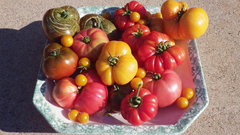 Tomatoes · More Info
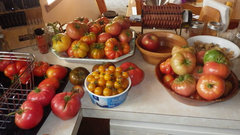 Tomatoes · More Info
Strawberries anyone? The white ones are pineberries. Well the small yellow are alpines. Some musk strawberries in there too.
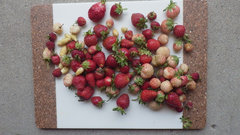 Strawberries. · More Info
Here's a musk strawberry, notice the red seeds. These taste like strong wild strawberries, Quite
unique tasting. You need a male and female plant to produce berries. One
male to about 8 females. Berries are small but bigger than alpines. Tastes like a strawberry creamcycle. Soft creamy texture. Some do not like them. Hard to grow. Spoil fast. This one is perfect!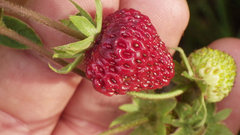 Strawberries. · More Info
,
White D is the best pineberry cultivar. June bearing, productive and big for pineberries.
Tastes like no other strawberry, sort of like pineapple, but each pineberry cultivar has a slightly different taste, I grow about 4 varieties, forget? All mixed up in the beds now! White D stands out though. Extremely hard to find White D. I keep propagating runners to always have them. I have about 60 plants. They are soft, you need to preserve or eat them soon after harvest. I make preserves if any are leftover.
 Strawberries. · More Info
 11 years ago
So Jay, your raspberry is probably purple because of it sprouting, a lot of my sprouting plants were red, purple, blue, but it goes away
- 11 years agolast modified: 11 years ago
Hi charlie.. It rather depends on what the insect is. BT is still considered a safe organic insecticide for caterpillar types. I will use it in sparing applications when called for. It's a whole different issue and far, far from being safe when it's genetically spliced into every cell in a corn plant. If it's an invasion of small insects, my fav would be a light Summer oil spray. In reasonably warm weather, these oils will evaporate in a few days. It works by smothering small pests up to an 1/8" or so. The kaolin product the Drew mentioned is also worth a shot. It's effective on a wide range of fruit munchers. My last resort cannon is spinosad. It's been around for a number of years now. It received a "certified organic" status several years ago. I use a concentrated version that is quite effective at 1/4 tsp. per gallon. A little goes a long way. It's the only thing that I have found to stem the annual Spring invasion of thrips on my large collection of epiphytic ferns. I sprayed it prophylactically for several years. I rarely have had to spray it the last few years.
- 11 years ago
Just a note a new strain of BT is being used against Japanese beetles. Not a problem in CA, but man they are nasty here! I saw an interview with one of the guys doing the testing, not the company selling it, and he said it worked well. The beetles consume the BT sprayed on the leaves and it kills them.
- 11 years agolast modified: 11 years ago
Yes, there are a number of different strains of BT. The toxin works by causing gut tract ulcerations in insects. Interestingly, there has been no known connection to human issues...that is before the introduction of GMO BT toxin producing corn. When we spray in the garden, it's external. The usual wash of fruits and veggies removes most of the residue. There now have been some indications that the massive amount of the toxin present in every ear of corn may be an issue in humans. In vitro studies showed that the toxin is capable of producing human gut ulceration at the dosage we receive in a relative small amount of GMO BT corn.
We do have some issue with Japanese flea beetles here in the West. Back when I had tiny plots of turf around the yard, they were planted in dichondra. Within 2-3 days of the first sighting of the beetles, the turf would all but disappear. For a month or so prior to their annual appearance, I dropped a white cloth and would check on it several times over a half hour or so. Missing an early detection could be a disaster. Ask how I know.
- 11 years ago
I need to withdraw my endorsement of Bt- Kurstaki. This is the variant approved in the early 1980s for coddling moths. It is the most widely used form in gardens. After a lengthy review of contemporary literature, it has been found to be or could be causative of a number of neurological issues and diseases. It is also suspected that these diseases may occur years after exposure. Indeed, there is far from conclusive evidence. It's difficult to gold standard trial. Personally, I'll choose other solutions from now on.
- 11 years ago
For me they need to prove it. Coffee is rated as a probable cancer agent. Even with all those anti-oxidants. Moderation, don't use it every year. Only use as needed. I don't even use the same compost every year.
- 11 years agolast modified: 11 years ago
LOL! I can cite whole list of studies that say moderate coffee consumption is cancer protective. Especially for prostate in the old guys. (dang, that includes moi)
As a retired chemist with a med research background, I find the evidence rather convincing against Bt-K. There is a boodle of it out there.
Well, Drew.... You've sent me out on a rather fruitless ;-) search for White D and musk strawberries. On the other hand, since I grow exclusively in containers, I took your advice and recently planted some Jewels just for kicks. As a last note, I've now harvested 4 varieties of blueberries (close to 30#) and have more on the way. Just today picked a good handful of Logans from the ongoing season. Just picked the first Ollalies, Young berries (a favorite), too. The first black berries now coloring nicely. Lots of strawberries, too.
- 11 years agolast modified: 11 years ago
I was a med tech who worked in research Phil, do you know what exactly the problem with it is? Anybody who works with BT works around hundreds of other toxins too, how did the resolve that confounding factor? Studies with mice and stuff don't convince me of anything. When you feed ten pounds to it, they would die if you made them drink a gallon of water too. I would have to read the studies myself to see if I find them creditable.
If you have done research you know it's more about how much money you can bring in if you report the results expected. I was so disgusted with it I left the profession. To me the studies are totally political having to do with Monsanto. So I refute everyone of them as garbage.
All info on the strain I read said low toxicity we do not digest food the same way as insects so the offending delta-endotoxin has no effect on our digestion. Colorado and Missouri Universities declare it as very safe. So the propaganda isn't working with all.
I don't use it it anyway and it is not the strain used for Japanese beetles.Bt galleriae is the strain I use.
The studies on coffee as a cancer agent were done by the World Health Organization, which is a totally political entity. So no of course I don't believe them, or ANY studies they have done. Or any studies by the UN on anything are all crap. NASA and NOAA are also political tools, not having to do with real science anymore, what a shame. They used to be so respected. They did great work, but now have an agenda and are willing to falsify data having been caught numerous times doing so. George Orwell was a genius, as we are living his book, 1984.
- 11 years agolast modified: 11 years ago
I'm a bit embarrassed that I didn't keep track of my references that I used in my assessment of Bt toxicity in vertebrates. This was one I did use. It a project at McGill University. You might find this and several of the references interesting: http://eap.mcgill.ca/MagRack/JPR/JPR_22.htm
I couldn't agree with you more regarding the Monsanto 'studies'. Monsanto 'expert promoters' are little more than hired guns. Although there are many, many, UC Davis seems particularly overloaded with them. The grant list there from the Big 5 agro bio folks (Monsanto, Dupont, Dow, Syngenta, BASF) is astounding. It's fearful that these corporations now control over 35% of the World non GM commercial seed. All under patent, of course. Monsanto's stated goal is to control all the World food supply. They alone control over 25% as I write this.
The W.H.O. is a laugh. They do make some interesting statements. A couple weeks ago they classified glyphosate as a probable carcinogen. There are some studies that confirm.
Then there is the unscrupulous, in my mind totally a hired gun (Monsanto's) attack on Seralini's work and findings. I reviewed the peer reviews as well as Seralini's findings. Seralini's methods that were attacked were for the most part, valid to me. The attacks were generally without scientific merit. Nearly all the attackers were agro bio grant recipients. Shills!
You are soooo correct in the sham that 'Science' has become. Our government protection agencies, the FDA, USDA, etc. are now used as tools to make money. They make a mint in any approval process, then even more when the product proves harmful. The FDA has collected many billions of $$ in just this Administration alone. The drug manufacturers just crank that into the cost of doing business. Meanwhile the public has been exposed to life ending or threatening issues. I am one of those victims. I will die prematurely due to a bad med. The manufacturer lied about trial results and admitted so in Federal Court. We victims collected a pittance, yet live with the pain daily. The Govt collected a bundle.
Wow.... We drifted way off Heaven Can Wait. Sorry to all that we may have sucked into our discussion here.
- 11 years ago
It looks like pruning practices for blackberries vary by type. What is the best pruning practice for Heaven Can Wait? Thanks.
- 11 years ago
HCW produces lots of shorter canes for me. I usually don't have to prune it until the Winter. If any cane gets to long to deal with (4-6') I would simply tip it to produce side growth and more fruit. So far, I've not had to do that with mine. As a side note, I am growing in containers. I do see about the same growth pattern with this as a friends in the ground. A nice, compact, great grower.








Phil Peck