Software
Houzz Logo Print
ampersand12

Plum Curculio control

11 years ago

This should be my first year getting decent cropping from my 2 apple trees. I had some fruit set last year but opted to thin it all off. I noticed curculio damage on nearly every apple I removed. Due to my location (SE Pennsylvania) and selection of scab and rust resistant varieties (Liberty and Enterpise), I'm operating on the assumption the Curculio will be my main issue.

I am not an organic grower, but I prefer to use minimal synthetic chemical inputs and many things I do in the garden wind up being organic. I've been doing reading on the topic of curculio control and thought it might be helpful to see what I've come across and get input from those of you who are more experienced.

- Remove fallen fruits that may contain eggs. Not easy in my case as there are several OLD apple trees in the neighborhood.

- Trapping - seems impractical to a backyard hobbyist, but can help.

- Physical Removal - knocking trunks and destroying adults that fall out. Old fashioned way, not much control, labor intensive.

- Kaolin clay (Surround) - effective, but expensive for small scale due to shipping.

- Spinosad - not effective?

- Neem oil - limited control, timing is critical.

-Pyrethrum - some to good control, may need lots of applications. Can hurt beneficial insects.

- Imidan - very effective, hard to find?

- Spectracide/Triazacide - effective and readily available.


My plan is use Spectracide after petal fall and again 2 weeks later. Once apples are at about 3/4" I'll thin and apply sandwich bags for other fruit worm control.


Please correct me if I'm incorrect on anything!

Comments (25)

  • 11 years ago

    That is what I'm using on the orchards I manage in the SE NY area, but no bagging is necessarly because coddling moth and other worms don't damage the apples much

  • 11 years ago

    I've had much curculio damage on my apricot tree in the last couple years. This year, I sprayed with Spectricide, but it wasn't very effective. Maybe that was because the gallon I had was a few years old. (As a side point, it seems that most insecticide chemicals don't usually have expiration dates.) In any event, I've become more interested in Surround, or if I have to, in wrapping the fruits in polymesh netting bags, which is a lot of work. Has anyone tried wrapping the entire tree in polymesh? I'm curious if too much sunlight is blocked. I can also try a combination of different strategies, such as Surround, with a spray made from Pyrethoids, Spinosads, Neem oil and perhaps Rotenone, but it's rapidly getting late in the season to save much fruit. How have other people fared with this 2015 crop?


  • 11 years ago

    I wish I had a magic answer. We sprayed our trees with Bayer fruit tree spray just before the buds came out, then as soon as the petals fell I sprayed with insecticidal soap, then again last week, about a week apart on the sprayings. Last night I went out and looked and just about cried. EVERY tree had at least 50% loss already due to those stupid bugs. I know it was curculios not just by the damage but I found and killed several adults - boy are they UGLY bugs! So what do I do now? I bought some fruit & orchard spray by Bonide, has anyone had any luck wih that? Anything else I can try besides going tree to tree hand-picking them? We have 9 trees spread out over almost an acre; some in the front yard and some in the back yard.

    Thanks in advance for any help you can give.


    Edie

  • 11 years ago

    ampersand12:

    I read your comment about removing fallen fruits as "may contain curculio eggs". No need to. Curculio damage on apples from egg laying is cosmetic. Unlike stone fruits, the eggs seldom hatch as the apple fruit expands so rapidly in June that the eggs are crushed.

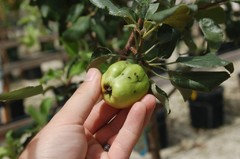
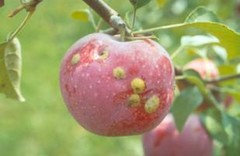
    The crescent shaped scar you find in June on the fruits will grow to a big ugly lump on the apple by fall. The flesh underneath the scar will be fine to eat for cooking anyway.

  • 11 years ago

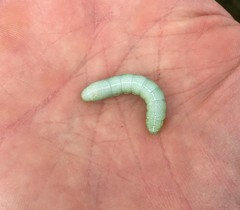
    I'm in the Lehigh Valley and do 2 or 3 sprays per year. Triazicide + Immunox right at petal fall and then 2 and 4 weeks later. I have 10 trees or so and you really need to get the timing right at petal fall when the apples are pea sized. If you let them get to be marble size, you get a lot of damage already. I thin the bad ones out if I'm a bit late. This year I have green fruit worms going crazy on the baby fruit doing a lot of damage. They are hard to find but shaking the tree can shake them off.

    ampersand12, if you want some Surround I have a 50 lb bag of it that will last me 50 years. Post here or message me (if that's possible on this new site) and I can share some somehow.

  • 11 years ago

    Sharppa,

    If you go out at dusk or at night, you'll catch more of those buggers. Late last evening, I found more kinds of worm/caterpillars than I like. They probably hide under the leaves when it's hot out and come out to feast when it's nice and cool.

    When I got my 25 bags of Surround, I thought it'd last me a long time. Not true. I spray 3 times a year for 15 trees (skip the other 10 that are too young to fruit). I also use it to soak footsies for bagging stonefruit. WIth that, Surround can go fast.

  • 11 years ago
    last modified: 11 years ago

    I don't regularly use Surround on my apples, Asian pears or peaches at this point. I use it on my squash plants to deter caterpillar bugs which seems to work okay. So I use maybe 4 cups a year of it and have a big bag left.

    What types of caterpillars are you finding? I put some tanglefoot rings on my 2 Asian pears trees that seem to get the most damage (and I don't spray) but haven't caught many caterpillars. I thought the gypsy moth ones would move up and down the trunk daily. (Or they do later in their life). I am finding a few of these big green ones now...

  • 11 years ago

    Ours are all apple trees, sorry I didn't make that clear. I will stop at Home Depot tomorrow night and get some of that Once and Done stuff. If it ever stops raining we will get all the trees sprayed ASAP. Thank you!

  • 11 years ago

    To help insecticide stick to leaves/fruit better, grab a bottle of Bonide Turbo spreader/sticker. It's the only Bonide product I use. Mix this spreader to Triazicide.

    Sharppa - got one that big, looked the same like yours last evening. I got mostly very small green ones. Some small brownish ones. Only one big one like that. I checked. It's some kind of moth. It went to worms' heaven already. I checked before I got rid of it. I don't want to kill butterfly or ladybug caterpillar. The rest are gone. I wear latex glove so squishing is not as awful as bare-handed.

  • 11 years ago

    You can easily find information on the web about the plum curculio. As I understand it, just after the adults come out of winter lay over, they feed on small fruit, leaving a crescent shaped pit. This mark is only a blemish on the fruit. Then the bugs mate, after which the female bites the fruit again, but this time makes a small cavity on the wall of the bite, leaving a small flap of fruit skin as a cover. She then lays an egg inside this small cavity. The flap of skin prevents rapid growth of the fruit from crushing the egg and/or small larva. This bite i the deadly one. It's not true that the growing fruit crushes the larva. With my apricot tree, the onslaught is devastating to the crop. It's a young tree, and already this year, we collected well over 300 dropped fruit.


  • 11 years ago

    Tom,. In my experience,. PC does not always successful in damaging pomme like apples and pears. That is what people refer to regarding rapid fruit cell expansion crushing eggs. Stone fruit is not as lucky.

  • 11 years ago

    I just checked out Spectracide's Triazicide products. There are two products and they can be confused. Both are called "Triazicide Insect Killer." One version is ready for spraying at the recommended concentration and contains one Pyrethoid pesticide, Lambda-Cyhalothrin, 0.002% concentration. This product has the additional label, "Once and Done," and it does NOT list the plum curculio as a targeted pest. (I'm not sure, but the label "Once and Done" may not be discontinued because I couldn't find it at the Spectracide website, though I bought it at Home Depot.) The other product, called "Triazicide Insect Killer, for lawns and landscape, Concentrate," also contains one Pyrethoid pesticide, Gamma-Cyhalothrin, 0.08% concentration. This second product DOES list the plum curculio as a targeted pest. I've read that the Gamma form of Cyhalothrin is more potent than the Lambda form. You need to dilute this second product as explained on the label (3 Tablespoons per gallon water, for fruit trees). You can buy a mixer to attach at the end of a water hose, with adjustable dilution, for about ten dollars. I don't know why Spectracide makes such confusion with the same label for two different chemicals. Some marketing geniuses don't understand us. Anyway, I bought a quart of this Concentrate at Ace Hardware for about $12, and I will try to save our remaining apricots after the rain stops.

  • 11 years ago

    rphcfb, I think you're right, because I do remember reading that. My comments apply only to the stone fruits. BTW, what's the difference between a pome and a stone?


  • 11 years ago

    I don't have deep botanical knowledge.

    All I know is that people refer to pears, apples (maybe other fruit like these) as pome while peach, plum, cherry, nectarine, apricot, is called stone fruit (I guess it is for fruit that contains one single stone/pit per fruit.)

    Hope this help.

  • 11 years ago

    Tom,

    I checked mine. It's Triazicide Insect Killer Once and Done. It's Gamma Cyhalothrin 0.08% concentration. It does have Once and Done on the label.

    But from what you said, marketing geniuses at Spectrazide really confuse people with a Lambda ingredient and slaps Once and Done on that label, too.

    It's said Triazicide loses its effectiveness after 2 years. Not sure because it's heat/freeze or what. I also have read that water with high ph may interfere with its effectiveness, too.

  • 11 years ago

    Where I live (near valley forge, PA) we have a terrible plum curculio problem. I use bagging which has worked well for me:

    http://gordosoft.com/orchard/bagging.htm


  • 11 years ago

    Bagging can be tedious and labor intensive when one has hundreds of fruit to bag. Also,.plum curculio attack fruit as soon as shuck split or soon after petal fall.

    At thay stage,. Many people are about to thin their fruit. Baggibg will need to wait after fruit are thinned.

    Spray once to cover during that time may be needed. Nowadays, I spray Surround

  • 11 years ago

    So at what point are apples at a stage where the curculios lose interest? In other words, when can I stop spraying?

  • 11 years ago

    You need to read up life cycle of insects that prevalent in your area. Besides PC, apple maggot flies, codling moths, Oriental Fruit Moth, and stinkbugs are fruit trees' enmies. PC has about 2 generations in one growing seasons. OFM has up to five. Check your local university extension services. They all have info for you.

    If you do not have many trees or many fruit, you should learn to bag fruit. Or, use kaolin clay called Surround as protectant.

  • 11 years ago

    Bag and thin at the same time, read the description at the link I posted.

    From what I've read, spraying pesticides generally requires 12 or more applications (as mentioned, there are many apple pests) and rain can wash it away requiring even more applications. Not to mention you should wear a full body covering suit and respirator to protect your health when spraying. Not something I'm into personally.


    Also not convinced the clay sprays save any time over bagging since you have to spray repeatedly. It costs more too, and is less effective.

  • 11 years ago

    Darren,

    I've experienced in both bagging and spraying Surround (or chemical for that matter).

    When I spray chemical or Surround, I only do it one spray to cover before I bag. Plum Curculio start attacks fruit trees around petal fall and right shuck split (for peaches). At that time, fruit are very small and difficult to bag. Fruit drops also occur (from inadequate pollination) which is different from June drop.

    I've found that if I wait about two weeks after petal fall to bag, I do not have to worry about poor pollination drop and fruit size is adequate. I also thin while I bag, down to mostly one fruit per cluster (for apple).

    I am all for safer way. In fact, I just finished bagging almost 300 bags on only two apple trees.

    A while back before I started bagging, I did spray chemicals. For apple, I do not need more than 2-3 sprays in my area. The number of spray really depends on how much bug pressure one experiences. Like others said, plum curculio is one of several bugs that ruin fruit during a growing season.

  • 11 years ago

    edie:

    For me in SE WI, curculios are an issue from petal fall (feed on the young fruit) to about mid-late June. Once the fruit has sized up enough, the females start their egg laying and make the crescent shaped slit in the fruit. I don't have curculio issue after about june 15th-20th as their egg laying is over.

    The worst apple pest I battle is curculio. Maggot and coddling moth are issues where I live but at least they are easier to control. Curculio is difficult to control due to all the rain we get this time of year (insecticide washes off) and the dismal results many insecticides provide on curculio control (triazide, malathion ect).

    Curculio hits my peaches,pears,apples and plums. Odd but somehow I never find any damage on my tart cherries. Perhaps I just do not notice it on the cherry. They seem to hit my pome fruits early (noticed some crescent scars on pear this past weekend) and my peaches later (Mid-June). I never see damage on peaches til about mid-June when the fruit is fairly good size (size of small olive).


  • 11 years ago

    I haven't found it difficult to bag small apples, I like to bag them soon after petal fall but I can totally understand the desire to get one spray in there before bagging. Yes, when I bag the curculio are active already, and yes they will have gotten to 10-20% of the newly forming apples already, but considering 95% of the apples naturally drop anyway, I don't see that as a big deal. Then again, I'm not trying to squeeze every last ounce of possible yield from my trees. I bag the biggest apples in a cluster (the kings) only. I lose very few to poor pollination, but perhaps that is because I have 30,000 solitary bees (equivalent to about 3 million honey bees for pollination purposes, haha) on a third acre (I know, total overkill, will be selling a lot of them this year). You can also sometimes tell if a newly forming apple had poor pollination by the color of its stem (yellowish stems are about to drop).


  • 8 years ago

    I hope we can update this topic. I have a couple apricot trees in central New Jersey and up to now, I've had serious problems with the Curculio. But this year, I have pure Neem Oil, and I'm curious if this insecticide/fungicide is strong enough to kill the Curculio. Does anyone have recent experience with this? Alternatively, I can spray with Spectracide Triazicide, but its active ingredient, Gamma Cyhalothrin, is a Pyrethroid (a synthetic, more powerful extension of the Organic, Pyrethrin). The MSDS of this Pyrethroid, like other Pyrethroids, does not appear too dangerous to humans (no carcinogenicity) but it is harmful to beneficial insects and the environment. On the other hand, Neem Oil is regarded as an "Organic," and it does not harm pollinating bugs (bees, butterflies, etc.) and ladybugs (bugs that don't eat the plant), and it breaks down well in the environment. So I'd much rather spray with Neem Oil than with Triazicide. Any comments are well appreciated. Thanks.