Software
Houzz Logo Print
circa83

Remodeling Kitchen to Code

11 years ago
last modified: 11 years ago

The previous owner of our home had the kitchen completely remodeled by a local company. The house was built in 1949 and has 2-wire romex throughout. My question is, when the kitchen was remodeled should have the remodeling company upgraded the electrical to bring it up to code? The outlets near the sink are GFI but the ground is not connected. The inspector said that we shouldn't be concerned. The panel is grounded and is newer but the wiring throughout the house has not been upgraded.


Thanks!

Comments (13)

  • 11 years ago
    last modified: 11 years ago

    It depends on your locality what is ''required'' vs. ''Best Practice'. If your inspector says it's fine, then it was probably grandfathered if left in place and the GFI added. Sure, that would have been the smarter and easier time to redo some electrical, but it's your hot potato now. You gonna do ''best practice'' here and replace the 60 amp fuse panel to a modern 200 amp breaker panel? Or will that be too pricy for you too?

  • 11 years ago

    "Up to code" is used too often as a buzz word by people who don't have any idea what "code" is. It is entirely possible, from what you describe, that what was done at the time of remodeling did meet code reguirements for the scope of work that was actually done. To know anything contrary, all the facts would need to be known. When was the remodel done? Where is this house? Did they take the drywall off all the walls and do a complete gut job? Some codes won't allow the wiring to be upgraded unless it is/ can be replaced all the way back to the panel. GFCI devices are acceptable on non-grounded circuits.

  • 11 years ago

    Thanks Fred! The remodel was done in 2008, house is in Colorado, walls are plaster on Solid Brick, house built in 1949. I am considering hiring the same company for a bathroom remodel but of course I want the work done right.

  • 11 years ago
    last modified: 11 years ago

    Well here is part of the code that is pertinent NEC 406.3(D)

    "Plaster on solid brick" .... How did they run the "Romex" through the walls, in conduit? How hard do you think it would be to replace the wiring back to the panel? If it is conduit, does the conduit go all the way back to the panel? I will have to refresh my memory, but I don't think they had "Romex" in 1949. Is the cable in a plastic sheath or cloth covered?

    OK, it was called Romex, it just didn't have a plastic sheath.

  • PRO
    11 years ago
    last modified: 11 years ago

    Fred S:

    Romex was invented in 1922.

  • 11 years ago
    last modified: 11 years ago

    Yes. I already corrected that while you were reading it. We just don't normally refer to the brand name Romex unless we are talking about the generic plastic sheathed cable these days, as opposed to any nonmetallic sheathed cable.

  • 11 years ago

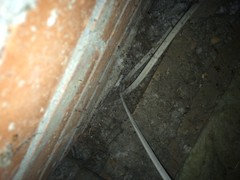
    Fred, I honestly am not sure how the cable is routed through the brick. The original paperwork mentions an add on for chiseling out the brick to route cable. I expect that is the case for the original electrical as well. The panel is on the opposite end of the house, The cable goes up through the attic and then along the joists to the back of the house. This is what it looks like where it comes though the wall.


  • 11 years ago

    That is not the original 1949 wire. You should be able to read what it is on the outer sheathing. It will either say 12-2 NM-B with ground, or 14-2 NM-B with ground. It should also have a manufactured date on it. If it is going to the kitchen receptacles, it should be 12-2. Once we know what the wire says, we can figure out the no ground mystery. It may be just the wires going to certain previously existing outlets.

  • 11 years ago

    It says 14-2 with ground. I didn't see the date but it appears this was all put in with the kitchen remodel.

  • 11 years ago
    last modified: 11 years ago

    That wire is probably not going to the countertop receptacles. It was most likely new circuits to take lights, garbage disposal, dishwasher, etc. off of the existing kitchen appliance circuits so that everything was to code. A GFCI will protect people even without a ground wire, and for the most part can replace a ground wire in that respect The bigger concern is that the old wires may be buried in insulation and is not rated for that. It can overheat and get brittle, which will cause sparking and start a fire. Replacing ALL the old wiring has never been in the scope of any work. This is usually because, unless you replace ALL of the wiring, it isn't much better than playing Russian Roulette. A better immediate alternative is to change all the breakers to AFCI breakers. The new CODES require AFCI breakers on practically everything anyway.

  • 11 years ago

    Now, the following post is my philosophical view of old homes and wiring. It does not attempt to meet current code anywhere in the universe.

    There are wires that you will never be able to access no matter how hard you try. Knob and tube is always bad. Aluminum is always bad. Insulated wiring is not always bad. It's not the best, but it's not always bad. Try to replace what you can. Commit to making sure you have a new, large adequate electrical panel with adequate service to the house.

    Everything that you run that requires a lot of voltage needs new wiring. That means, all of the large appliances in the kitchen, laundry, jacuzzi, and HVAC. You don't have to ground every outlet. There is a way to do it by grounding the first in the series. Your electrician will know how to do it. Don't freak out if the porch light runs on the old wiring. If it's not frayed or worn, it's okay. Just don't load things onto wires that can't take it. Use some common sense.

    As a homeowner, your wiring looks to be newer. Still, I bet you can improve it. Find a good electrician and make good friends with him.

  • 11 years ago

    Well, for the most part, I might agree with the above statement. The only problem is that an arc fault on old wiring doesn't care if there is any load at all on the circuit as long as the wire isn't disconnected from the power entirely. That is one reason why the code now requires AFCI breakers.