Software
Houzz Logo Print
mrs_737

Blooming Evergreen Design Yard

11 years ago

Hello,

I live in Seattle area (Zone 8) and am looking to plant a broadleaf evergreen tree in my front yard. I'm looking for a tree that will bloom and have berries. The area receives full sun, there is no concern of root rot from sewer lines and I'm looking for a tree that would be a maximum of, say, 20 feet in height, with a slender spread.

Does anybody have suggestions for such a tree? I would greatly appreciate it!


Thank you

Comments (18)

  • 11 years ago

    Look into the various Sorbus , Malus, Crataegus, Amelanchier and Prunus species and see there are any you like. Then do some background checking to see if they will grow in your region.

  • 11 years ago

    There are a couple of species of evergreen Dogwoods. One is Cornus angustata and the other is Cornus capitata. Both are hardy to zone 6 so would survive in your area. They don't look very 'slender' but you might take a look. I'll post a link below.

    Empress of China Dogwood


  • 11 years ago
    last modified: 11 years ago

    You might like to try the 'Marina' arbutus - although damage during a hard winter is possible. Otherwise there is A. unedo. Both of these have been prevalent at local outlets in recent years, although I may not be seeing so much of the first one this year (the other is a kind of standard item around here).

    Otherwise, I rather like Luma apiculata - and know of some lingering specimens of some size in Seattle. You can often eat the fruits of this one. And it is not as broad-growing as the first two.

    What would ultimately fit the bill depends on what specific ideas about flowers and fruits you have, if the flowers need to be of some particular minimum size or the fruits edible and so forth.

    Something interesting may be available from Desert Northwest at this time, see their web site. What you are asking for is a bit of an unusual combination this far north, that might best be realized by patronizing a specialist operation such as this one. As the company name suggests their focus is on warm and dry climate plants such as would be encountered in California, the Southwest and Mexico - but their menu is not limited to these types.

  • 11 years ago
    Wow, thank you so much, guys! I really appreciate your help. Looks like I'll be calling local nurseries looking for these trees. If you have any more suggestions, I would love to hear them. Thank you again!
  • 11 years ago
    last modified: 11 years ago

    A lot of hollies would fit your size parameters. They certainly bloom and have attractive berries.

    Or are you looking for something with 'showy' blooms + berries?

  • 11 years ago

    but do understand.. that no tree.. ever really stops growing.. its all about how much it grows per year.. and how many years.. it will take to grow past your size demand ... we call it.. the ANNUAL GROWTH RATE ...

    and if you convert to the latin names.. and add such to the search engine ... you can get some idea as to how long it will take to your height ... e.g if it grows 1 ft per year ... and you buy it at say.. 5 feet... inside 15 years or so.. it will go above 20 feet ...

    that said.. plant something that will bring you great joy.. make your toes tingle.. for those 15 years.. then get rid of it ... dont make your decision on size alone ...

    ken


  • 11 years ago

    another trick.. is to take the latin name to google.. and flip to the images side.. to see pix of its potential .... seeing is believing .. as they say

    ken


  • 11 years ago
    Dave, I guess I am looking for something showy for a curb appeal. Although, I could use hollies somewhere else. Thanks.

    Ken, thank you for the suggestions. I haven't thought about the fact that trees do continue to grow past their stated "max" size. One trick somebody told me about is to plant so as to minimize pruning in the future. Basically, if you are looking for something small, don't add extra work for yourself by planting something that will require constant pruning to keep it that size. Anyway, just something I remembered. Thanks.
  • 11 years ago

    Chilean Fire Tree
    (Embothrium coccineum)......loved by hummingbirds

  • 11 years ago
    last modified: 11 years ago

    English holly is all over the place in local parks and other unpaved space, has definitely been a serious weed here for some time. But other kinds of hollies are present in local outlets, if you can find any of the Highclere holly cultivars around now those are the most impressive.

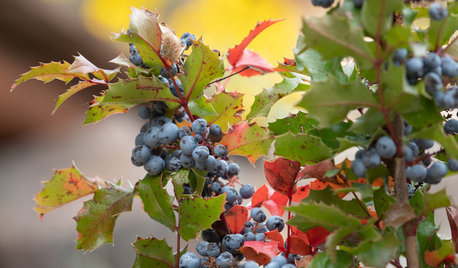
    The Mahonia makes a dramatic feature and is stocked by garden centers in this area. Although it is not 20' high and slender-growing maybe because it is so bold you would find it adequate. Of those kinds that have been present on the local market at one time or another in recent years the best one may be 'Winter Sun'. Otherwise you can see what is possible from this cross by going to the Witt Winter Garden in the Seattle arboretum and looking at the older 'Arthur Menzies' planted there.

    Additional candidates might be encountered walking around the rest of the Arboretum also. A more compact collection can be explored in the Carl English Garden at the government locks in Ballard.

    Using broad-leaf evergreen as the only requirement 47 entries are listed beginning on page 425 of Jacobson, Trees of Seattle - Second Edition (2006).

  • 11 years ago

    Duh - I missed the evergreen stipulation. I was concentrating on the flower/berry criteria. Sorry. However, on second thoughts there are evergreen Prunus and semi-evergreen Crataegus.

    Another genus which could fit the bill in all ways is Cotoneaster.

  • 11 years ago
    last modified: 11 years ago

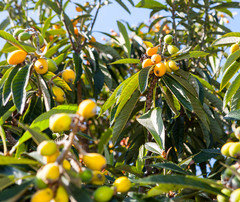
    The perfect tree for you...that would actually even overexceed your specific expectations = LOQUAT!!!


  • 11 years ago

    Unfortunately, both the evergreen types of laurel, Prunus laurocerasus and P. lusitanica, and the larger growing cotoneasters are showing signs of invasiveness as well. Both are considered invasive by the state forest service.

    This seems to be a somewhat common situation with many local berrying plants - the birds eat the berries and disperse the seeds to natural areas and all of a sudden, we've got problems. While I wouldn't go so far as to recommend removal of all existing plantings, I have hard time advocating planting new ones. Just doesn't seem very responsible.


  • 11 years ago
    last modified: 11 years ago

    The locally abundant Rose Family pest shrubs are the two laurels along with Cotoneaster rehderi* , Stranvaesia davidiana and Crataegus monogyna. Urban forest parks and similar places in this area have the first two in particular forming actual thickets (in combination with Ilex aquifolium , Hedera helix and H. hibernica - the latter being the common large nuisance ivy).

    There is also a lot of naturalized, actively reproducing sweet cherry - which crosses with the native bitter cherry to produce a third kind, called Puget cherry - around, as well as a pretty generous scattering of Sorbus aucuparia.

    *Although usually seen as individual shrubs popping out of salal and other vegetation here and there at least one Lynnwood park has an entire grove of the thing, of some height

  • 11 years ago
    Thank you a lot, guys! This has been an invaluable resource. Just when I thought I found a perfect tree, another suggestion came up that also fit the bill ideally. Ha. It's really nice to have choices and people that can suggest them to you. So, thank you!
  • 11 years ago

    I'm suffering the dangers of pronouncing on regions I don't know. Curiously, I am not aware of any invasiveness issues with Cotoneaster here despite what you might consider a conducive climate. Prunus laurocerasus escapes sometimes but is not a big problem. I've never come across P lusitanica outside cultivation. The real problem invasive evergreen here is Rhododendron ponticum. Of course C monogyna and S aucuparia are natives so not invasive.

    I am curious to know if Loquat would fruit in Seattle. It grows fine here but fruit is a rarity.

  • 11 years ago
    last modified: 11 years ago

    Have seen heavy fruiting one time - definitely not an annual occurrence here. The flowers attract Anna's Hummingbird but are not showy. The 1990 winter made many of the trees look as though they had been torched.