Software
Houzz Logo Print
tcstoehr

Ants in the Brassicas again

11 years ago
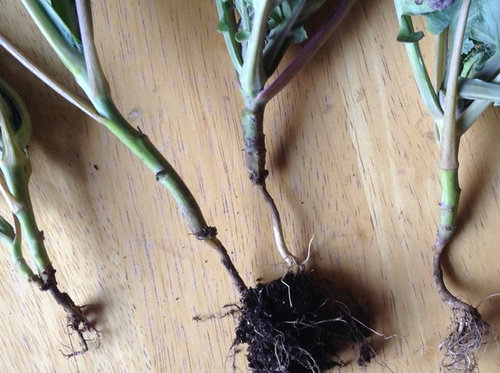
From time to time on Gardenweb I have seen complaints of ants in peoples' brassicas. Often the consensus was that the ants were innocent bystanders, or that their activity was accidentally harmful, and that ants would never directly attack any garden vegetable. I suppose you might have counted me to be among those thinking like that.

Not anymore.

It started with Cauliflowers. I always optimistically start a row of purchased transplants knowing that Root Maggots will arrive sooner or later. This year I tried plastic collars as a deterrent. Hope springs eternal. As usual they grew for a while then wilted badly when the sun popped out during otherwise cool and moist weather. I figured the usual suspects were at work. I pulled a few to look at the roots and noticed that the roots were mostly intact although the stem above the roots was badly mangled. I couldn't find any actual Root Maggots but I did see lots of ants but they were not on my radar at the time. I just assumed the usual suspects even though I knew it was too early for Root Maggots.

A few weeks later I put out the Collard and Kale transplants. After some decent growth the wilting began. This was completely new to me. Root Maggots have never bothered these crops much. Closer inspection showed ant activity around each and every wilting Collard and Kale plant. The Collards were all hit but only half of the Kale were.

Here is a picture of a few pulled plants. The roots are mostly intact but the underground portion of the stems are badly injured. I don't know how they manage to survive at all. The second one from the left is freshly pulled, the others have been laying around for several days and I stripped their roots during examination.


The ants appear to be completely obsessed with the stems from the ground level downward. I have closely observed them at the soil line crowded as they can be. Moving the soil aside I could see that the same activity was occurring below ground as well. I cannot see for sure but I have to assume they are biting and/or chewing the stem. Perhaps there's a bit of sweetness there that they like, but I don't really know. It's hard to see what they're doing as they are quite tiny.

The point is I think there is little doubt that they are actively killing my Brassicas. I in turn have begun killing them. I can see their tell-tale mounds of debris around each stem so I brush that away and smash all refugees. I've tried harassing them as well as drowning them, with some success. But they are persistent.

Going forward my strategy will be to plant transplants as high as possible, without burying any stem as I usually do. I may also have to reconsider my use of soybean meal as a fertilizer as I believe that attracts them. I have definitely seen them carrying bits of it around.

Comments (18)

  • 11 years ago
    last modified: 11 years ago

    I did take a look at the Blackeg documentation. The symptoms are not consistent.

    Observing this going on for several weeks and noting the absolute consistency of the ants corresponding with the wilting problems does alot to convince me. The picture does not show it well but I can see the outside tissue of the stem has been eaten away down to the woody interior core. I'd be very skeptical of this if I hadn't seen it myself.

  • 11 years ago

    Well you can see much more in person than I can from any photos for sure. But correct diagnosis is crucial to correct treatment. And the odds with brassicas are 9 to 1 that it is one of the fungal diseases or even nematodes (which ants love to eat too) rather than ants.

    But I haven't ever used soybean meal as a fertilizer either. I only use cottonseed and alfalfa meals. So I can't say what their response to soybean meal might be. Assuming it was mixed in well prior to planting it is difficult to picture them all congregating right at the base of the plants for it.

    Dave

  • 11 years ago

    It's difficult -- impossible? -- to see the details of damage you describe. I also doubt the ants are the culprits. Looks very similar to damping off.

    I've never seen black leg in person. But here's info from the official disease reference used by Master Gardeners and Extension agent here in Oregon.

    You can enlarge the images by clicking on them, then enlarge them further if you enlarge them further by clicking the "X" (if any) in the lower right corner of the image.
    Enlarge the 1st image to the max to see the pycnidia (evidence of the fungus) in the leaf lesion.

    If you decide that black leg might be the diagnosis, please notice that management is only cultural. Remove all plant debris and rotate out of that crop for at least 4 years.
    None of the pesticides listed are for home use. (Put another way: All the listed chemicals are for commercial growers.)


  • 11 years ago

    tcstoehr,

    I have had the same problem with ants and small broccoli transplants. This year I noticed ant activity around the stems of only 2 of them. Like you, the first thing I noticed was wilting. Then I saw many ants around the stem, and noticed they were also going underground.


    With one transplant I put an outdoor ant bait station (don't remember the name) and within a few days I saw a decrease in ants and the plant recovered and is almost ready for harvest. With the other, because it had only been planted for a week, I carefully transplanted it to a different location. The ants did not follow it, and it also recovered. This one didn't grow as well as the other, however.


    I know I've commented on other posts about ant damage to seedlings, and most gardeners seem to think ants don't pose a problem. But from what I've seen, they can be a nuisance to small transplants. Maybe it's only the ants we have in the Canby/Milwaukie area!


  • 11 years ago

    I knew before posting this that people would look for any other explanation other than an ant attack. I would have been skeptical myself, which is why I looked hard and long at the situation. Nothing makes sense except that these ants are actively destroying these plants. Why they're doing it I cannot say. I would have to admit the possibility that they are only attacking already diseased plants. I'm not sure why that makes any more sense than the explanation that they are attacking undiseased plants. Is there some known pattern of this?

    Dave, as far as the soybean meal goes, I thought it possible that it attracted large numbers of ants into the area, who then found other mischief to make. I can see them making their little hills around my squash plants, but they seem to be ignoring the plants themselves.

    These ants seem uniquely obsessed with the stem area of the brassicas at and below the soil level. They literally crowd onto the entire below-ground stem surface so that scarcely another one can fit in. As they remain there hardly moving, I can only imagine that they must be working on that stem in some way.

    Sherman, I have had the same experience. Getting rid of the ants gets rid of the wilting, although the plants are obviously stunted. Another PNW soil pest is all we needed. I might end up having to fumigate my soil like all the farmers around me do. I wouldn't actually do that. Before I'd do that I would rotate my beds out of production to go fallow for a couple years at a time to reduce the pest pressure. And open up some new beds at the same time. Ants aside, I may do this if the Symphylans get much worse.

  • 11 years ago

    Try sprinkling some cinnamon around the base of the plants and see if the ants leave. Every spring, ants try to set up a nest in my mailbox of all places - literally thousands of them along with ant eggs. I "blow" about a tsp of cinnamon into the mailbox and a few hours later, they're all gone. They take the eggs with them too.

    Might be worth giving this a try. Cinnamon is cheap too.

  • 11 years ago

    If ants are mining around the root system, those tunnels can divert the water away from the plant. The result: wilt.


  • 11 years ago

    I agree with jean001a. I don't believe that ants will eat your veggies. But I have had plants wilt and stunt because of ant tunnels underneath them.

  • 11 years ago

    Yes, I was also aware of the tunnel hypothesis. I considered that until excavation, in all cases, revealed well moistened roots with no lack of soil contact. Keep in mind this is in cool, moist weather.It's hard for me to look at those mangled stems and conclude that tunnels were the issue.


    The picture above might be misleading since the roots are dry and stubby. This is only because I tore through those roots looking for clues, and then let them sit on the ground for a few days before taking the picture. Only the second one from the left is fresh.

    It seems that ants have such a halo of innocence that scarcely anyone could believe that they could do any harm. I pretty much thought the same way until this happened in my garden and I looked long and carefully at the evidence.

    I seriously doubt they came into my garden with the idea of attacking my Brassicas. And they didn't seem to be actually eating the plants. They were, however, destroying the stem tissue. Why they're doing this, or under what circumstances they do this, I can't say.

  • 11 years ago

    I don't know how, but I stumbled onto this thread:

    Root Aphids

    It claims that ants were coming in after the aphids that were infesting the roots of her pepper plants, and I believe it. It makes me wonder if I had the same issue. I did not see any aphids but I could have missed them. If what I read was true, then the ants not only protect the aphids but actively move them from one host plant to another, spreading the problem. On the plus side though, the ants would also be a visible signal to the problem.

    Going forward, I will keep this on my radar. Now, where did I put that magnifying glass?

  • 11 years ago

    <It seems that ants have such a halo of innocence that scarcely anyone could believe that they could do any harm. >

    I can understand your frustration and heaven knows they aren't saints. But they aren't the evil denizens that the many "help! ants are destroying my plants so how do I kill them?" posts we often get here.

    And in this case it's just that the odds so heavily favor the far more common causes and that the ants are just a side-effect of one of those other causes.

    Sure ants can get out of control in some situations and in those instances you have to intervene. You do what you have to do. But the majority of the time ants are beneficial to the garden in so many other ways that in general they should be tolerated, even accommodated, whenever it's possible.

    Dave

  • 5 years ago

    I have the same problem in my garden this year for the first time. Broccoli, cabbage, kale kale, cauliflower, cucumber. They are nibbling the stem below the ground to the bone until plants wilt and get disconnected from roots. we have several different kinds of ants in my garden. I only see the tiny black ants do this. its literally 100s of them and when i pull out the plant they all try to run underground. i tried many different methods including heavy pesticides but after a couple of rains and watering they are back at it.

  • 5 years ago
    last modified: 5 years ago

    I have a lot of ants this year for some reason. I was dividing and moving perennials in a full sun bed and once I dug up two perennials to pot up and left the area without a plant waiting to add one later, the ants moved into the newly bare spot. I did try to discourage them from building a home there knowing I was going to replant soon. What I did was dig up the area make a hole with mounds of dirt around it and then would go back and disturb it some more when I would walk by it. They do seem to have moved on and found another spot to locate which I'm not bothered by.

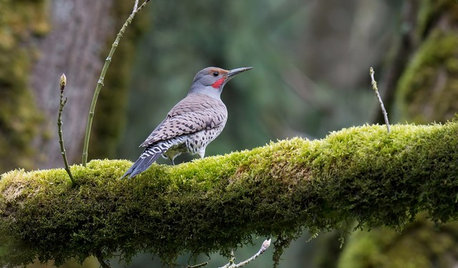
    And the other day, I was looking out my window and noticed a Northern Flicker in the front yard in that bed that has so many ants this year. Normally, I see them on the back lawn. They do eat ants. So I was happy to see them in the front, if they are attracting Northern Flickers and that in turn the birds are reducing the number of ants.

    I have no experience or opinion about whether the ants could be the cause of the broccoli root damage, but I'm really surprised by Shayan,s post, saying he used heavy pesticides in an area that he grows vegetables, but not surprised that despite making the area you grow vegetables in toxic, that it didn't help with the ants. Working with nature is always better and easier than trying to work against it and trying to control it.

  • 5 years ago

    Oh gosh...another thread that is 6 years old...but the last post was 3 days ago. Moving on.

  • 5 years ago

    I started this thread years ago I have continued yearly to fight the ants basically with constant vigilance. Every day I get out and get on my knees and search around the young plants for the signs of ants excavating soil. When I find them I flood them and stir them into a slurry of mud which they do not like. For reasons I don't understand the ants become a non-issue once the plants reach a certain size, like when their main stem is about a quarter inch diameter.

    This year I've avoided the problem almost completely. I started the seedlings in a raised bed that has a very organic soil medium. The ants don't seem to go here much, heck if I know why. So I raised my Collards in this bed until they had quarter inch stems. Only one plant got attacked by ants there. I then moved them into their permanent beds and for good measure I planted them way down low so the part the ants liked to attack was buried lower. This was a bit difficult as some root damage was inevitable and I was transplanting into warmer weather so I removed several leaves off of each plant to get them through. No ant problems now but I feel like I've delayed Collard greens season by a couple weeks. I'll take it.

  • 5 years ago

    tcstoehr - Thanks for coming back and updating. If it's not one thing it's another. I'm glad for you that you are able to have fewer problems with the ants. I see a lot of places where they seem to be setting up house here, but so far, it hasn't been an issue for me. Good luck!


  • 4 years ago
    last modified: 4 years ago

    I am also having this issue. Last year I lost a bunch of brassica plants when I (too late, after a windy spell knocked over a bunch of plants that had been looking great) eventually figured out they were attacked by cabbage root maggots. (When I excavated the plants/soil around where it had been planted, I found small white maggots.) For the rest of the season I protected plants with skirts (flat on the soil, with a slit/star cut for the stem) made from weed cloth. This seemed to work well, although from what I learned, earlier spring is when they are most an issue, so maybe the worst of it had already passed. So this year, I was prepared, and every brassica seedling I planted was given a skirt. Well, after they seemed to be doing well, all of a sudden after another windy day, I noticed several plants looking pretty wilted. After closely inspecting all of my plants, I found very small (what I would call sugar) ants around several of the plants. I too, have understood that ants don't usually attack plants, but rather 'farm' other things. I dug up one plant, and found two very small wire worms (which I am familiar with, but because I am always keeping an eye out for them in the garden (and feeding them to my chickens), they do not usually do significant damage. I also found one very small white larvae of something. I'm not going to rule out that the ants, but around some of the plants, I also noticed some very tiny gray bugs. And also small winged bugs, similar to aphid flies I've seen on the leaves of brassicas.

    I need to do more research, but the two things I'm going to investigate further are springtails and root aphids. (I think pill bugs could also be an issue, as I think they like the slightly more damp environment that the weed cloth skirts create, especially as we are actually having a wet spring here in WA. But they aren't my #1 suspect right now given the ant activity.)

    I applied a thick circle of diatomaceous earth around each plant (I think that should work against both springtails and root aphids, although only if they come up to the surface), and also sprinkled some cinnamon to deter the ants. I figure even if the ants aren't actually the primary issue, I don't want them encouraging any pests that are feeding on the roots. The long and short of it is that I am suspecting in my efforts to deter one pest from feeding on my brassica roots, I've created conditions that encouraged some others. (Ugh. I swear, I do enjoy gardening...right?!)

    Hoping this might be helpful for others...