

Overcrowded outlets, need advice
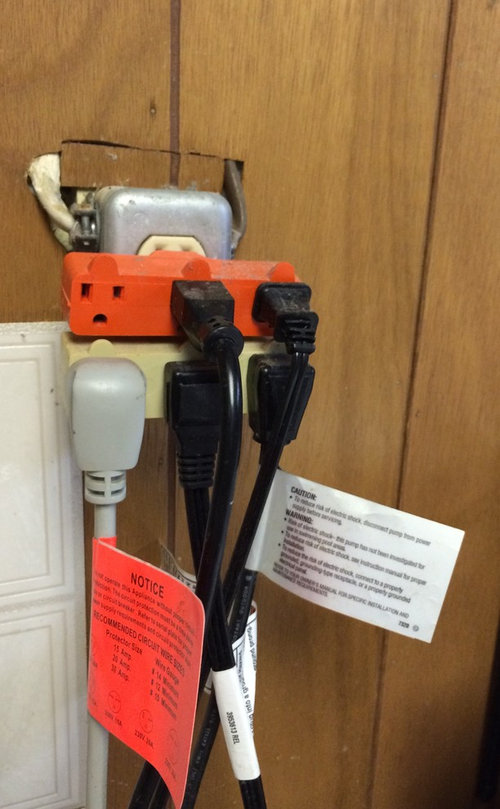
We have some overcrowded outlets in the basement by the washer and dryer and I need to move some of these plugs. I assume there is a specific kind of heavier duty extension cord I need? I'd like to plug half of these things into a different outlet but the plugs on the appliances won't reach…
It's been this way for many years I assume-- at least before the two years that we have been in the house. It was one of those things I meant to do right away when we bought it and never got around to it… Whoops. Other than upgrading to a larger dehumidifier, nothing plugged in has changed.
Any advice greatly appreciated! Thanks in advance guys :-)
Comments (32)
 11 years ago
I would use a power strip, current and surge protected, to power those appliances.
Or you could have an electrician extend that circuit and install additional receptacles, and improve the installation of the existing receptacle at the same time.
Either way, that existing receptacle should be GFCI protected.
- 11 years ago
Actually, there's all kinds of things wrong here. First that looks like a 13 cu in handy box that somone has crudely surface mounted with what appears to be 14g NM on one side and some size of UF on the other. That puts the box fill at at least 14 cu in.
What you need to do is get an electrician with a clue to come in and replace that box with a proper size one that can support sufficient receptacles. Further, if this is the laundry area, the circuits serving the area are not sufficiently sized (20A is required, the 14g NM implies only a 15A circuit here).As Randy points out the following areas require GFCI protection:
1. Unfinished basements
2. Laundry areas
3. Anything within 6' of a sink
I suspect at least one applies to this area.
The code abhors cubetaps like that and extension cords. Related Professionals
Cape Girardeau General Contractors · Meridian General Contractors · Huron General Contractors · Fayetteville Home Remodeling · Mount Vernon Home Remodeling · Morgan City Home Remodeling · Clarksville Home Remodeling · Boston Home Remodeling · Odessa Home Remodeling · Olympia Home Remodeling · Riverton Home Remodeling · Myrtle Beach Bathroom Remodelers · Sioux Falls Bathroom Remodelers · Santa Barbara Bathroom Remodelers · Coeur d'Alene Bathroom Remodelersnnmjdklil
Original Author11 years agoThanks guys, so glad I decided to ask! I'll call someone asap.
Nicole
- 11 years ago
Guessing from the paneling, this was probably done more than 13 years ago when 12 gauge (20 amp) was also in a white jacket. But, even then, it is most likely that you need another circuit, not just more places to plug things in.
nnmjdklil
Original Author11 years agoI should maybe also mention that we have aluminum wiring-- the house was built in '73. I've spent countless hours researching and speaking to several highly reputable and specialized electricians about what to do about it, and due to the fact that no method to *safely* remedy it is possible financially for us right now (Copalum connectors or complete rewiring), we were advised to leave it alone until we can afford to do so, as further tampering with the wires and boxes may loosen something and actually make it hazardous when it wasn't before...
Hopefully this situation can be remedied without causing other hazards. Oh and also, we did have arc fault breakers put in when we moved in. Before most of my freak outs about the wiring. And they were definitely freak outs. I've been starting to feel anxious again just thinking about all of this, Ew.
So I guess I need to make sure that whoever comes to remedy this is also one of the Copalum aluminum wiring specialists. Only problem is none of them were willing to do just *some* of our outlets, so I'm not sure they're willing to handle this. I will try though.
I feel a little sick now. These were not fun discussions 2 years ago.
Nicole
- 11 years agolast modified: 11 years ago
There are ways for a qualified electrician to work with old aluminum wiring and have it end up safer than it is currently without using Copalum connectors. In this case, I would take the newer wires out of that box and just hook up the original AL wire to a duplex receptacle rated for aluminum wire connections. Then bring in a new circuit to power another receptacle and whatever the white cable feeds. This will lighten the load on the AL wire and reduce the effect of heat on the situation.
"we were advised to leave it alone until we can afford to do so, as further tampering with the wires and boxes may loosen something and actually make it hazardous when it wasn't before..."
This is basically true if you don't know what you are doing, but because it is the connections, and not the wire, that is the problem, common sense should tell you that taking them apart and cleaning the corrosion up, then adding an anticorrosive agent (this was not done originally) and using several other UL approved connectors and terminations should make it better than when it was new and last another 40 years. The problem starts when someone opens a junction box and moves things around without changing ALL the connectors and cleaning ALL the wires. That is when you get "may loosen something and actually make it hazardous when it wasn't before"
- 11 years agolast modified: 11 years ago
I agree with Fred. While aluminum has latent problems (especially when confronted with idiots who don't understand how it was EVER supposed to be property installed), the situation you show above is SERIOUSLY BAD in its own right from the overloading problem.
Further, given the fact that the receptacle shown in the picture appears to be NON-PROFESSIONALLY INSTALLED. I'd get this one FIXED NOW. If the incoming branch circuit is indeed aluminum, the stuff coming out the right side appears to be UF which is almost certainly a later COPPER installation. If those aren't joined in a proper listed fashion inside that overcrowded box, you've got issues.
I suspect you'll want to pull a new branch circuit wire to this location anyhow as the existing one seems undersized by the both the code and the shear number of things you want to connect to it. I'd have a new (copper) 20A circuit pulled in and the correct BOXES and sufficient receptacles installed.You can worry about the rest of the house later.
nnmjdklil
Original Author11 years agoThanks guys. Everything you've said makes sense, now I just need to find the right guy. It's been frustrating because so far, as nobody who has come out here (4 "highly rated" companies) has sent someone who seems knowledgeable about ALL the issues-- with the exception of course of the ones who push the COPALUM method, which is so exorbitantly priced ($60/box at 80-some boxes which adds up to be like around, give or take, 6 ka-ZILLION dollars), that we may as well wait til we can afford a complete rewire.
I wish I had someone who knew about ALL the different scare tactics (if you'd call them that) I find online and could give me what felt like informed advice on how to proceed. For instance, I don't want to hear about the purple wirenuts UNLESS they are aware of the burning issues I see online and can explain why the way THEY do it, WON'T cause that to happen... (I believe that's possible but when these guys look at me confused at the mention of the burning purple wirenuts, I get concerned, especially when they look really young and may not have come across much aluminum wiring yet)... I just want someone knowledgeable to address all the concerns.
And of course after talking to several electricians and hearing either:
A) seemingly uninformed guys saying "pigtailing is really no big deal" but not backing that statement up with knowledge of these issues but instead a blank stare or seem anxious themselves, or
B) specialists wanting to charge upwards of $6K to Copalum the whole house,
we just get tired and frustrated and decide to table it again til something else comes up. Obviously though, that time is now, so I will go back into another round of getting estimates and talking to people. Worst part of it is that *I've* been the one reading up on stuff and talking to electricians while husband is just completely over it.... he's in that camp where "nothing's gone wrong so far" and thinks it's all a bunch of baloney. And I honestly don't feel like starting a new fight about this, as this is our m.o. for just about everything with the house... I maybe worry too much, he doesn't worry at all... and we JUST got a new roof-- not even finished yet-- so he's most definitely not in the mood! I'm going to just handle it without even discussing it this time though.
Wish me luck, ha. And thanks again for all the insight-- I'll use that when I start my round of convos this time...
Nicole
nnmjdklil
Original Author11 years agoOk everyone, just wanted to hop on here quick and leave an update-- I just spoke with an electrician who seemed to know his stuff AND had a reasonable option for the aluminum wiring. Company's been in business for 25 years and they have tons of experience with this, they use the King (alumiconn, I assume) connectors. He's coming out Tuesday but for now, we are just addressing this basement issue. I will definitely go over the aluminum issues further though, and likely have them do the rest next year though.
Wanted to thank everyone again!
Nicole
 11 years ago
Yup, they should use connectors like below
More info about AL risks. Should take care of entire house now instead of next year honestly.
nnmjdklil
Original Author11 years agoOh believe me, I've read that article and many, many hours more. But we aren't changing the load on anything and there has been absolutely no flickering or warm plates or any sign of issues since we bought the house, plus all inspected outlets looked really good and tight. Everything I've read, minus the scare tactic stuff, and including the guy I spoke with today, says that if it's all working fine I can wait, just keep an eye out. We randomly feel the outside of outlets and lightswitches for warmth, and we had the arc faults put in, and the bottom line is the money isn't there now.
- 11 years agolast modified: 11 years ago
I haven't found one article yet that mentions either alumiconn or copalum that isn't mostly just a scare tactic to use the newest and most expensive products out there. Since they are using "laboratory testing" to bolster their claims, instead of real world, long time use, I will give you some history. As for the purple wire nuts (not that I would use them), I can show you the same type pictures of burnt/melted wire nuts on copper wire. If you dig far enough, you will find it with the new products too. In fact, the copalum method tends to actually increase the number of splices in a circuit which is the main cause of heat. While some of these new methods may have their place in some circumstances, there is nothing wrong with the tried and true method. Those that push for the newest and most expensive just call the methods from as little as 4 years ago "obsolete" with no good justification. The only reasons they give is that you must know how to do it properly. So, their justification for calling the proven method obsolete is the exact same reason they praise the copalum, since you have to be trained and certified for the copalum method??? Might I remind everyone that electricians ARE trained and certified without all this hype? The only problem I can find with the old method is that they are not making enough money off of it at the corporate level, and nobody is getting paid to "train" electricians on something they should already know how to do. While many of the newer electricians probably need some training on when to do what, a new type of connector isn't going to fix THAT problem.
Not long after aluminum wire was abandoned for wiring branch circuits in a house, the engineers came to the conclusion that crimping and properly torsioned lugs were NOT the best method for splicing aluminum because the expansion from heat would loosen the connection. Thus, the reason for a spring connection device commonly called a wire nut (scotchloks) UNFORTUNATELY, we now get a new generation of engineers out there that want to make the same mistakes all over again and have the propaganda machine rolling at full speed trying to get everyone to follow them. Somehow, every generation thinks they are so much smarter than the last that they refuse to learn from the previous generations mistakes.
nnmjdklil
Original Author11 years agoFred, I think you nailed my apprehension perfectly here. There are simply too many *totally different* suggestions to be found here on the Internet, on how to handle this aluminum wiring issue... And for the average homeowner with no electrical knowledge, it can all get way too overwhelming way too fast. Who to believe? Seems obvious we should give little credence to the sites that actually sell the specialized products, as well as to the sites of the specific electrical companies that specialize in just one particular method. BUT beyond that, we still have this guy saying purple wirenuts are best when "done right", this other guy saying stay away from the purples, yet another saying not to trust any of it, that a complete rewire is only truly safe option, and so on and so forth with lots of different methods that are "perfectly fine" when "done right" by someone who "knows what they're doing"..... And they all say they are good electricians. Who to believe?? Especially when you have this major (supposedly unbiased) group called the Consumer Product Safety Commission recommending only 3 options- the complete rewire, Copalum, and alumiconn. It's enough to terrify a person.
It has to come down to what feels right to the homeowner and while I'm the first to admit that I don't know electrician stuff, I like that the guy I spoke to today has a long track record w this issue, lots of personal and professional experience. He told me that the county comes in after and checks to make sure it's been done properly? Apparently this "King" connector (he was calling it a "King connector" but when I googled that, the alumiconns came up and I'd researched them a while back so put 2 and 2 together) is approved here in my county for the majority of insurance companies... and I can personally vouch for the fact that when we bought the house we did get turned down by one insurance co. because of this issue). I don't know enough about these county checks though; I'll ask the guy on Tuesday when he gets here.
I will say that the alumiconn connectors are FAR less expensive than the Copalum ones. They may be more than whatever would be considered traditional but they're much less than the other specialized one.
Makes me honestly wish I was just an electrician so I could rewire my own darn house!! That's what I'd most like to do so I could forget this was ever even an issue. Ugh.
Nicole
- 11 years agolast modified: 11 years ago
Purple wire nuts are fine IF done correctly. The issue they claim is that the anticorrosive compound in them is flammable. The problem with that claim is that there would already need to be a situation that will degrade the wire insulation and start a fire regardless before that would happen. So if the wires are twisted together properly before the wire nut, the wires will never heat up to the point that would make the wire nut bad. A bad connection on any copper wire with any type connector will do the same thing, and frankly, these connectors with separate terminations are MORE likely to cause heat if even only one wire becomes loose simply because the wires are all physically separated and not twisted together.
CPSC is just a govt agency trying to make itself look important. The NFPA and UL do not agree with them. Govt agencies are wrong more than they are right. "Weapons of mass destruction", "Brown, you're doing a heck of a job", etc, etc.
- 11 years agolast modified: 11 years ago
The problem here is that they are trying to fix one theoretical problem of dissimilar metals being connected together in a wire nut, but are creating the same, more real problem that the wire nut fixed in the first place. And don't forget that these new connectors are even adding another dissimilar metal into the mix. The ideal connector would twist all the existing aluminum wires together and fasten them under spring tension and then have a tap off the side for a copper pigtail.
PS I have edited my last two posts slightly to hopefully be clearer.
As far as who to believe? I would go with whatever your insurance company will give you in writing ;)
- 11 years ago
Oh my, those are very scary pictures. Wait a minute. They all caused house fires with several fatalities, right? No? Serious property damage if not some fatalities? No again? Minor property damage and some dead pets? No? How about minor inconvenience?
nnmjdklil
Original Author11 years agoOk that all makes sense too Fred, and you have me reconsidering. You don't by any chance work in maryland, do you? : )
However I'm still a little confused... in one of your first posts you said: "not that I would use them", about the purple wire nuts... Why wouldn't you? Isn't that the one you're saying you prefer?
Nicole
- 11 years agolast modified: 11 years ago
Well... this conversation can be very confusing because every junction box can be a different situation. What I meant to say is that I would not use them as the cure-all for most situations, and that there are other methods of doing the same thing here. http://m.inspectapedia.com/site/inspectapedia_2/air_conditioning-2?url=http://InspectAPedia.com/aluminum/pl2p12.htm
HOWEVER, even though I still have scotchlocks that were listed for this purpose, the company may have quite listing them for aluminum wire since they came out with the purple things in order to boost sales. I'll have to make some in depth inquiries about this later. Essentially, the old method of adding inhibitors separately is the same thing as the purple thing. (I may be being forced to use them in the future) Also, it is just as acceptable to use a device (the receptacle) listed for aluminum wire to make the connections in many cases.
The larger point here is that there are way worse wiring methods used before the aluminum era that are presently more prone to problems, but don't get a fraction of the hype. And that every method of "fixing" aluminum wiring has its own theoretical faults, including the most expensive ones. There is even controversy as to whether wires should be twisted before screwing on a wire nut. The answer to that question can be just as complicated if you try to make it black and white. An experienced electrician will know the answer as soon as they start to twist the wires, because it depends on how hard or soft the wire is, along with other thing. If it is too soft, and you twist it fully, twisting it further with the wire nut could damage it. If it is a hard drawn copper, and you don't twist it first, you are likely to get a wire to pop right out of the wire nut when shoving them back into the box. I take apart several splices that apprentices make and inspect them before they really figure it out. The moral of the story is that there are many methods that will be perfectly safe if done properly and inspected for problems at every step until the cover plate is put on, and aluminum just happens to be the one that takes the most diligence.
nnmjdklil
Original Author11 years agoI hope that whomever we eventually decide to go with, is as experienced and well versed in all of these scenarios. Short of learning the trade myself... and working in the field under top notch electricians... for many years... until I feel confident enough to do this myself, I suppose I have to take a leap of faith with it all. I won't do anything about the wiring in general until I feel good about the guy doing it though, so far that hasn't happened. I will get this basement overcrowding situation remedied asap though.
thanks again,
Nicole
- 11 years agolast modified: 11 years ago
As ionized was trying to sarcastically point out, the reason that all splices must be made in junction boxes is because sometimes things go wrong, even with copper. The junction box contains the problem so that it remains a little problem instead of a big one.
Presuming the circuit is as loaded as it appears, and if it is relatively easy to get a new circuit into the area, I would try for my first recommendation.
"In this case, I would take the newer wires out of that box and just hook up the original AL wire to a duplex receptacle rated for aluminum wire connections. Then bring in a new circuit to power another receptacle and whatever the white(copper) cable feeds. This will lighten the load on the AL wire and reduce the effect of heat on the situation."
nnmjdklil
Original Author11 years agoOk I will keep that in mind when he comes on Tuesday-- hopefully he says the same thing and doesn't confuse me further! Does this seem like it will be a very expensive thing? Ugh I hope not, we haven't even had the roof done yet so there's still a few grand to put there in a few weeks once they get here to do the job. Being a homeowner isn't so fun sometimes. ; )
- 11 years ago
The other way of looking at it is you can do it properly. If you were renting, your landlord could do any old thing. That's if he did it at all. Do know what you mean, though.
nnmjdklil thanked User - 11 years agolast modified: 11 years ago
Kind of hard to say how expensive it will be. It depends on where the breaker panel is and how pretty you want it to look for now. I have seen some people just run conduit around the outside of the house :-/ And, sometimes it works out to be way easier than you would imagine.
nnmjdklil
Original Author11 years agoGreat point chook, love that redirection of perspective!!! Truly
- 11 years ago
From looking at this, I was just wondering if maybe this receptacle was added later when the basement was 'finished'. If so, it may be all copper anyway. But the electrician will tell you.
nnmjdklil
Original Author11 years agoActually weedmeister I do think I remember the home inpector saying the basement didn't have aluminum wiring but then one of our electricians (only one though and Ive had a few come out) said we did. I'm interested to see! Either the one guy was wrong, or just some of the outlets downstairs have aluminum and some don't.
Thanks!
Nicole
- 11 years ago
The handybox is usually a sign that some non-electrician installed it. That's obviously the case here or that a non-electrician hacked on it afterwards as there's no way you have a legal box fill. A handybox can only legitimately support one 14-2 cable and a device. This one has two cables going through it.
nnmjdklil thanked Ron Natalie - 11 years ago
To me, it looks like the box was there on the naked concrete originally. The panel was poorly cut for the existing box and had to be patched. When the circuit was extended is a puzzlement that might be solved by examination of what is connected to it if it matters.
- 11 years ago
Yes. That is what usually happens. That box is meant as a durable means of attaching a receptacle to an unfinished concrete wall where when a normal box would be used, the plastic cover plates always ended up broken leaving exposed conductors. These only had one cable going into them that went straight back to the panel. The intent was that the circuit with only one duplex receptacle on it could be used to finish the basement at a later date, except for the circuit that went to the washing machine. The box was intended be replaced with a suitable box with enough volume and that sat within the wall when the circuit was extended. For a long time, basement walls were furred out with 2×2 lumber and not much insulation. At that point we use a 1.5" deep 4 square and mud ring. This appears to be furred out with only 1×2 strips with no insulation, meaning it was done as inexpensively as possible, which usually means the homeowner did the paneling and the extending of the circuits.
 PRO11 years ago
Hire an electrical contractor and get a proper installation. That is a fire waiting to happen.









User